What Flooring Is Best for Arizona Homes?
The best flooring for most Arizona homes is luxury vinyl plank or porcelain tile. LVP is waterproof, quieter and $4 to $9 per square foot installed; porcelain is the coolest, longest-lasting floor at $9 to $18. Engineered hardwood suits climate-controlled rooms, and carpet belongs in bedrooms. RDC installs all four in the Phoenix area.
The answer is the same across the state for a structural reason: the floors RDC installs usually go over a concrete slab, and Arizona homes live with hot, very dry air, so a floor has to cope with heat, dust and whatever moisture the concrete holds. In Phoenix the decision then goes room by room. Where there is water, as in a kitchen, laundry or bathroom, pets, or hard afternoon sun, a hard floor earns its place; where softness and quiet matter, carpet still does. In North Phoenix you can settle it by touch at the Bell Road showroom, with tile and LVP laid out next to each other. Totals for a whole house are on the flooring installation cost page.
The Best Flooring for Phoenix, at a Glance
- Coolest underfoot: large-format porcelain tile, which pulls heat away from your feet during 100-plus-degree summers.
- Most versatile: luxury vinyl plank (LVP), waterproof, scratch-resistant, comfortable, and budget-friendly.
- Best wood option: engineered hardwood, far more stable than solid wood in Arizona's dry air.
- Bedrooms only: carpet, still nice for comfort and sound in bedrooms, but not for high-traffic desert living.
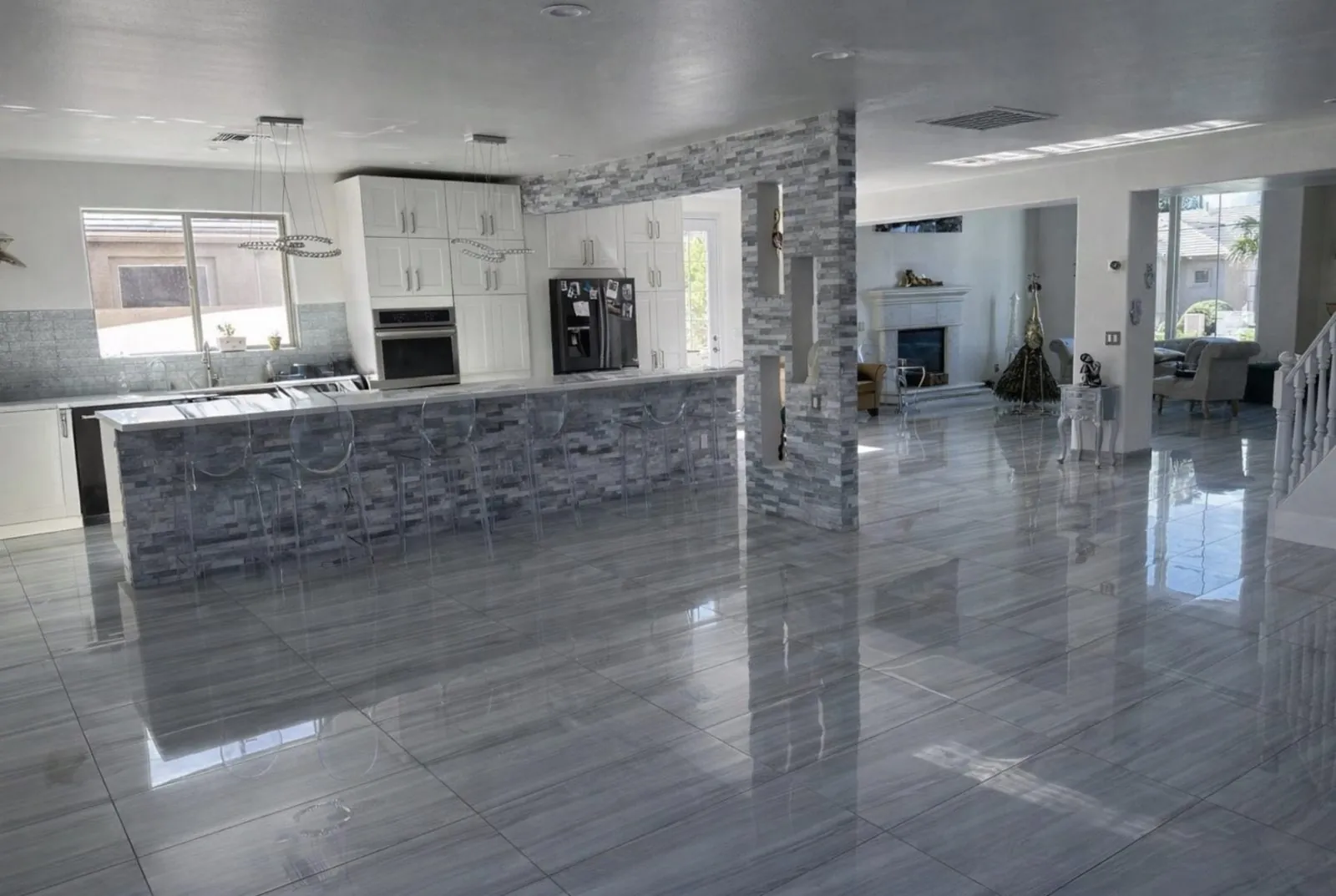
Large-format porcelain tile, the coolest-underfoot choice for Arizona summers.
What Arizona Does to a Floor
The best flooring for Arizona homes is simply the floor that survives 110-plus-degree summers, monsoon humidity swings and constant fine dust without moving. In 2026 that still comes down to the same short list.
RDC Renovation & Design Concepts is a flooring contractor in Phoenix, Arizona. Phoenix heat, plus intense UV through big desert windows and very dry air, is hard on flooring. Solid wood shrinks and gaps in low humidity, glossy finishes show every speck of dust, and cheap materials warp. The floors that thrive here are the ones built for heat, moisture swings, and easy cleaning.
| Flooring | Heat & Climate Fit | Best Room |
|---|---|---|
| Porcelain tile | Excellent, coolest underfoot, impervious (0.5% or less water absorption) | Whole home, especially living areas |
| Ceramic tile | Good indoors, cool underfoot, more porous than porcelain | Indoor floors and walls on a tighter budget |
| Luxury vinyl plank (LVP) | Excellent, waterproof, easy-clean; needs an expansion gap and sun control | Whole home, kitchens, high-traffic |
| Engineered hardwood | Good, stable if AC-controlled | Living & dining, climate-controlled rooms |
| Solid hardwood | Fair, can gap in dry air | Formal rooms with steady humidity |
| Carpet | Fine indoors, not for heavy use | Bedrooms & bonus rooms |
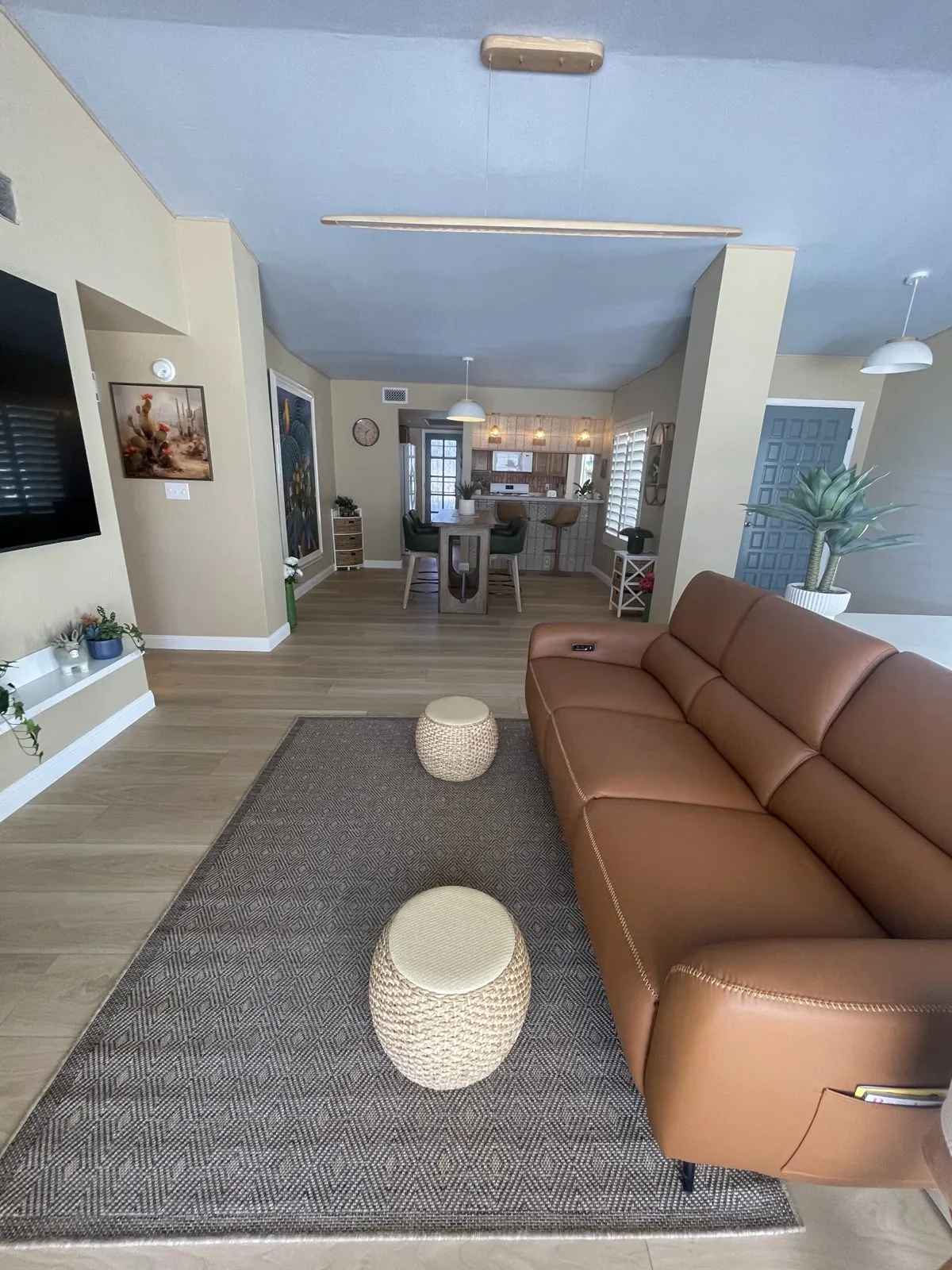
LVP running continuously through an open floor plan, waterproof and comfortable underfoot.
Why LVP Works in Phoenix Homes
Luxury vinyl plank fits Valley homes for practical reasons. It's fully waterproof, so spills, mopping, and monsoon-season tracking are non-issues. It resists scratches from pets and furniture, installs quickly, and comes in warm wood looks with the low-sheen matte finishes that hide the desert's ever-present dust. It's also softer and quieter underfoot than tile. For a family home that needs to look good and take abuse, LVP is hard to beat. See our LVP sales and installation page for brands, pricing, and the install process.
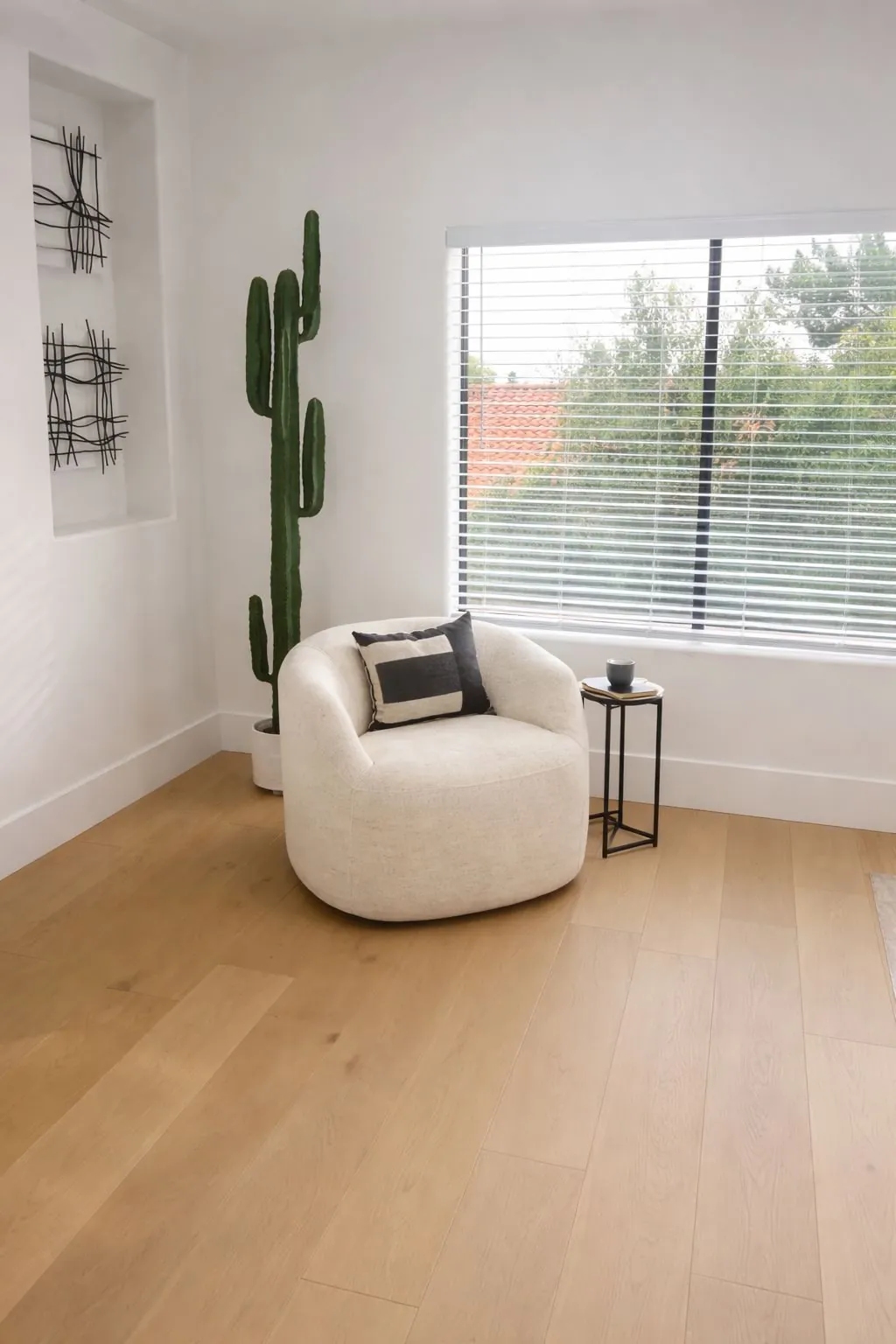
A white-oak-look LVP, wood warmth with waterproof, desert-tough performance.
When to Choose Tile or Engineered Wood
- Choose porcelain tile if you want the coolest floor in summer, maximum durability, and a surface that will outlast the house, ideal for entries, kitchens, and sun-drenched living rooms.
- Choose engineered hardwood if you want real wood underfoot and keep the home climate-controlled. Its layered core resists the gapping that plagues solid wood here.
- Skip solid hardwood in most Phoenix homes unless you're committed to steady indoor humidity year-round.
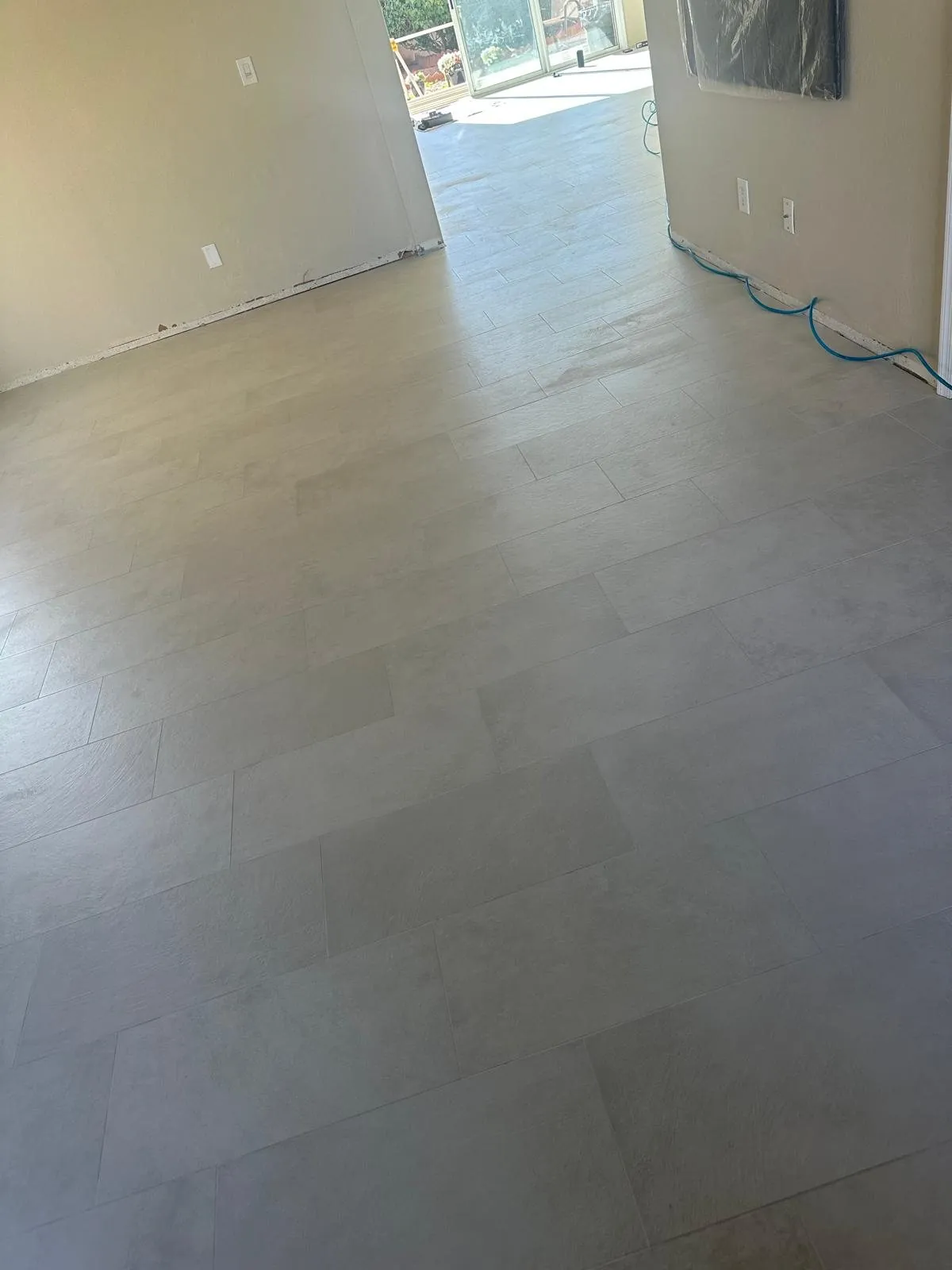
Light large-format tile keeps rooms feeling cool and bright through the summer.
Which Flooring Handles Direct Sun Through Arizona Windows?
Porcelain tile handles it best: its color is fired into the tile, and there is no vinyl wear layer for the sun to fade. It handles water just as well, since the Tile Council of North America defines porcelain as impervious, with water absorption of 0.5% or less. LVP works in sunny Phoenix rooms too, but its makers warn that long direct sun can fade it and make it expand, so plan window coverings and the gap the product sheet asks for.
The detail sits in the installation sheets. Shaw's Floorte guidelines say excess heat from direct sunlight can cause thermal expansion and UV fading, and recommend drapes or blinds in the hottest hours. Mohawk widens its standard expansion space from 1/4 inch to 5/8 inch in areas exposed to more than 85°F, and its SolidTech R instructions ask for 1/2 inch in sunrooms and three-season rooms. None of this rules LVP out of a bright great room; it means the right gap at the walls and shade on the west and south glass. Engineered hardwood follows the same logic, plus the steady indoor humidity covered below. Where a room takes hard afternoon sun through big windows and nobody wants blinds, porcelain is the floor that needs no workaround.
Best Flooring for High-Traffic Areas in Phoenix
For high-traffic areas in Phoenix, porcelain tile and premium LVP hold up best. Porcelain has a dense body that shrugs off scratches and heavy furniture, and it suits entries and main living floors. With LVP, choose a wear layer of 20 mil or more, which RDC installs at $6 to $9 per square foot.
In a Phoenix house, the wear on a busy floor comes from desert dust tracked in from the yard, furniture and pets' claws. That is why the wear layer matters more than the pattern: at least 12 mil for ordinary rooms, 20 mil or more for hallways, kitchens, the path to the back door and any home with pets. A rigid-core (SPC) plank adds dent resistance on top. Porcelain is also the choice for a covered patio, because porcelain is impervious to water, with absorption of 0.5% or less, while ceramic is made for indoor floors and walls. The two floors to keep out of the busiest paths are solid hardwood and carpet. What each LVP tier costs for a whole house is set out on the page how much does LVP flooring cost in Arizona.
Engineered Hardwood vs LVP in Arizona
Engineered hardwood vs LVP in Arizona comes down to what each floor tolerates. Both arrive as planks and both can look like oak, but they are built differently. Engineered hardwood is a real-wood veneer over a cross-layered plywood core. Luxury vinyl plank is vinyl with a protective wear layer over a waterproof core. On a desert slab, that construction decides which rooms each one belongs in.
Water favors LVP. It is fully waterproof, so kitchens, laundry rooms, bathrooms and homes with pets are where it earns its place, and a click-lock plank that gets damaged can be replaced on its own. Dry air is the test for wood. The National Wood Flooring Association advises keeping a home with wood floors between 60 and 80 degrees and 30 to 50 percent humidity year-round, and notes that floors losing moisture can gap or split. The layered core is why engineered boards cope with a Phoenix winter far better than solid wood, but the house still has to stay in that range and the boards have to acclimate before installation. In return, engineered wood can usually be sanded and refinished once or twice, depending on the wear layer. Installed, LVP runs $4 to $9 per square foot and engineered hardwood $8 to $16. More on each: the engineered hardwood page and the LVP installation page.
Best Carpet for Arizona Homes
The best carpet for an Arizona home depends on the room: plush (Saxony) for bedrooms, frieze for family rooms and stairs because its twisted fibers hide footprints and wear, and berber or loop pile for home offices and busier rooms. Installed with pad, carpet runs $3 to $7 per square foot at RDC in Phoenix.
Carpet is still the softest and quietest floor, which is why it can make sense to keep it in the bedrooms and run LVP or tile everywhere else. Its weak point in the desert is dust: carpet holds on to it, and it does not handle spills the way a hard floor does. Loop styles are durable, but a loop that catches can pull, which is worth knowing in a home with pets. Pad thickness and density change how the carpet feels and are itemized on RDC's estimate. Plush, berber and frieze samples are at the Bell Road showroom, and the styles are compared on the carpet flooring page.
What Is the Best Flooring for a Phoenix House?
In a Phoenix house, the main floors come down to porcelain or LVP, and the age of the house narrows the pick. The median Phoenix home was built in 1985, with 19% of the city's housing from the 1970s, 17% from the 1980s and 13% from the 1990s (U.S. Census Bureau, American Community Survey 2020-2024 five-year estimates).
An older slab may need grinding or leveling before large-format porcelain or glue-down plank, and it still gets the moisture test first. Rooms with west-facing glass point to porcelain, or to LVP with window coverings and the expansion gap the product sheet asks for. Carpet stays a bedroom floor.
Best Flooring for Homes in Scottsdale, Paradise Valley, Mesa and Peoria
The same short list works in all four cities: porcelain tile, LVP and engineered hardwood, with carpet kept to bedrooms. What tips the choice is the house. An older home can mean an old hard floor to remove first, and homes with big glass walls need a floor, or window coverings, that can live with direct sun.
- Paradise Valley. Rooms with a wall of west-facing glass are where color and window treatment matter most, and many floors being replaced are 1980s and 1990s travertine or saltillo. Porcelain keeps a stone look without the upkeep. See Paradise Valley flooring and stone.
- Scottsdale. A median build year of 1991 means plenty of homes from the 1970s and 1980s, where the slab may need grinding before large-format porcelain. See Scottsdale flooring installation.
- Mesa. Median home 1989. A central Mesa slab can need more leveling than a newer East Mesa pour, which matters most for tile and glue-down plank. See Mesa flooring.
- Peoria. The newest housing of the four (median 1999). A newer, flatter pour suits floating LVP, and the slab still gets a moisture test, because newer pours can hold construction moisture. See Peoria flooring.
Home ages: U.S. Census Bureau, American Community Survey 2020-2024 five-year estimates.
The Prep That Makes It Last
The Phoenix floors RDC installs usually go over a slab-on-grade foundation: concrete that sits directly on the ground with no basement. Before any floor goes down, RDC tests slab moisture following ASTM guidelines, grinds down high spots, and fills low areas so everything is dead level. This step is invisible once the floor is in, but a new floor is only as flat and dry as the slab under it.
More on the moisture test and leveling: the slab prep guide for Phoenix floors. Prices for every floor: the flooring installation cost guide.
Explore all of our flooring installation services, compare LVP vs. tile for Arizona homes, see our guide to the best flooring for pets, avoid the flooring mistakes we see in Phoenix homes, read how Arizona's climate changes your renovation, browse real project photos, or get a free estimate. Cool-underfoot is easier to judge by touch than by description. Feel the difference at our Phoenix flooring showroom on Bell Road, where the same team that sells the material installs it.