Why Phoenix Floors Start With the Slab
Almost every home in the Phoenix Valley is built slab-on-grade. The concrete foundation sits directly on the ground, with no basement and no crawlspace under it.
That makes the slab the subfloor for every room. Whatever the slab does, the new floor does too. A damp slab lifts glue and cups wood. A slab with a dip shows through LVP as a soft spot and through tile as lippage.
The desert does not make a slab dry. Irrigated yards, monsoon storms and the moisture a new pour holds for years all reach the underside of the floor.
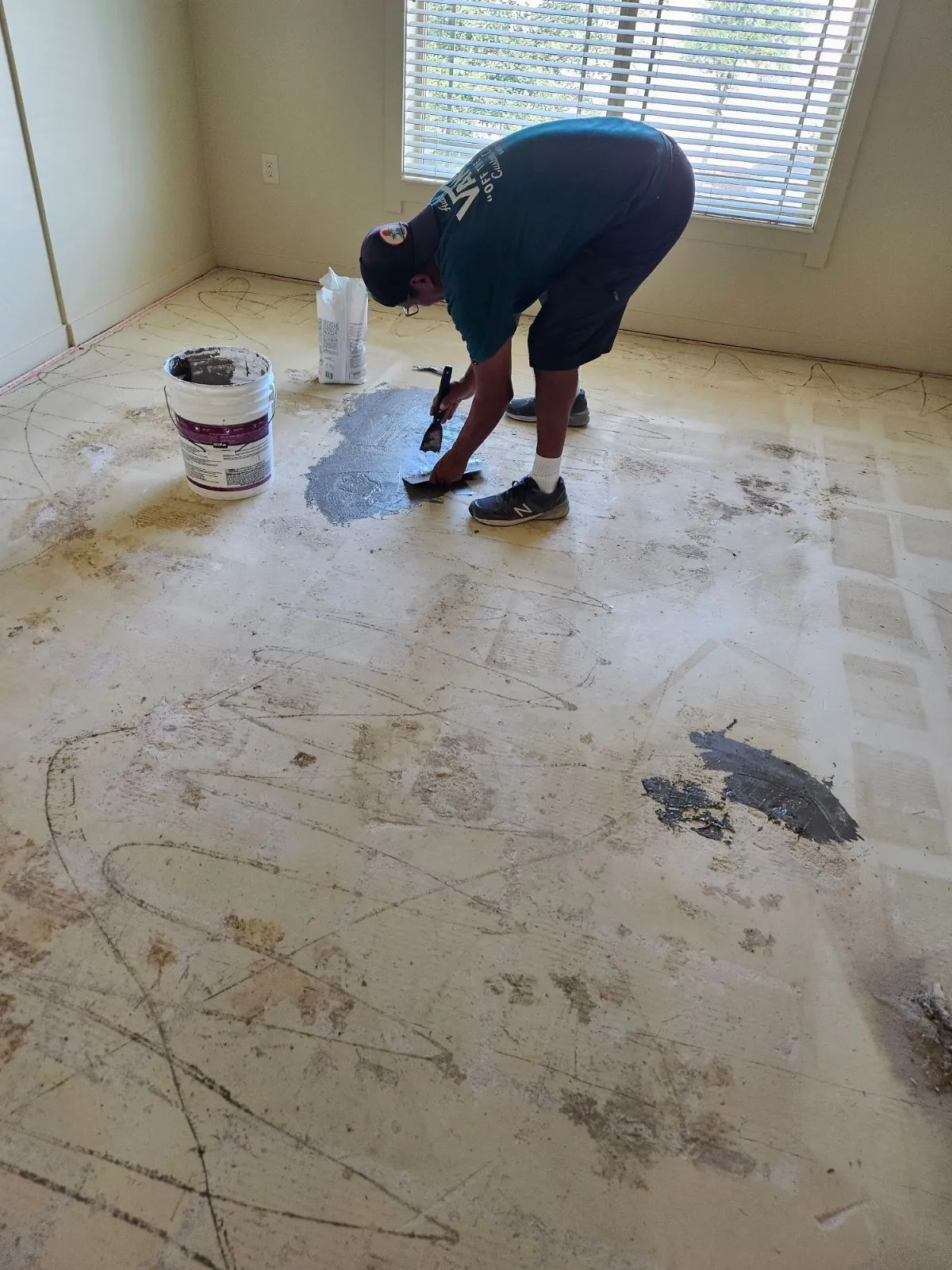
A Phoenix slab after the old tile and thinset came off, before the moisture test and leveling.
How a Slab Moisture Test Works
ASTM publishes the test methods most flooring manufacturers point to. ASTM F710 covers preparing a concrete floor for resilient flooring, and it calls for a moisture test on every slab. Two test methods are common.
Relative humidity probes (ASTM F2170)
ASTM F2170 measures relative humidity inside the slab with probes set into drilled holes. It reads the moisture the floor will actually sit on, not just the surface.
Calcium chloride test (ASTM F1869)
ASTM F1869 measures how much moisture vapor leaves the surface over a set time, under a sealed dome. It is an older method that some manufacturers still list.
The pass or fail limit is not set by the test. It is set by the flooring manufacturer for that exact product, and it is printed in the installation instructions. That is why the reading is only useful once the floor has been chosen.
How Flat a Floor Has to Be
Moisture is half of slab prep. Flatness is the other half, and it matters most for large tile and long planks.
- Large-format tile has the tightest tolerance. ANSI A108.02 calls for no more than 1/8 inch of variation in 10 feet, and no more than 1/16 inch in 24 inches, for tile with any edge 15 inches or longer, as TileLetter summarizes it.
- LVP and laminate follow the manufacturer. Each brand publishes its own flatness limit. A click-lock floor over a dip flexes at the joint, and that is how locking joints fail.
- Engineered hardwood adds acclimation. The National Wood Flooring Association guidelines cover how close the wood and the slab must be in moisture before installation.
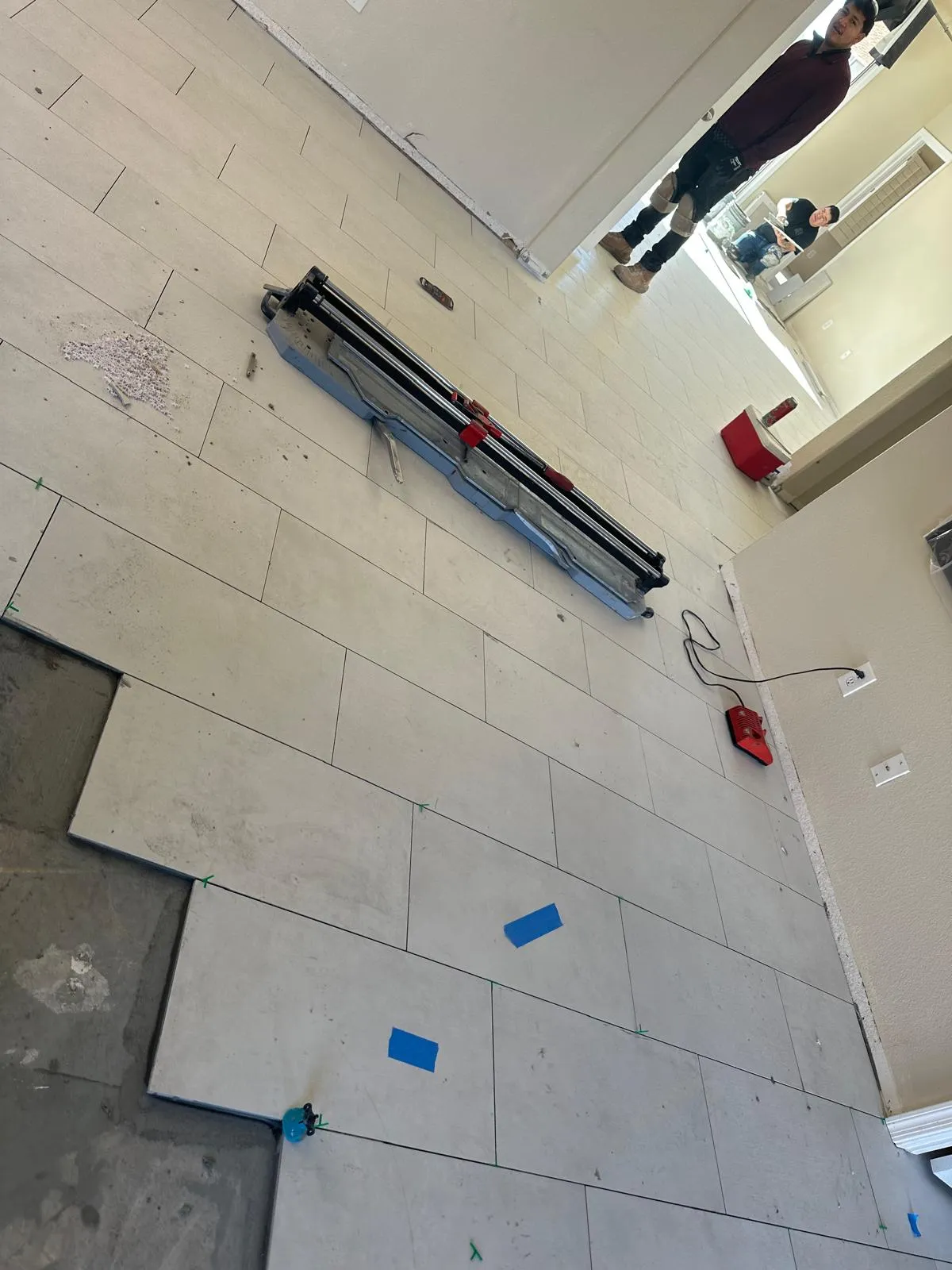
Large-format tile set with a leveling system, on a slab ground and filled to tolerance first.
Grinding, Filling and Self-Leveler
Slab prep is not one product. It is a short sequence, and each step solves a different problem.
- Grinding the high spots. Ridges, old thinset and trowel marks are ground down first, because a floor can only be as flat as its highest point allows.
- Filling cracks and low spots. Non-moving cracks and shallow dips are filled with a patching compound.
- Self-leveler for wide areas. Where a whole room is out of plane, a pourable self-leveling underlayment brings it back to flat in one pass.
On a typical Phoenix quote, slab prep adds about $1 to $4 per square foot when it is needed. RDC writes it into the estimate as its own line, rather than discovering it after the old floor is up.
What Happens When a Slab Fails the Test
A high reading does not end the project. It changes the plan, and there are three honest options.
- Find and stop the source. A leak, a sprinkler aimed at the foundation or poor drainage is fixed first, because new flooring over an active leak fails faster than the old one did.
- Use the manufacturer's moisture mitigation system. Many flooring makers approve a specific membrane or sealer for slabs above their limit, and using it keeps the warranty intact.
- Choose a floor with a higher tolerance. Each product publishes its own moisture limit, and porcelain tile set in thinset is generally more tolerant than glued-down wood.
After Tile Removal, the Slab Needs More Work
Many Phoenix homes still have the original ceramic. When it comes up, the thinset stays behind in ridges, and the slab is rarely flat enough for a new floor as it stands.
RDC removes tile only as part of installing the new floor. The grinding and leveling after removal are part of the same estimate. See tile removal and replacement in Phoenix.
What It Means for Your Quote
Two flooring bids often differ by the slab prep one of them left out. Ask every contractor whether moisture testing and leveling are included, and in which line.
Price context is on the flooring installation cost guide. Material choices for Arizona slabs are on best flooring for Arizona heat and LVP vs tile. Everything RDC installs is on the flooring installation page.