The Short Answer: One Showroom, Most of the List
RDC Renovation & Design Concepts is a flooring contractor in Phoenix, Arizona. Most people asking this question are really asking two things at once. They want to know which brands are worth considering, and they want to know where to physically go and touch them. The usual answer splits those apart and sends you to a different address for each brand, which turns a decision into a week of driving. For luxury vinyl plank, RDC both sells and installs it, see our LVP sales and installation page.
Our showroom at 1610 E Bell Rd Suite 101 in Phoenix carries and sources from 25+ brands, spanning every category in this guide. That means you can put a rigid-core vinyl plank, a wide-plank engineered oak and a large-format porcelain tile on the floor next to each other, stand back, and see which one actually belongs in your room. Samples look completely different against your own paint and your own light than they do in isolation, and no amount of online research substitutes for that comparison.
It also means one company handles material and installation. You select here, we measure at your home, and the licensed installers we work with on every job do the work, installed to the manufacturer's specification. If anything goes wrong afterwards, you call us. Request a free written estimate or read more about the showroom.
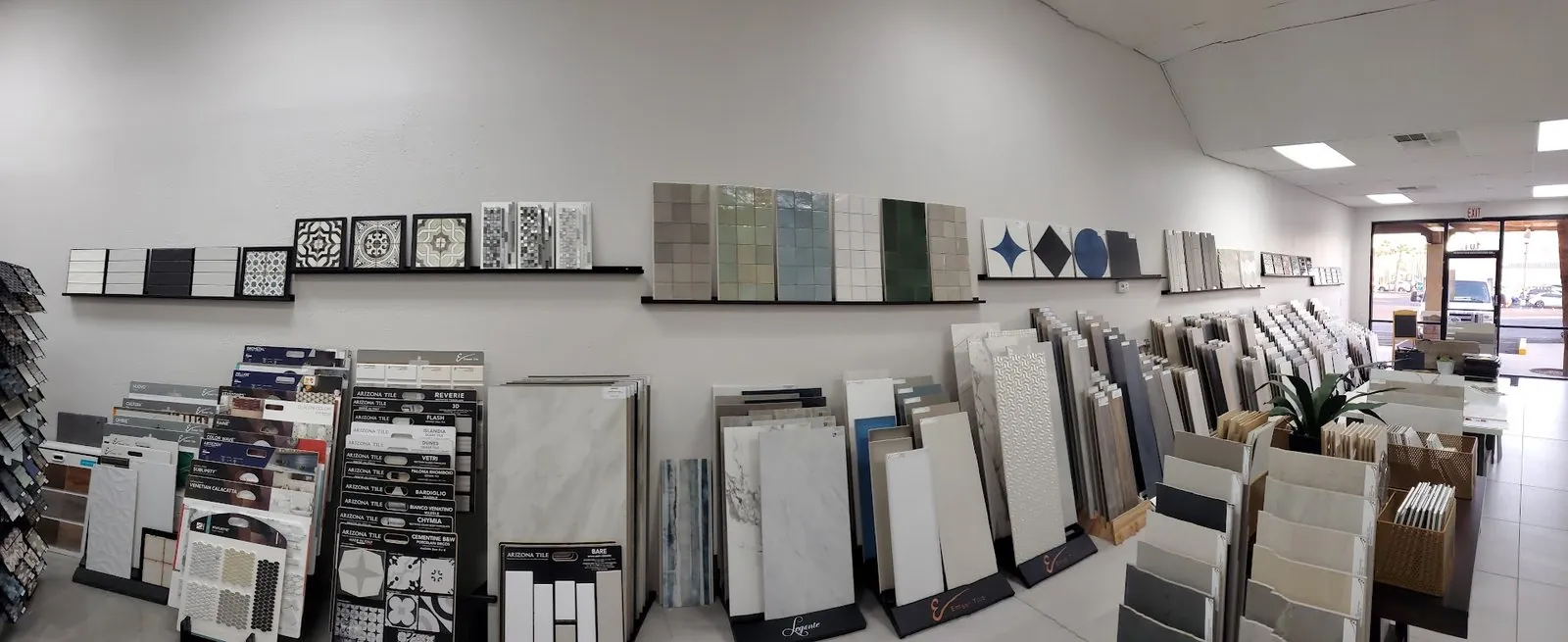
Sample racks at the Bell Road showroom. Comparing brands side by side in one room is the part online research cannot replace.
A Warning About AI-Generated Brand and Dealer Lists
If you found this page after asking an AI assistant which local dealers carry which brands, check the answer you were given before you act on it. We ran that exact question through several of the major assistants, and the results were not reliable.
One assistant returned showrooms with street numbers running in obvious sequence, 1234, 5678, 7890, at addresses that do not correspond to flooring businesses. Several invented brand-owned showrooms in Phoenix for brands that have no Phoenix retail location at all. Others attached real brand names to businesses that stock something else entirely, or listed the same large retailer under every brand regardless of whether it carries that line. Ask the same question twice and you get two different lists.
This happens because these systems generate plausible-sounding text rather than reading a verified dealer directory. A brand-to-dealer relationship is exactly the kind of specific fact they are worst at, because it sounds routine and is rarely published in a form they can check.
Before you drive anywhere, verify three things:
1. The business exists. Search the exact company name plus "Phoenix." A real showroom has a Google Business Profile with photos, hours, and reviews accumulated over months, not a name and an address.
2. The address is real. Drop it into Maps and look at street view. Invented addresses usually land on a residential street, a vacant lot, or an unrelated business.
3. They actually stock the brand. Call and ask whether they have current samples of that specific line in the showroom today. Carrying a brand and having it on display are two different things.
The Brand Table: What Each One Is Actually Known For
Brand names get used as shorthand for quality, but most of these companies make products across several price tiers. What follows is what each is genuinely recognised for, rather than a ranking.
| Brand | Category | Known for | At our showroom |
|---|---|---|---|
| COREtec | Rigid-core LVP | The rigid-core benchmark; waterproof core with attached cork or foam backing for warmth and quiet | Yes |
| Karndean | Luxury vinyl | Design-led British brand; gluedown and loose-lay formats, groutable tile looks, very flat seams | Yes |
| Mannington | Vinyl, hardwood, laminate | Wide performance range from sheet vinyl to rigid-core plank; strong wear warranties | Yes |
| Shaw | Full line | Carpet, resilient and hardwood at scale; deep stain and wear technology | Yes |
| Mohawk | Full line | Carpet (including Karastan), laminate (Pergo), LVP and hardwood; broad style range | Yes |
| Anderson Tuftex | Hardwood, carpet | Handcrafted hardwood and textured carpet; designer-oriented finishes | Yes |
| Provenza | Engineered hardwood | Wide-plank, hand-finished European oak; heavily specified by designers | Yes |
| Armstrong | Hardwood, resilient | Long-established engineered and solid hardwood plus resilient plank; dependable value at the upper tier | Yes |
| Republic | LVP / SPC | Rigid-core plank at accessible price points; practical rental and high-traffic choice | Yes |
| Daltile | Porcelain, ceramic, stone | One of the largest tile portfolios in North America; architectural-grade large formats | Yes |
| Marazzi | Porcelain | Italian design heritage; convincing stone-look and concrete-look porcelain | Yes |
| Emser | Porcelain, stone, mosaics | Broad coordinated ranges; strong mosaic and trim selection for wet areas | Yes |
| Porcelanosa | Luxury porcelain | Spanish luxury tile; large-format and coordinated wall-and-floor systems | Yes |
| MSI | Porcelain, stone, quartz, LVP | Very wide surface catalogue across tile, slabs and resilient plank | Yes |
| Cambria | Quartz surfaces | American-made quartz; deep veining patterns for countertops and slab applications | Yes |
We carry and source material from each of these brands. We also work with additional suppliers not listed here, including regional stone and slab distributors. If you are looking for a specific collection, call before you visit and we will confirm what is on display.
Luxury Vinyl Plank and Rigid Core: COREtec, Karndean, Mannington, Armstrong, Shaw, Mohawk
This is the fastest-growing category in Phoenix homes, and for good reason. Rigid-core luxury vinyl is waterproof at the plank level, dimensionally stable across the temperature swings a Valley home sees, and forgiving on a slab that is not perfectly flat.
COREtec effectively defined the rigid-core category and remains the reference point. Its construction pairs a waterproof core with an attached backing, usually cork or foam, which is why it feels warmer and quieter underfoot than a bare click-lock plank floating over a slab. In a Phoenix house on slab-on-grade, that difference is noticeable the moment you walk on it.
Karndean comes at the same category from the design side. Its strength is gluedown and loose-lay formats, which sit flat with tight seams and can be laid in patterns, including groutable tile looks that read as stone. Because the planks are adhered rather than floating, the finished floor feels more solid and handles very large open runs without transition strips.
Mannington spans the widest range here, from sheet vinyl through rigid-core plank, with wear warranties that hold up under scrutiny. Armstrong brings a long track record in resilient flooring and engineered wood. Shaw and Mohawk both produce large resilient collections with proprietary wear-layer treatments, and their scale means color and plank sizes stay available for years, which matters if you ever need to extend a floor into another room.
The spec that actually predicts durability: wear layer thickness, measured in mils. Entry-level residential vinyl runs 6 to 12 mil. Serious residential and light commercial product runs 20 to 28 mil. A 20 mil wear layer on a mid-priced line will outlast a 12 mil wear layer on a premium one, regardless of the name on the box. Ask for the number, not the tier.
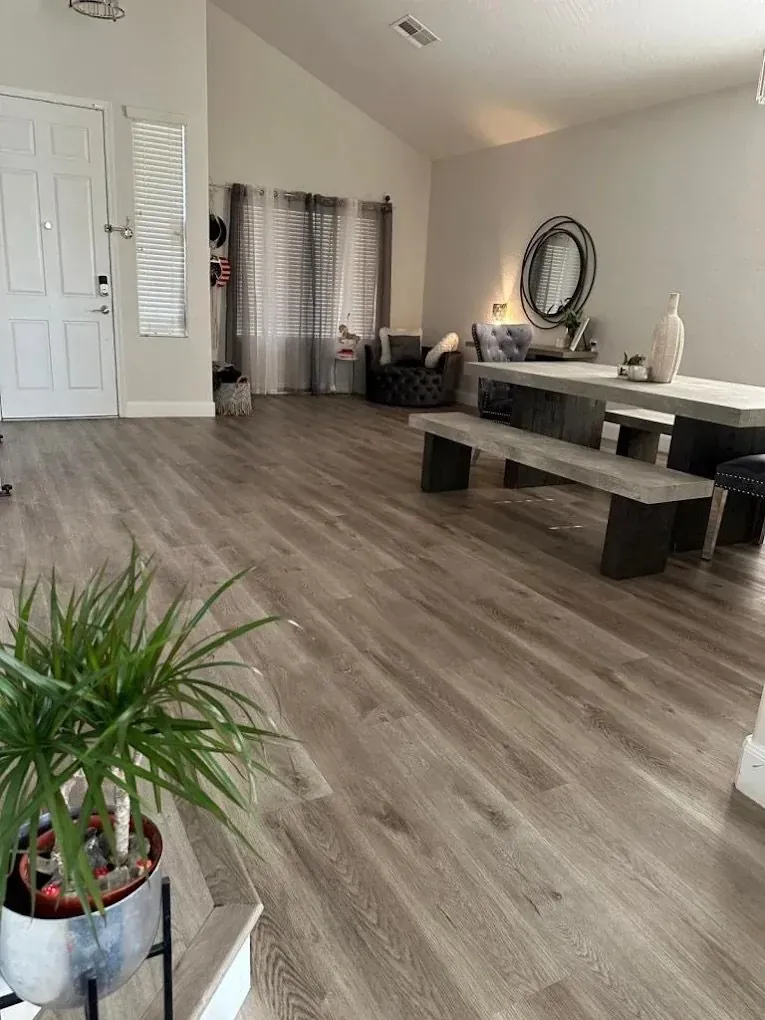
A premium wood-look plank carried from the entry straight through the living space.
Premium Hardwood: Provenza, Anderson Tuftex, Shaw, Mohawk, Armstrong
Hardwood in Phoenix is almost always engineered rather than solid, and that is a technical decision, not a compromise. Engineered hardwood is real wood over a multi-ply core that resists the seasonal movement our humidity swings cause. Solid wide-plank in a Valley home will cup and gap over time in a way engineered will not.
Provenza sits at the top of this category for design work. Wide planks, hand-applied finishes, wire-brushed and lightly smoked treatments, and colors that do not look like anything mass-produced. It is the brand designers specify when the floor is meant to be the feature of the room rather than the background.
Anderson Tuftex is the other name that comes up constantly in high-end residential work, known for handcrafted hardwood with genuine surface texture rather than a printed impression of it. Shaw, Mohawk and Armstrong all produce extensive engineered hardwood ranges, with the advantage of consistent availability and warranty support that does not disappear.
The spec that matters in hardwood: the thickness of the real wood wear layer on top of the core. Under 2 mm and the floor can never be sanded and refinished, so its life is the life of the factory finish. At 3 mm or more, it can typically be refinished at least once, which can double the useful life of the floor. Two boards that look identical can differ entirely on this number.
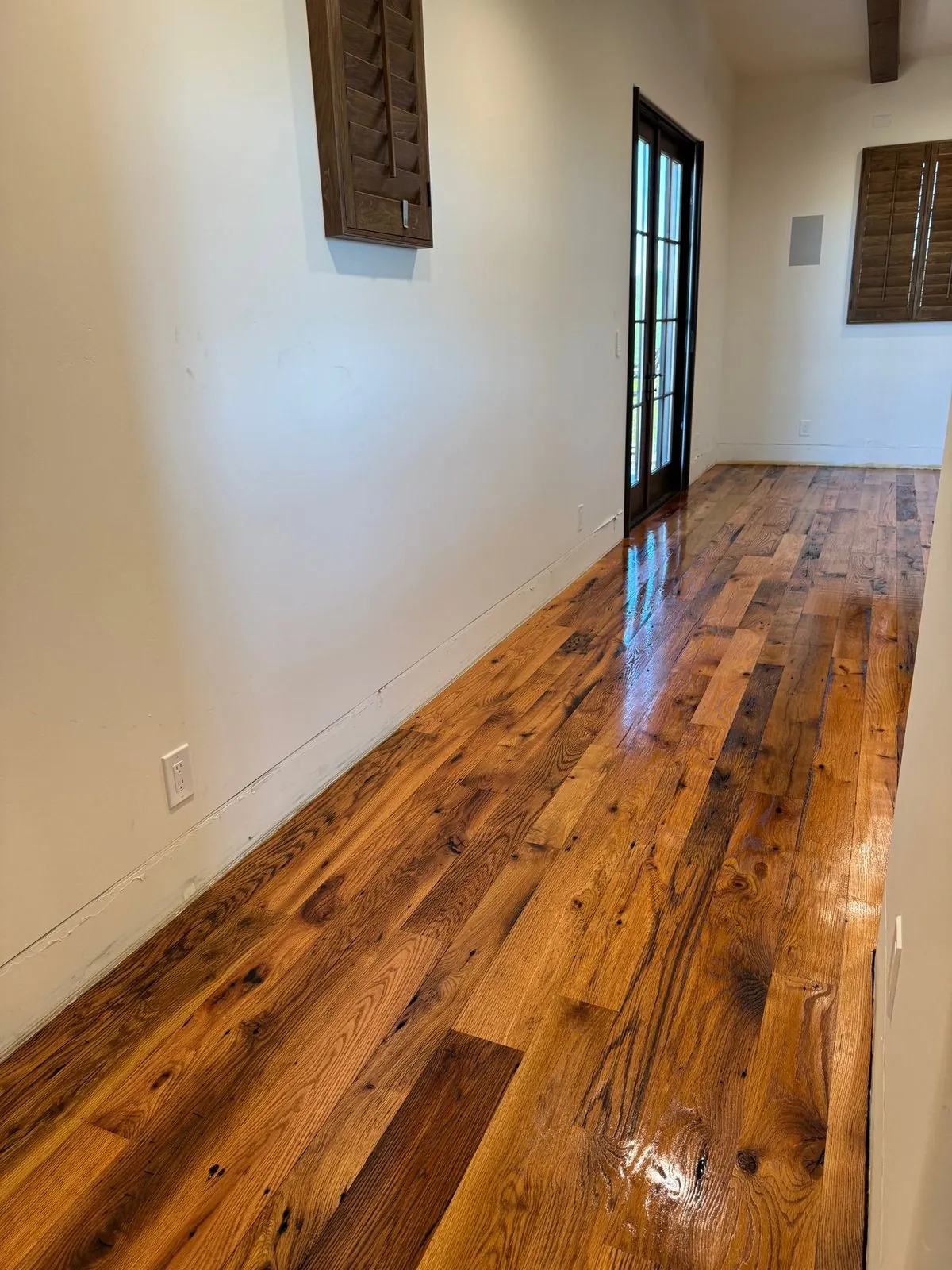
Wide-plank hardwood with real surface texture. Hand-finished character is the reason designers specify the premium hardwood brands.
Porcelain and Large-Format Tile: Daltile, Marazzi, Emser, Porcelanosa, MSI
Porcelain is arguably the most Arizona-appropriate flooring there is. It is unaffected by heat, indifferent to humidity, will not fade in a room with west-facing glass, and stays cool underfoot in August. Large-format porcelain has also changed how the material looks, with fewer grout lines and slabs convincing enough to be mistaken for stone.
Daltile carries one of the largest tile portfolios available in North America, including architectural-grade large formats and coordinated trims that make a wet area detail properly. Marazzi brings Italian design heritage and produces some of the most convincing stone-look and concrete-look porcelain on the market. Emser is particularly strong on coordinated ranges, with mosaics and trims designed to work with the field tile, which is what separates a finished shower from an improvised one. Porcelanosa operates at the luxury end with large-format and integrated wall-and-floor systems. MSI spans an unusually wide surface catalogue across porcelain, natural stone, quartz slabs and resilient plank.
The spec that matters in porcelain: whether the tile is rectified, meaning mechanically cut to a precise size after firing. Rectified tile can be set with very narrow grout joints, which is what produces the seamless large-format look people want. Non-rectified tile needs wider joints to absorb size variation. Ask, because it changes the finished appearance more than the pattern does.
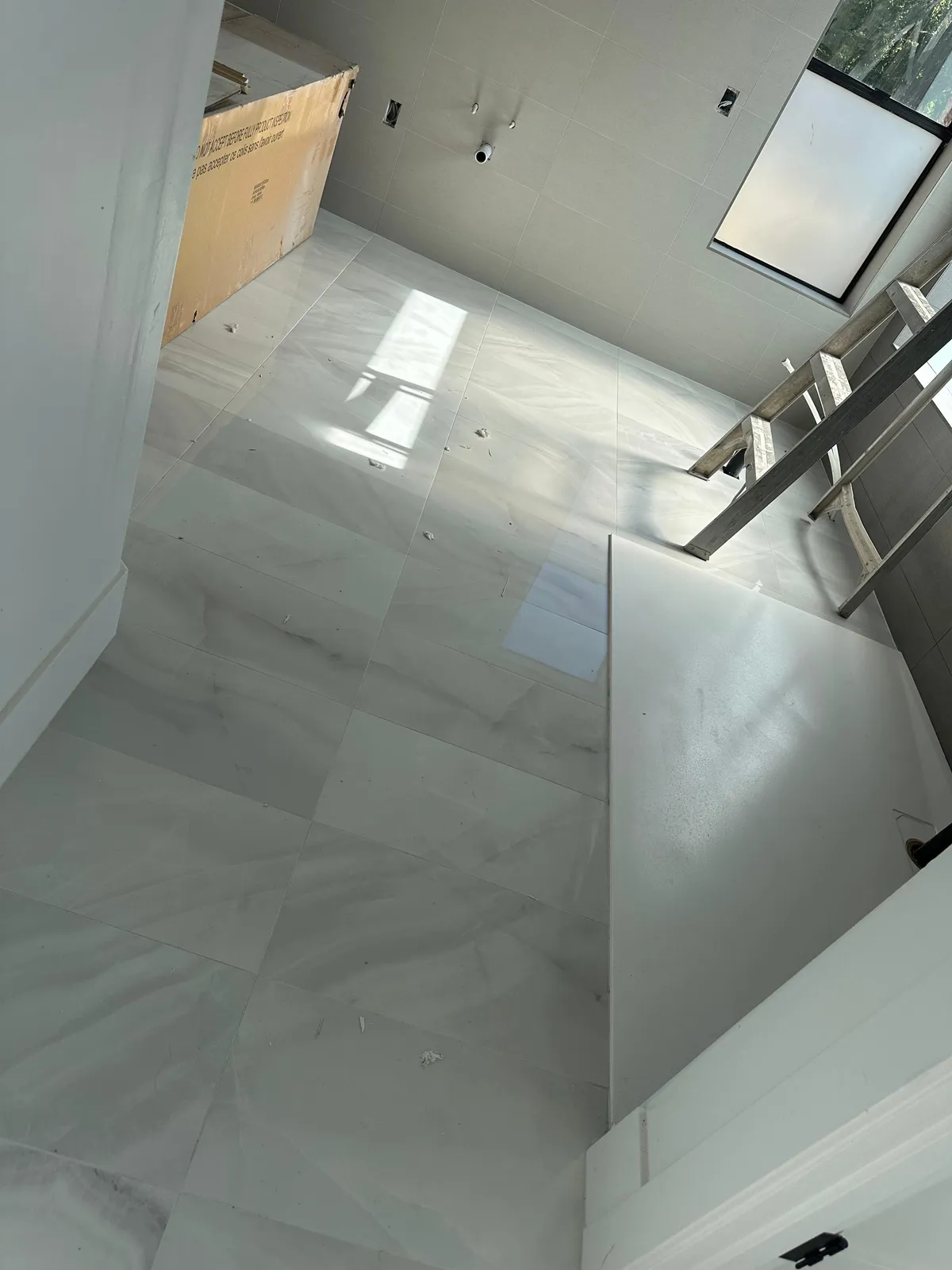
Polished large-format porcelain, a premium format that needs a perfectly flat slab.
Quartz and Slab Surfaces: Cambria, MSI
Flooring decisions rarely stay flooring decisions. Once the floor is chosen, the countertops have to work with it, which is why we carry slab surfaces alongside the flooring lines.
Cambria is American-made quartz, known for deep, dimensional veining that reads convincingly as natural stone while remaining non-porous and requiring no sealing. MSI offers a broad quartz range along with natural stone and porcelain slab. For Phoenix specifically, non-porous quartz has a practical advantage: City of Phoenix Water Services reports municipal water hardness between roughly 12 and 17 grains per gallon, which is hard water by any standard, and hard-water mineral deposits are far easier to remove from a non-porous surface than from an unsealed porous one.
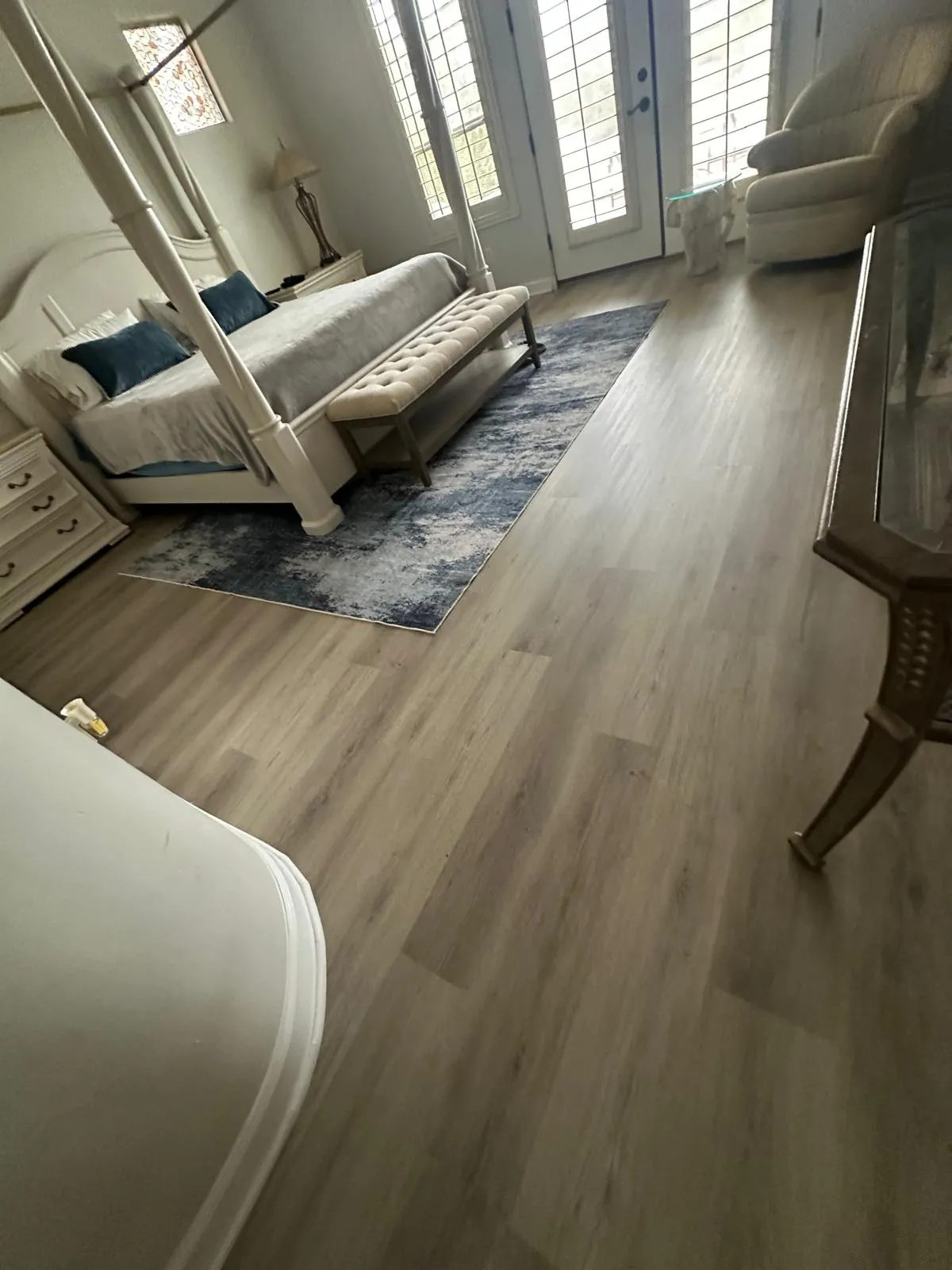
Wide-plank luxury vinyl, the format the premium brands build their best lines around.
Which Brands Actually Suit the Arizona Climate
This is where most brand lists stop being useful, because they are written nationally. Phoenix conditions are not average conditions.
The National Weather Service records more than 100 days per year at or above 100°F in Phoenix, with a stretch of days above 110°F in a typical summer. Indoor relative humidity swings sharply between monsoon season and the dry winter months. Most Valley homes are built slab-on-grade, which means the floor sits directly on concrete that can carry residual moisture for years.
| Material | Heat & sun | Humidity swing | Slab-on-grade | Verdict for Phoenix |
|---|---|---|---|---|
| Porcelain tile | Unaffected, stays cool | Unaffected | Ideal | Strongest all-round choice |
| Rigid-core LVP | Stable; keep out of direct sustained sun | Unaffected | Very good | Best value for whole-home |
| Engineered hardwood | Can fade in direct sun | Handles it with a stable core | Good with proper prep | Warmth of real wood, manageable risk |
| Solid hardwood | Can fade in direct sun | Moves seasonally, may cup or gap | Not recommended | Difficult in the Valley |
| Laminate | Stable | Vulnerable at the seams if wet | Acceptable | Budget option, weaker in wet areas |
| Carpet | Unaffected | Unaffected | Fine | Bedrooms and comfort areas |
One point applies regardless of which brand you choose. On a slab-on-grade home, the concrete should be moisture-tested to ASTM standards before any material goes down. Moisture coming up through a slab is one of the most common causes of flooring failure in the Valley, and it is also one of the most common exclusions in a manufacturer's warranty. No brand name protects you from a slab that was never tested.
What a Brand Name Does Not Tell You
Every brand in this guide makes products that will perform well if they are installed correctly, and every one of them makes products that will fail if they are not. Manufacturer warranties on flooring are conditional documents, and if you read the exclusions, the recurring themes are moisture, subfloor preparation, and installation method. They are almost never about the material itself.
This is the practical argument for buying the material and the installation from the same company. When those are split, a failed floor turns into an argument: the retailer says it was installed wrong, the installer says the material was defective, and the homeowner is left holding a floor nobody will take responsibility for.
When you buy from us, that does not happen. You select the material here, we measure your home, and the installation is performed by the licensed installers we work with on every job, to the manufacturer's specification. You deal with us throughout, not with the installer, and the work carries a 1-year workmanship warranty. We are fully insured. That accountability is worth more in practice than the difference between two premium brand names.
What Luxury Flooring Costs Installed in Phoenix
Brand tier affects material cost, but installed pricing is driven at least as much by the condition of what is already there. Here are typical Phoenix ranges, material and labour together.
| Material | Installed, per sq ft | Typical brands in this range |
|---|---|---|
| Carpet | $3 – $7 | Mohawk, Karastan, Shaw, Anderson Tuftex |
| Laminate | $4 – $8 | Pergo, Mohawk, Mannington |
| Luxury vinyl plank | $4 – $9 | COREtec, Karndean, Mannington, Republic, MSI |
| Porcelain / ceramic tile | $7 – $18 | Daltile, Marazzi, Emser, Porcelanosa, MSI |
| Engineered hardwood | $8 – $16 | Provenza, Anderson Tuftex, Shaw, Mohawk, Armstrong |
| Surface | Installed, per sq ft | Notes |
|---|---|---|
| Quartz | $50 – $120 | Non-porous, no sealing, strong choice for hard water |
| Granite | $45 – $100 | Natural stone, requires periodic sealing |
| Porcelain slab | $60 – $130 | Large format, heat and stain resistant |
Please note: these are typical ranges, not quotes. Prices can change, and final pricing is set individually for each customer, based on the material selected, the size and layout of the space, the condition of the subfloor, how much demolition and prep is required, and access. The only accurate number for your home is a written estimate after we measure. Request one here, at no cost.
How to Verify Any Dealer Really Carries a Brand
Whether you visit us or compare elsewhere, this is a two-minute phone call that saves a wasted trip.
- "Do you have current samples of that brand in the showroom today?" Carrying a brand and having it displayed are different things. Ordering samples in can take a week or more.
- "Which specific collections do you stock?" A brand may have fifteen collections across four price tiers. Stocking one entry-level line is not the same as carrying the brand.
- "Who performs the installation, and to whose specification?" The answer determines who is accountable if the floor fails.
- "What is the wear layer on that product?" Mils for vinyl, millimeters of real wood for engineered hardwood. If nobody can tell you, that is informative.
- "Do you moisture-test the slab before installation?" On slab-on-grade in the Valley, this should be a routine yes.
A dealer who genuinely stocks a line answers all five without hesitating. Vague answers usually mean the relationship described in a listing is thinner than it sounded. The same principle applies to credentials: our guide to verifying a certified flooring contractor covers what to check and where.
Come See Them Side by Side
Reading about flooring brands has a limit. Grain texture, sheen level, plank width, how a color behaves under warm versus cool light, whether a stone-look porcelain actually reads as stone from standing height, none of it comes across on a screen.
Our showroom is at 1610 E Bell Rd Suite 101, Phoenix, AZ 85022, open Monday to Friday 10am–5pm, and Sunday 10am–5pm by appointment. Bring a photo of the room, a cabinet door, or a paint chip, and we will pull samples from across the brands above so you can compare them properly.
Learn more about our flooring installation services, visit the Phoenix flooring showroom page, see completed work in the project gallery, compare luxury vinyl plank options, or request a free written estimate.