
Key takeaways
- At RDC, porcelain tile runs $9 to $18 per square foot installed, ceramic $7 to $14, and large-format tile (24x48 and up) $12 to $22.
- Porcelain absorbs 0.5% water or less, the Tile Council of North America's definition.
- RDC is a tile store and a tile contractor in Phoenix in one: it sells the tile at its Bell Rd showroom and installs it.
- About 1,200 sq ft of tile takes one to two weeks of work, and thinset and grout cure for 24 to 48 hours.
- Every RDC tile installation carries a 1-year workmanship warranty.
Why Porcelain Tile Suits Phoenix Homes
- Cool underfoot: tile conducts heat away from your feet, so it feels cooler than wood, carpet, or vinyl in a Phoenix summer.
- Low water absorption: the Tile Council of North America defines porcelain as tile that absorbs 0.5% of water or less.
- Stable in dry air: tile doesn't shrink, gap, or cup in Arizona's low humidity.
- Easy desert cleaning: dust and monsoon grit mop right off a grouted tile floor.
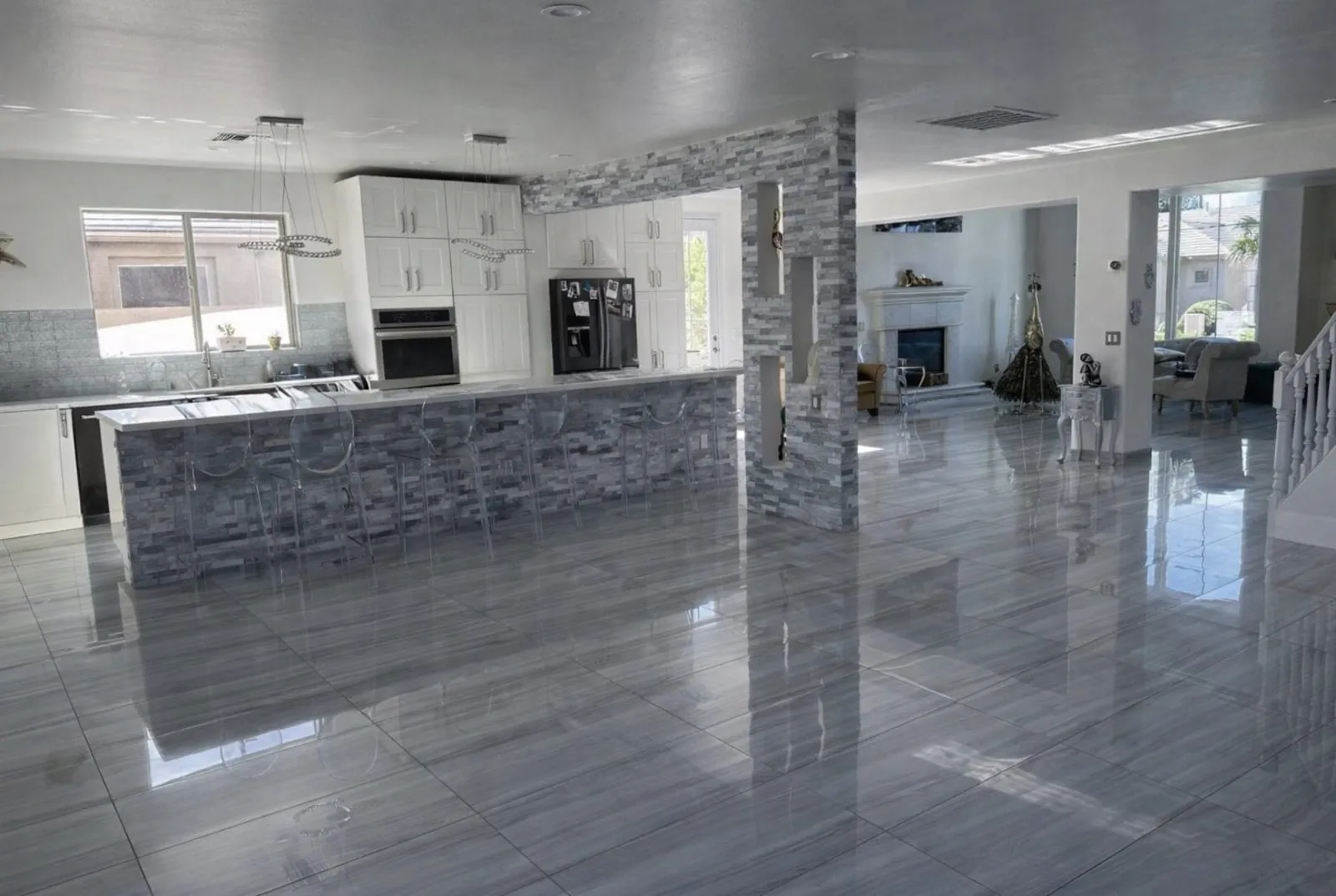
Polished 12x24 tile running through an open-concept Scottsdale home.
Porcelain vs Ceramic Tile: Which Is Better for a Phoenix Floor?
Porcelain tile is the better choice for a Phoenix floor that takes heavy traffic, water or patio use. Ceramic is the better buy for walls and lighter-traffic rooms. Porcelain is ceramic tile that absorbs 0.5% water or less (TCNA). At RDC, porcelain costs $9 to $18 per square foot installed and ceramic $7 to $14.
Porcelain is fired at higher temperatures than standard ceramic, so it also resists chips and heavy traffic better. For busy Phoenix floors and anything outdoors, porcelain is usually worth the difference.
| Factor | Porcelain | Ceramic |
|---|---|---|
| Density & hardness | Higher, fired hotter, absorbs 0.5% water or less (TCNA) | Softer, more porous |
| Best use | Floors, high traffic, outdoors, showers | Walls, backsplash, lighter-traffic floors |
| Outdoor / patio use | Yes, in tile its manufacturer rates for exterior use | Not recommended: absorbs more water than porcelain |
| Cutting & installation | Harder to cut, slower to install, more blade wear | Easier to cut and shape around fixtures |
| Installed cost at RDC | $9–$18/sq ft | $7–$14/sq ft |
Where Ceramic Tile Is the Smarter Buy
Ceramic gets treated as the budget option, but in the right room it's simply the better fit, not a compromise. Because it's softer and easier to cut cleanly, ceramic is quicker to install around outlets, fixtures, and tight corners, which keeps labor down on detail-heavy work. RDC installs ceramic tile throughout the Valley in the places it genuinely performs:
- Kitchen and bathroom walls and backsplashes, where nothing is walking on the tile and ceramic's lower density is irrelevant.
- Guest baths, laundry rooms, and low-traffic floors, where the foot traffic never approaches what porcelain is built for.
- Budget-conscious whole-room updates, where the savings per square foot go further than the extra density would.
Where ceramic is the wrong call in Phoenix specifically: any covered patio or outdoor area, since ceramic absorbs more water than porcelain. It is also the wrong call for high-traffic entries and main living floors, where the denser body earns its cost. If you're unsure which your room needs, that's exactly what the free in-home estimate settles, and both are on display at the showroom.
Please note: these are RDC's installed ranges. Final pricing is set individually for each customer based on your specific project, materials, and scope, confirmed in your free written estimate. Tile is priced next to every other floor in our Phoenix flooring price report.
Is Porcelain Tile Waterproof?
Porcelain tile is close to waterproof on its own. The Tile Council of North America describes porcelain as impervious tile, with a water absorption of 0.5% or less. In a shower, the water barrier is the layer behind the tile and grout. In Phoenix, RDC builds every tiled shower over a bonded waterproofing membrane (Schluter KERDI or RedGard).
On a floor, porcelain handles spills, wet mopping and monsoon grit. Ceramic absorbs more water than porcelain, so RDC does not recommend it for covered patios. The shower side of the job is covered on the walk-in shower installation page.
Which Tile Is Best for a Phoenix Kitchen, Bathroom or Living Room Floor?
For a Phoenix kitchen, bathroom or living room floor, porcelain is the tile RDC recommends. It absorbs 0.5% water or less and takes heavy traffic. Ceramic suits the walls and backsplashes of kitchens and baths, and lighter-traffic floors such as a guest bath. At RDC, porcelain floor tile costs $9 to $18 per square foot installed.
In a bathroom, the floor tile is chosen together with the shower tile, the vanity surfaces and the grout. RDC chooses the grout for each area, cement-based, sealed or epoxy, with the hard water in mind. A full room is planned on the bathroom remodeling in Phoenix page.
In a living room or bedroom, porcelain works the same way. Large-format porcelain gives an open living room fewer grout lines, and wood-look porcelain plank brings the look of hardwood to a bedroom. Tile still feels cooler underfoot than carpet or LVP, which suits a Phoenix summer more than a January morning.
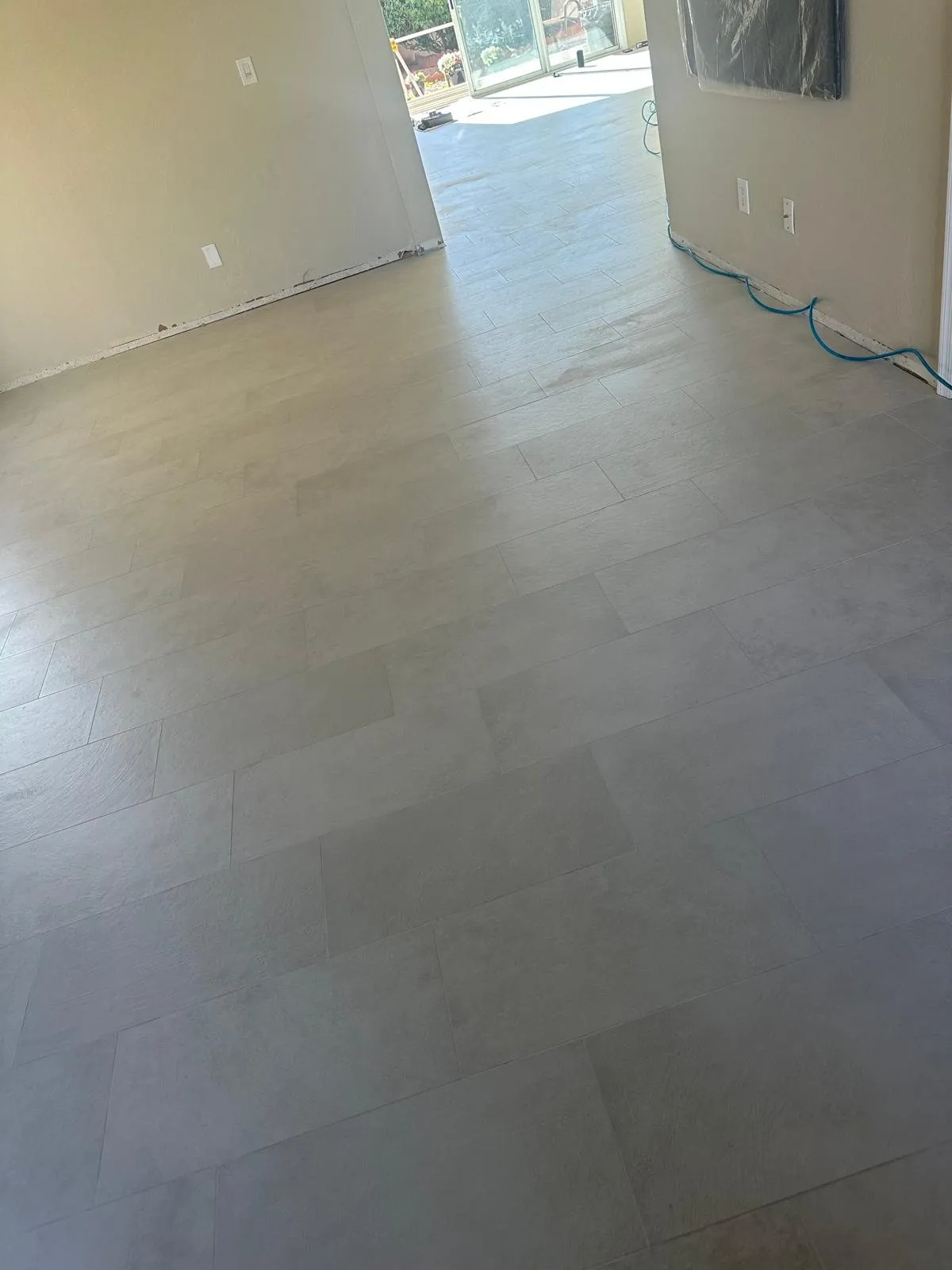
Light gray tile keeps rooms feeling cool and bright through the summer.
Porcelain Tile Pros and Cons in Arizona
Porcelain tile's pros in Arizona are a floor that feels cool in a Phoenix summer, handles water and does not shrink in dry air. Its cons are a hard surface that feels cold in winter, slower installation and a higher price than LVP. At RDC, porcelain runs $9 to $18 per square foot installed and LVP $4 to $9.
| Pros | Cons |
|---|---|
| Feels cool underfoot: dense tile pulls heat from bare feet quickly, which the instrument maker Thermtest calls high thermal effusivity. | The same effect makes tile feel cold on a winter morning. |
| Absorbs 0.5% water or less (TCNA). | Grout joints need a grout chosen for Phoenix hard water, 10 to 17.6 grains per gallon (City of Phoenix). |
| Does not shrink, gap or cup in Arizona's low humidity. | Harder to cut and slower to install than plank floors. |
| Color is fired into the tile body or glaze. The Tile Council of North America's 2025 report gives tile a 60-year service life. | Large formats need a flatter slab; leveling adds $1 to $4 per square foot where needed. |
Formats RDC Installs
- Large-format (24x48 and up): fewer grout lines and a cleaner look across open rooms. It needs a flatter slab, and RDC levels the slab before any large tile is set.
- Wood-look plank tile: the warmth of hardwood with tile's heat and scratch resistance, a good fit for households with pets (see our best flooring for pets guide).
- 12x24 and 18x18: standard formats for whole-home installs, with more grout lines than large-format tile.
- Outdoor and patio tile: porcelain its manufacturer rates for exterior use, for covered patios and outdoor kitchens (see pool deck and patio tile).
Large-Format or 12x24 Porcelain: A Worked Example
Here is how the format changes the price of a 600 sq ft great room at RDC:
- 12x24 porcelain: 600 × $9 to $18 = $5,400 to $10,800 installed.
- 24x48 large-format porcelain: 600 × $12 to $22 = $7,200 to $13,200 installed.
- Slab leveling, only if the bigger tile needs it: 600 × $1 to $4 = $600 to $2,400.
Final pricing is set individually for each customer based on their specific project, after RDC measures the room.
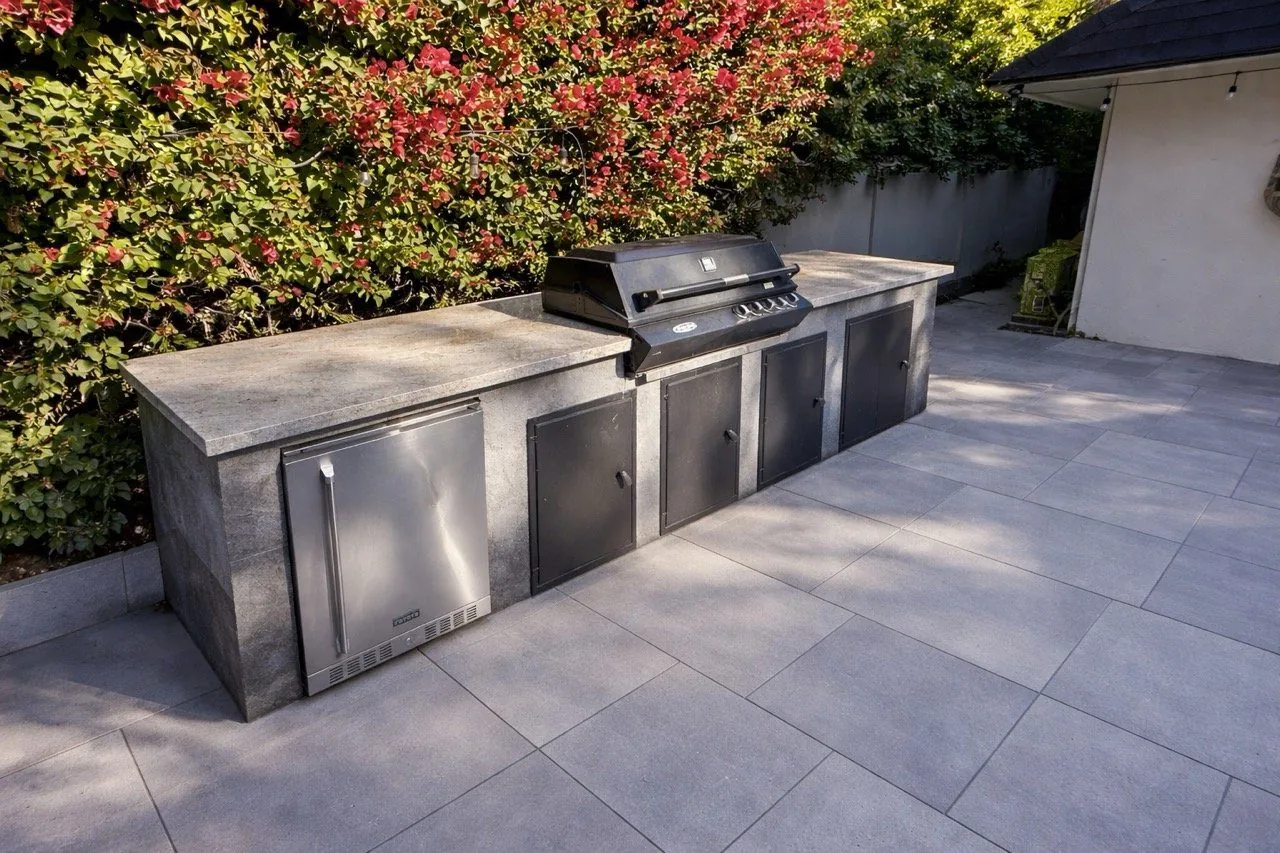
Porcelain tile on a Scottsdale outdoor kitchen patio.
The Slab Prep That Makes Tile Last
On a slab-on-grade home, the concrete foundation sits directly on the ground with no basement. Before setting any tile, RDC works through three steps:
- Test the slab for moisture, following ASTM guidelines.
- Grind down the high spots.
- Fill the low areas so the slab is flat enough for the tile size.
On large-format tile this matters double: an uneven slab telegraphs through big tiles as lippage and hollow spots. The prep is invisible when the floor is done, but it's what keeps a tile floor from cracking and sounding hollow later.
Large-format tile needs the flattest slab of any floor. The ANSI tolerance and how RDC meets it are on the slab prep and floor leveling page.
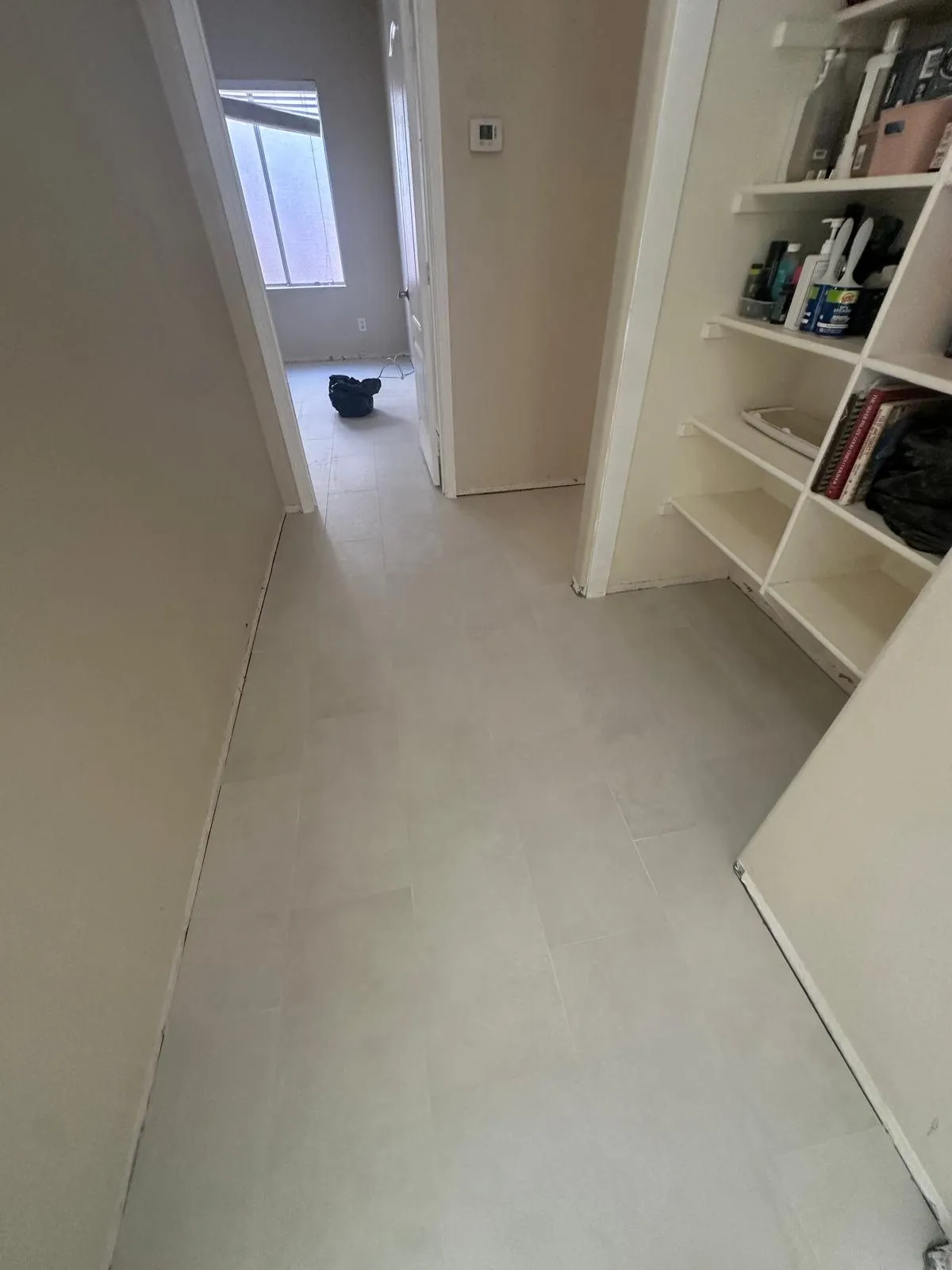
Tile carried through hallways and closets for a seamless, dust-easy surface.
Tile Installation Across the Phoenix Valley
Tile installation in Phoenix starts with the house. The median Phoenix home dates from 1985. Almost half of the city's housing, 49%, went up from 1970 to 1999 (U.S. Census Bureau, ACS 2020-2024, tables B25035 and B25034). When an older floor is still in place, RDC lists its removal, $3 to $5 per square foot, as a separate estimate line.
Phoenix water is hard: the City of Phoenix Water Quality Report measures 10 to 17.6 grains per gallon. RDC chooses the grout for each area, cement-based, sealed or epoxy, with the hard water in mind.
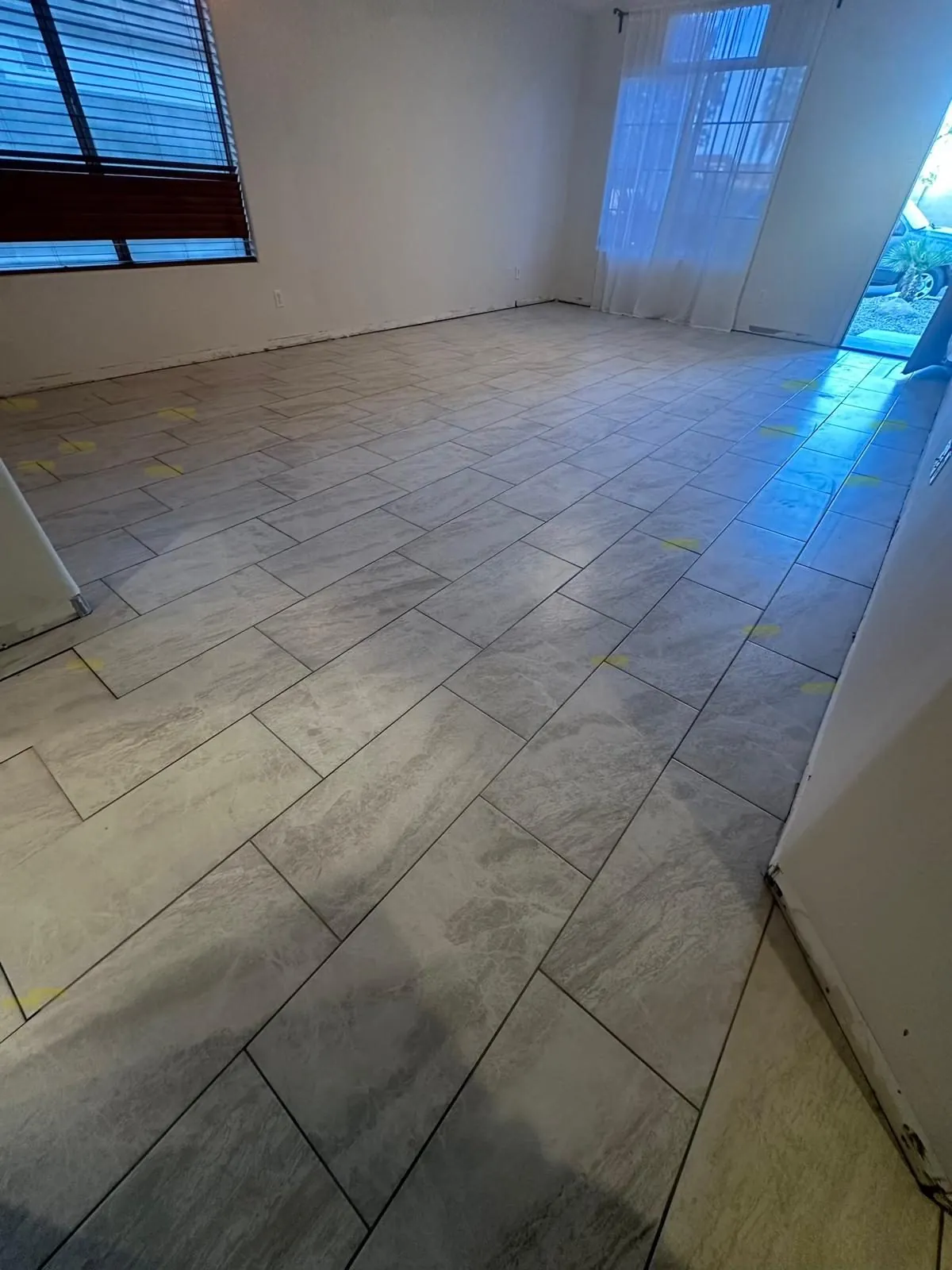
Old tile out, new porcelain in: an RDC job in a Phoenix living room.
Where Can I Buy Floor Tile in Phoenix?
You can buy floor tile in Phoenix at the RDC Renovation & Design Concepts showroom, 1610 E Bell Rd, Suite 101, in North Phoenix. Full-size porcelain and ceramic tiles are on display, from brands RDC carries such as Emser Tile, Daltile, Marazzi and MSI. Samples go home free, and RDC installs the tile it sells with a 1-year workmanship warranty.
The showroom is open Sunday to Friday, 10 AM to 5 PM, and closed Saturday; walk-ins are welcome. Call or text (602) 788-1446, or get directions. Store details are on the flooring store in Phoenix page.
Tile Installation in Scottsdale, Paradise Valley, Mesa and Peoria
- Scottsdale. The Scottsdale jobs on this page include 12x24 tile through an open kitchen, a light gray living room and hallway, and an outdoor kitchen patio. With 58% of Scottsdale's homes built from 1970 to 1999 (ACS), RDC checks an older slab for flatness before 12x24 or larger tile goes down. See tile flooring in Scottsdale.
- Paradise Valley. Paradise Valley homes have a median build year of 1985 (ACS). Many of the floors RDC replaces there are travertine or Saltillo from the 1980s and 1990s. Taking that stone out runs $3 to $5 per square foot before new porcelain or natural stone is set. See tile installation in Paradise Valley.
- Mesa. Mesa has the largest share of 1970-1999 homes of the four, 61%, with a median build year of 1989 (ACS). RDC has set marble-look porcelain in a Mesa shower. See tile installation in Mesa.
- Peoria. Peoria's homes are the newest of the four, with a median build year of 1999 (ACS). RDC has taken out old tile in a Peoria home before a new floor went in. See tile installation in Peoria.
In Chandler, tile removal is what RDC is called for most, and in Gilbert, tile showers and countertops are the most common requests. City pages: Chandler, tile installation in Gilbert, Surprise, Sun City and Sun City West. RDC also serves Glendale, Tempe, Arcadia, Cave Creek, Carefree, Fountain Hills, Anthem, New River, Happy Valley and Buckeye from the Bell Rd showroom. The tile photos on this page are from real RDC jobs in Phoenix and Scottsdale homes.
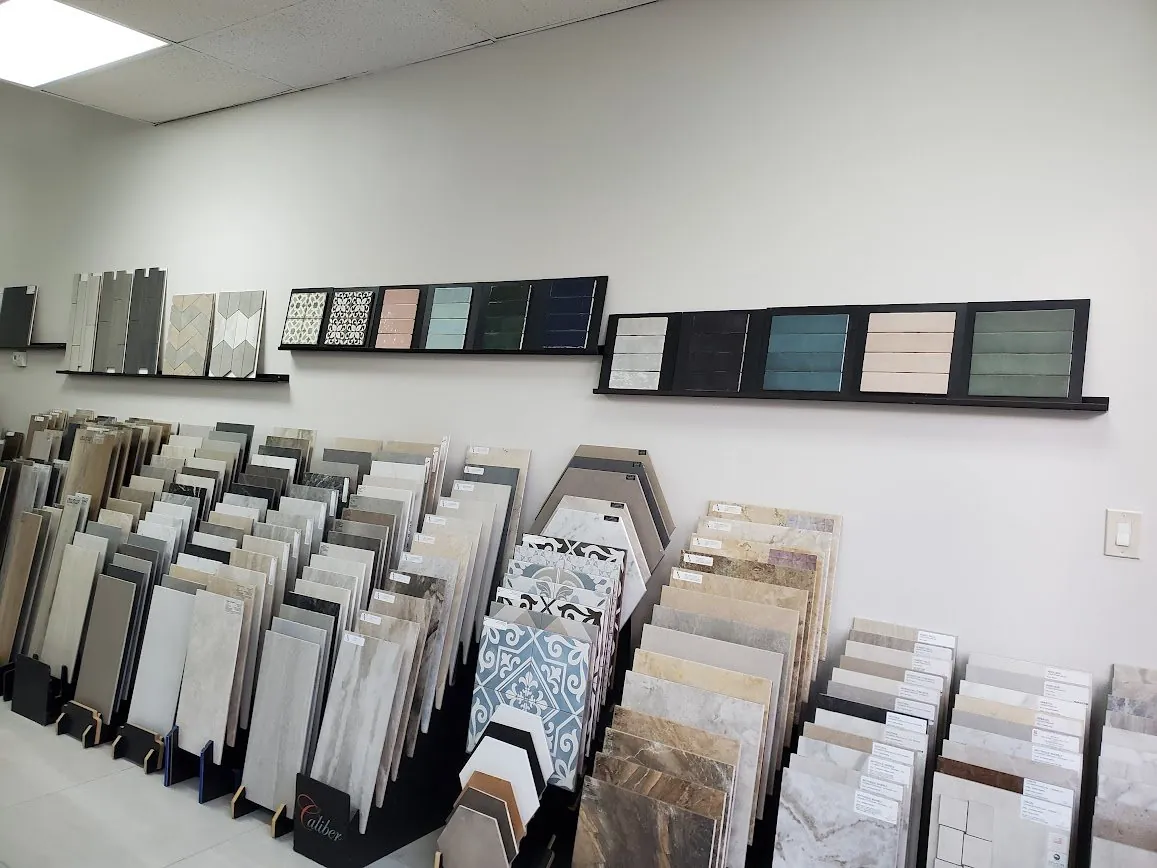
Compare porcelain and ceramic samples in person at the Bell Road showroom.
Compare tile against other floors in our guides to the best flooring for Arizona heat and LVP vs. tile. Prefer real stone? See travertine & natural stone flooring.
Planning a large floor and collecting bids? Read our guide to getting quotes for a 1,200 sq ft tile installation. Swapping out a dated tile floor first? See how tile removal and replacement works in Phoenix homes.
Browse all flooring installation services, the project gallery, or get a free estimate. Want to see full-size tile in person before deciding? Everything above is on display at our Phoenix flooring showroom on Bell Road, where the same team that sells the material installs it.