
Key takeaways
- The pass limit comes from the flooring manufacturer, not from the test, so the floor is chosen before the reading is judged.
- Tile with any edge of 15 inches or more needs a slab within 1/8 inch over 10 feet, per ANSI A108.02.
- A failed moisture test changes the plan: stop the source, use the maker's mitigation system or pick a floor with a higher limit.
Why Phoenix Floors Start With the Slab
The Phoenix floors RDC installs usually go over a concrete slab-on-grade foundation. That concrete sits directly on the ground, with no basement and no crawlspace under it.
That makes the slab the subfloor for every room on it, so whatever the slab does, the new floor does too. NRMCA notes that slab moisture can cause bond failures and other floor-covering problems. A dip can show through LVP as a soft spot and through tile as lippage.
The desert does not make a slab dry, as the moisture sources below show.
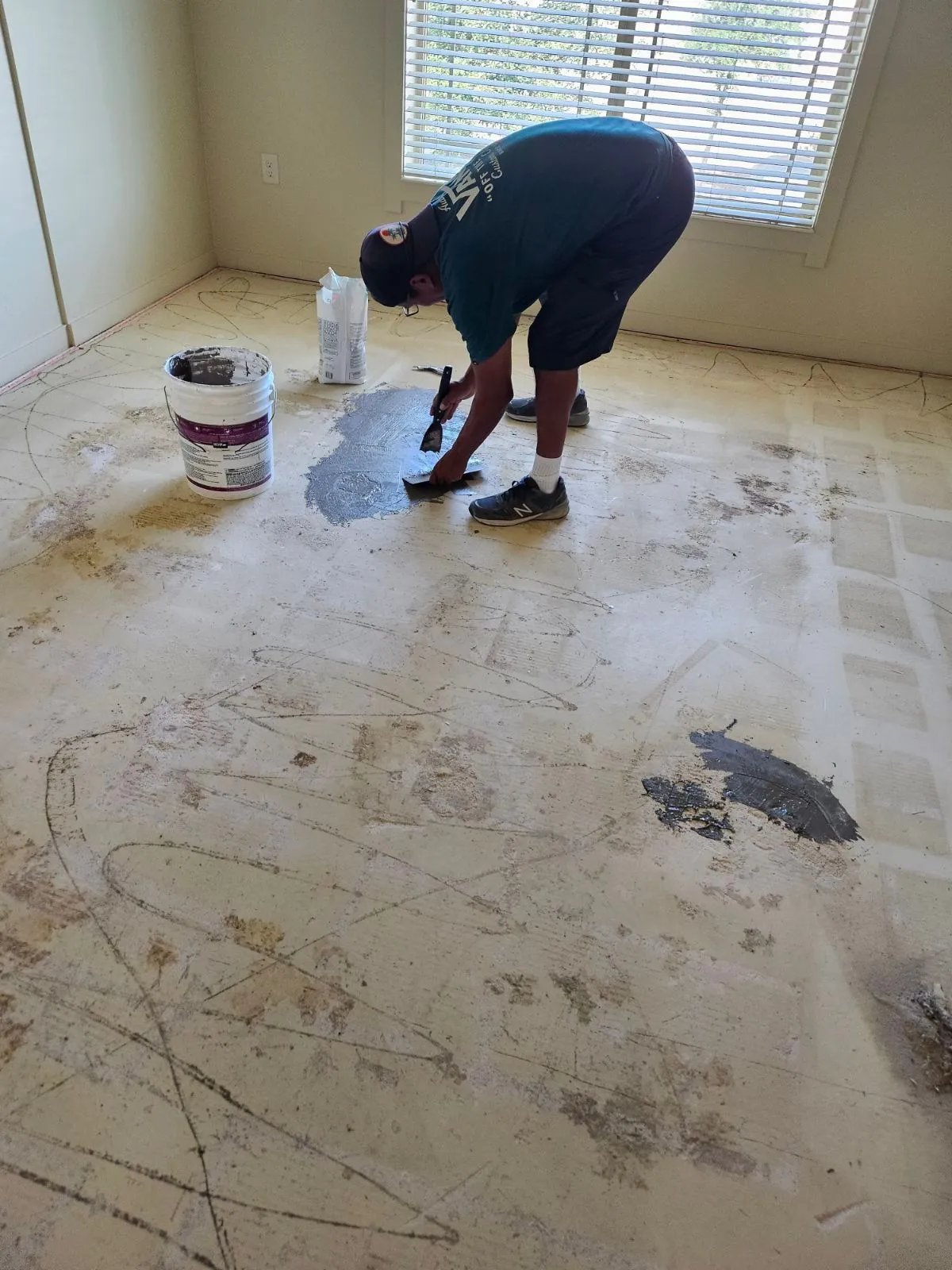
A Phoenix slab being patched after the old tile and thinset came off.
What Causes Moisture in a Concrete Slab?
Moisture in a concrete slab comes from the ground below and from the concrete itself. RDC treats every slab as a possible source, because the new floor sits right on it. The National Ready Mixed Concrete Association (NRMCA) guide to slab moisture names five sources.
- Ground water. Liquid water can rise from the water table through fine-grained soil under the slab.
- Water vapor. Vapor rises into the soil under any slab on ground, whatever the depth of the water table.
- The fill layer. Gravel or sand between the vapor retarder and the slab can hold extra water.
- Mix water. Concrete can take weeks to months to dry to a level flooring makers accept.
- Construction water. Rain or site work that wets the slab after curing lengthens the drying time.
Because those sources sit under and inside the concrete, RDC tests the slab and plans the floor around the reading. The full process is on the flooring installation in Phoenix page.
How Do You Test a Concrete Slab for Moisture?
A concrete slab is tested for moisture with one of two quantitative ASTM methods. ASTM F2170 sets relative humidity probes inside the slab, and ASTM F1869 seals a calcium chloride dish on the surface. RDC uses the method the flooring manufacturer names, then checks the reading against that product's limit.
ASTM F710 is the standard practice for preparing concrete floors to receive resilient flooring. It tells installers to test every slab for moisture, whatever its age or grade level.
Relative humidity probes (ASTM F2170)
ASTM F2170 measures the percent relative humidity inside a concrete slab. NRMCA describes a probe in a drilled hole that is left for 72 hours before the reading. It reads the humidity at a set depth inside the slab, not only at the surface.
Calcium chloride test (ASTM F1869)
ASTM F1869 measures the moisture vapor that leaves the surface, in pounds per 1,000 sq ft over 24 hours. The dish stays sealed under a dome for 60 to 72 hours, per NRMCA. Both standards note that a result reflects the slab only at the time of the test.
| Test | What it measures | Time on the slab | Example pass limit |
|---|---|---|---|
| ASTM F2170 | Relative humidity inside the slab, in percent | 72 hours in the test hole (NRMCA) | Mohawk SolidTech LVP: under 90% RH |
| ASTM F1869 | Moisture vapor emission, in pounds per 1,000 sq ft per 24 hours | 60 to 72 hours under the dome (NRMCA) | Mohawk SolidTech LVP: under 8 pounds |
The pass limit is not set by the test. It is set by the flooring manufacturer for that exact product, in the installation instructions. NRMCA says limits generally specified for the calcium chloride test are 3 to 5 pounds, while Mohawk's SolidTech LVP instructions set a higher limit.
That is why the reading is only useful once the floor has been chosen. Pick the plank or tile at the flooring showroom in Phoenix, and its installation sheet sets the number RDC tests against.
How Flat Does a Floor Need to Be for Tile and LVP?
A floor for tile with any edge of 15 inches or longer needs to be within 1/8 inch over 10 feet, per ANSI A108.02. LVP follows its manufacturer: Mohawk's SolidTech instructions say any unevenness over 3/16 inch in a 10-foot radius must be leveled. RDC checks every slab against the limit for the floor you choose.
- Tile with an edge of 15 inches or more. ANSI A108.02 also limits the slab to 1/16 inch over 24 inches, as TileLetter summarizes it. A 12x24 tile falls under this rule.
- LVP and laminate. Each brand publishes its own flatness limit. A click-lock floor over a dip flexes at the joint, which strains the lock.
- Engineered hardwood. The National Wood Flooring Association guidelines cover installing wood flooring over a concrete slab. Details are on hardwood floor installers in Phoenix.
RDC installs both over prepared slabs: see tile flooring installation in Phoenix and luxury vinyl plank installation in Phoenix.
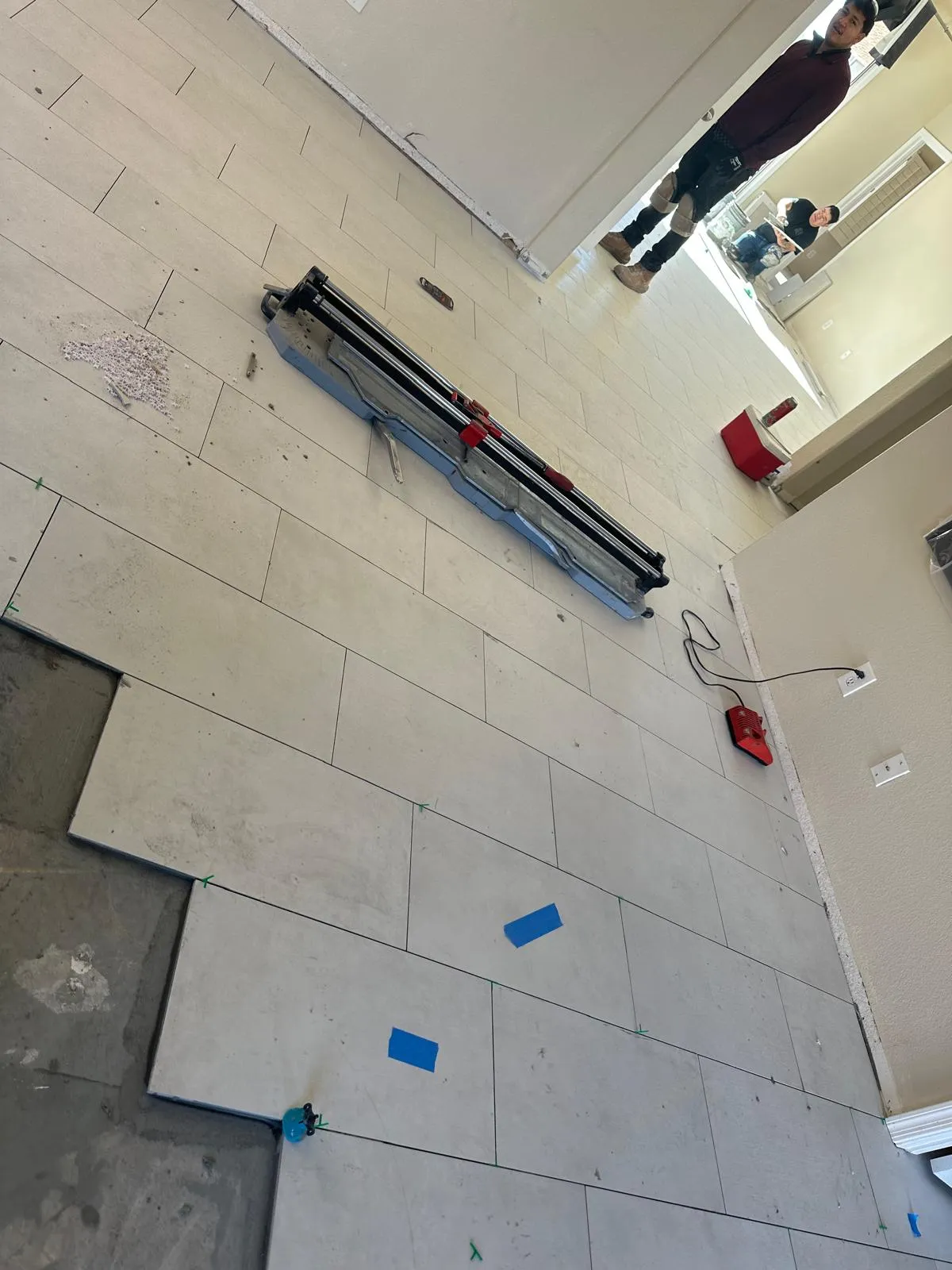
12x24 tile set with a clip leveling system in Scottsdale, next to the bare slab.
Grinding, Filling and Self-Leveler
Slab prep is not one product. It is a short sequence, and each step solves a different problem.
- Grind the high spots. Ridges, old thinset and trowel marks come down first, so the new floor does not rock on them.
- Fill cracks and low spots. Non-moving cracks and shallow dips are filled with a patching compound.
- Pour self-leveler over wide areas. Where a whole room is out of plane, a pourable self-leveling underlayment brings it back to flat.
How Much Does Floor Leveling Cost in Phoenix?
Floor leveling in Phoenix costs $1 to $4 per square foot at RDC when the slab needs it. The number depends on how far out of flat the slab is and how much of the floor needs self-leveler. RDC writes it into the estimate as its own line, before the old floor comes up.
Worked example. A 1,500 sq ft floor that needs leveling throughout: 1,500 × $1 to $4 = $1,500 to $6,000 for the slab prep line. If old tile comes out first, removal is a separate line: 1,500 × $3 to $5 = $4,500 to $7,500.
- How far out of flat. A few low spots take patching; a room that is out of plane takes self-leveler.
- How much area. Spot repairs cost less than a pour across a whole room.
- What came up before. Thinset ridges left by old tile are ground off before any leveling.
Please note: these are typical ranges and can vary. Final pricing is set individually for each customer based on their specific project, after the slab is measured and tested.
Prices for every floor are on the flooring installation cost guide. Call or text (602) 788-1446 for a free in-home measure.
What Happens If a Slab Fails the Moisture Test?
A slab that fails the moisture test changes the plan, not the project. There are three paths, and RDC explains which one applies before anything is installed. NRMCA advises moisture mitigating products the flooring manufacturer approves when results exceed the limit.
- Find and stop the source. A leak, a sprinkler aimed at the foundation or poor drainage is fixed first. NRMCA's guide puts drainage away from the slab at the top of its prevention list.
- Use the manufacturer's moisture mitigation system. Where the flooring maker approves a membrane or sealer for slabs above its limit, RDC follows those instructions.
- Choose a floor with a higher limit. Each product publishes its own moisture limit, so the floor can be matched to the reading.
The floors RDC installs over slabs are listed on the flooring installation page.
After Tile Removal, the Slab Needs More Work
When original ceramic comes up, the thinset stays behind in ridges, and the slab has to be ground and checked before a new floor. Tile removal takes 1 to 4 days.
RDC removes tile only as part of installing the new floor. The grinding and leveling after removal are part of the same estimate. See tile removal and replacement in Phoenix.
Slab Prep in Arizona, Phoenix and North Phoenix
Across Arizona, the same national standards apply to a slab under a new floor. They are ASTM F710 for slabs under resilient floors such as LVP, ANSI A108.02 for tile flatness and the flooring maker's own limits. RDC applies them in every Valley city it serves.
Phoenix
The median Phoenix home was built in 1985, per the U.S. Census ACS 2020-2024 (table B25035). Older and newer slabs get the same moisture test and flatness check before a new floor.
North Phoenix: the Bell Rd showroom
RDC's showroom is at 1610 E Bell Rd, Suite 101, Phoenix, AZ 85022. Buy the floor there, and RDC installs it under one contract, slab prep included. Hours are Sunday to Friday, 10 AM to 5 PM, Saturday closed.
Scottsdale, Paradise Valley, Mesa and Peoria
The median home was built in 1991 in Scottsdale, 1985 in Paradise Valley, 1989 in Mesa and 1999 in Peoria (same Census table). City details are on the Scottsdale, Paradise Valley, Mesa and Peoria flooring pages.
Where to Start
Two flooring bids can differ simply because one of them left out the slab prep. Ask every contractor whether moisture testing and leveling are included, and in which line.
RDC responds within two hours during business hours. Book a free in-home measure, or call or text (602) 788-1446.