
RDC Renovation & Design Concepts is a flooring contractor in Phoenix, Arizona, that sells and installs flooring, tile and countertops from its Bell Rd showroom. Its installed prices are published per square foot, so you can set them next to a builder's option sheet.
Key takeaways
- A builder upgrade goes in during construction, so the floor is finished when you get the keys.
- Replacing a floor after closing adds removal of the builder's floor, $3 to $5 per square foot at RDC.
- A fair comparison sets the builder's upgrade price and an installed price side by side, for the same rooms and the same type of floor.
- A brand-new slab still gets a moisture test: ASTM F710 says all concrete slabs should be tested regardless of age.
Should You Upgrade Flooring With the Builder?
Upgrading flooring with the builder makes sense when you need finished floors on move-in day. The builder's price per square foot should be close to an installed price elsewhere. Waiting makes sense when you want a product the builder does not offer. At RDC, LVP runs $4 to $9 and porcelain tile $9 to $18 per square foot installed.
The cost of waiting is the floor the builder puts down first. If you replace it after closing, that floor has to come out. RDC charges $3 to $5 per square foot to remove an old floor, and only together with the new floor.
What you gain by waiting is a wider choice and RDC's itemized price. Its written estimate puts the material, the removal, any slab prep and the installation on separate lines. See what flooring installation in Phoenix covers at RDC.
Questions to ask the builder before you choose:
- What exact product is in the base price: the brand, and for LVP the wear layer in mils.
- Whether the upgrade is priced per room or per square foot, so you can compare it with an installed price.
- How and when the upgrade has to be paid.
- Which areas the choice covers, such as stairs, closets and the laundry room.
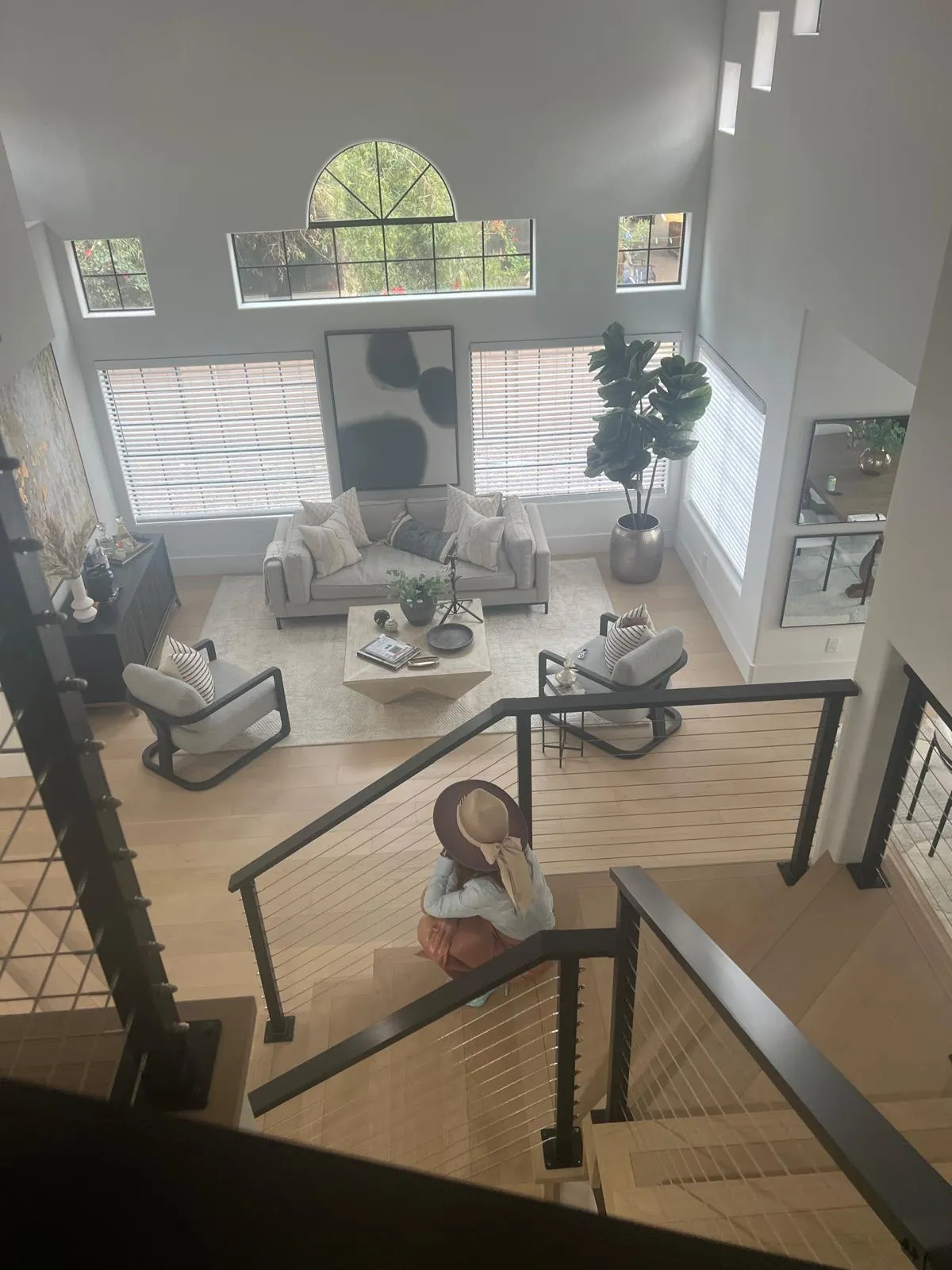
White-oak-look LVP through a two-story living room in Scottsdale, an RDC install.
Builder Upgrade or After Closing: Side by Side
The two paths differ in timing, choice and how the price is shown. The builder column below lists what to ask about, not what any one builder does.
| Question | Builder upgrade before closing | Replacing after closing with RDC |
|---|---|---|
| When the floor goes in | During construction, before you get the keys | After closing, ideally while the house is still empty |
| Product choice | The builder's option list | Any brand RDC carries, or one it orders for you |
| How the price is shown | The builder's option sheet | Material, removal, slab prep and installation on separate lines |
| Removing a builder floor | None: the upgrade goes in instead of the base floor | $3 to $5 per sq ft, only with the new floor |
| Slab check | Ask the builder how the slab is tested | Moisture and flatness checked before any floor goes down |
Please note: RDC's figures are typical installed ranges and can vary. Your own price is set after RDC measures the house and writes the estimate.
What Is Builder-Grade Flooring?
Builder-grade flooring is the floor that comes with a new home's base price, before any paid upgrade. The term describes a price level, not a material, so it can be carpet, tile, LVP or laminate. What tells you its quality is the product spec, so ask the builder for it before you sign the selections.
For LVP, the number to ask for is the wear layer: the clear top film, measured in mils. Heavier use calls for a thicker one. The luxury vinyl plank installation page explains which wear layer suits which room. For one city's view, see builder-grade flooring in a Buckeye home.
Is Builder-Grade Flooring Worth Replacing?
Builder-grade flooring is worth replacing when you already know you will change it, such as carpet in rooms where you want a hard floor. Replacing a sound floor is harder to justify, because removal is paid for a floor that still works. At RDC, removal of the old floor plus new LVP runs $7 to $14 per square foot installed.
Signs it is worth replacing:
- You want one hard floor through the house, and the builder put carpet in the living areas or bedrooms.
- The base plank has a thin wear layer, and the house will see large dogs or heavy traffic.
- The stairs are carpeted while the floors below and above them are hard.
Signs it is probably not:
- The builder's tile in the bathrooms and laundry room is sound and you like it. Taking tile out adds 1 to 4 days.
- The only problem is the color, and nothing else in the room is changing.
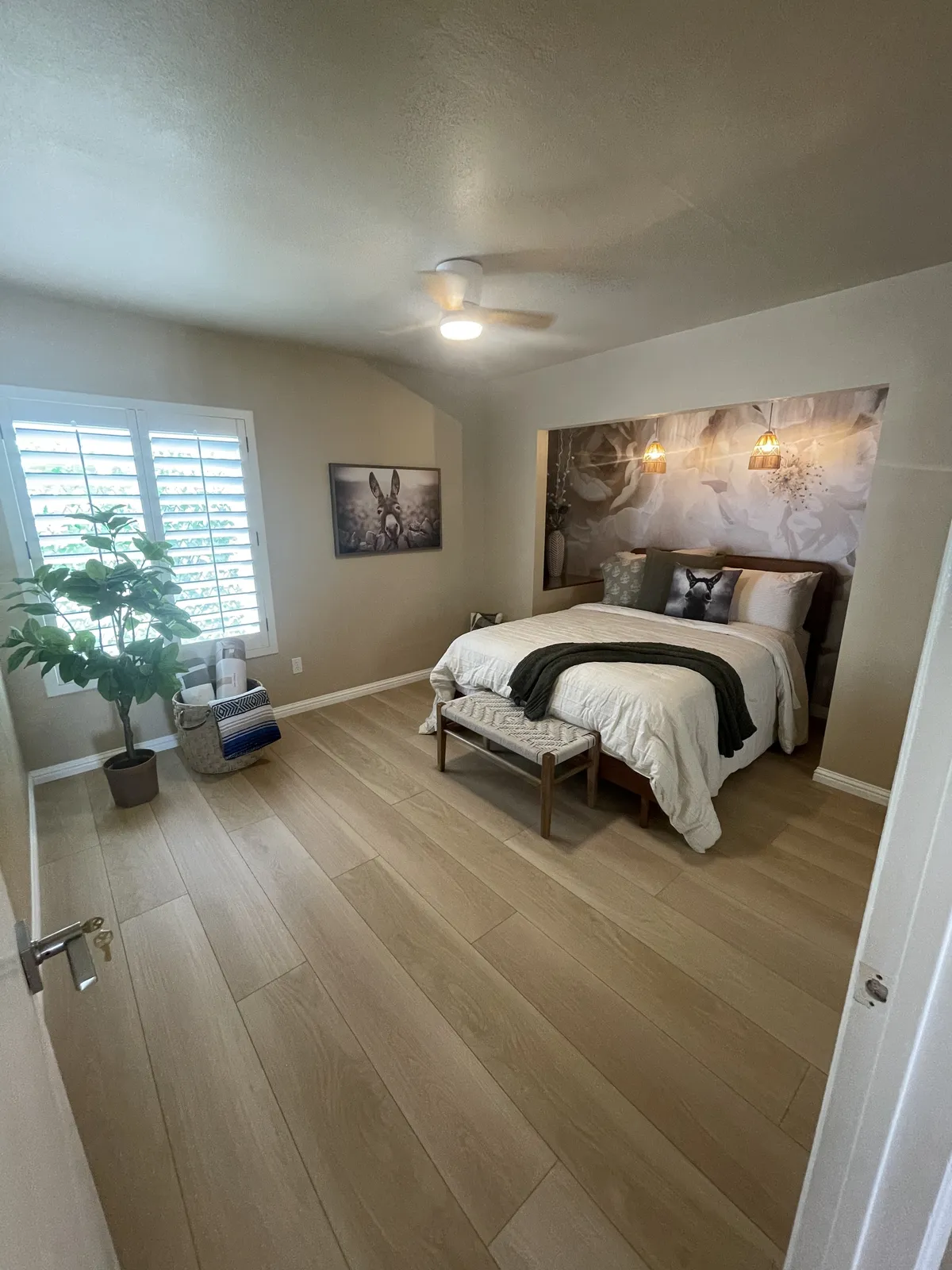
White-oak-look LVP in a guest bedroom of a Phoenix home, installed by RDC.
What Replacing Builder Floors Costs at RDC
At RDC, replacing builder carpet with LVP in 900 sq ft of bedrooms and living space costs $6,300 to $12,600, removal included. Fourteen carpeted stairs in LVP add $1,400 to $2,590. If parts of the slab need leveling, add $1 to $4 per square foot for those areas.
Worked example, 900 sq ft of builder carpet replaced with LVP, plus 14 stairs (RDC published prices):
- LVP: 900 × $4 = $3,600 to 900 × $9 = $8,100
- Removing the builder carpet: 900 × $3 = $2,700 to 900 × $5 = $4,500
- LVP with removal: $3,600 + $2,700 = $6,300 to $8,100 + $4,500 = $12,600
- Stairs: 14 × $100 = $1,400 to 14 × $185 = $2,590, including removal of the stair carpet, installation and the stair nose
- Total with stairs: $6,300 + $1,400 = $7,700 to $12,600 + $2,590 = $15,190
To compare, ask the builder for its upgrade price for the same rooms and the same type of floor. Then divide it by the square feet. The builder's figure is for a floor that goes in instead of the base floor. RDC's after-closing figure also covers taking the base floor out.
- Builder tile: RDC removes tile only as part of a new installation. New porcelain runs $9 to $18 per square foot installed. See tile removal and replacement in Phoenix.
- Baseboards: $4 to $6 per linear foot installed, on their own line of the estimate.
- Tile pattern: a herringbone or diagonal tile layout adds about 10% to 20% to tile labor.
If you are weighing one plank through every room, see whether to put LVP in your whole house. Whole-house totals by home size sit in the Phoenix flooring installation cost report. For plank tiers, see LVP flooring cost in Arizona.
Please note: these are typical ranges and can vary. Final pricing is set individually for each customer based on the specific project, materials and scope, confirmed in a free written estimate.
Installing New Floors Between Closing and Move-In
New floors after closing go in most easily between closing and move-in, while the house is empty. An RDC flooring installation usually takes 1 to 3 days, and that includes carpet for a whole house. Tile takes longer: about 1,200 sq ft of tile is one to two weeks of work.
An empty house has no furniture to work around, and every room can be done in one pass. Tile also needs its thinset and grout to cure, which RDC tells customers takes 24 to 48 hours. Plan the moving truck around that.
In an Arizona summer, keep the air conditioning running in the empty house. Mohawk's SolidTech guide says the plank must sit in the room it goes into, between 55 and 85°F, for at least 48 hours before installation. It should stay in that range during the installation and for at least 24 hours after.
To get a number early, text photos of the rooms to (602) 788-1446 for a preliminary estimate. During business hours, RDC replies within 2 hours, and the exact written quote follows a free measure at the home.
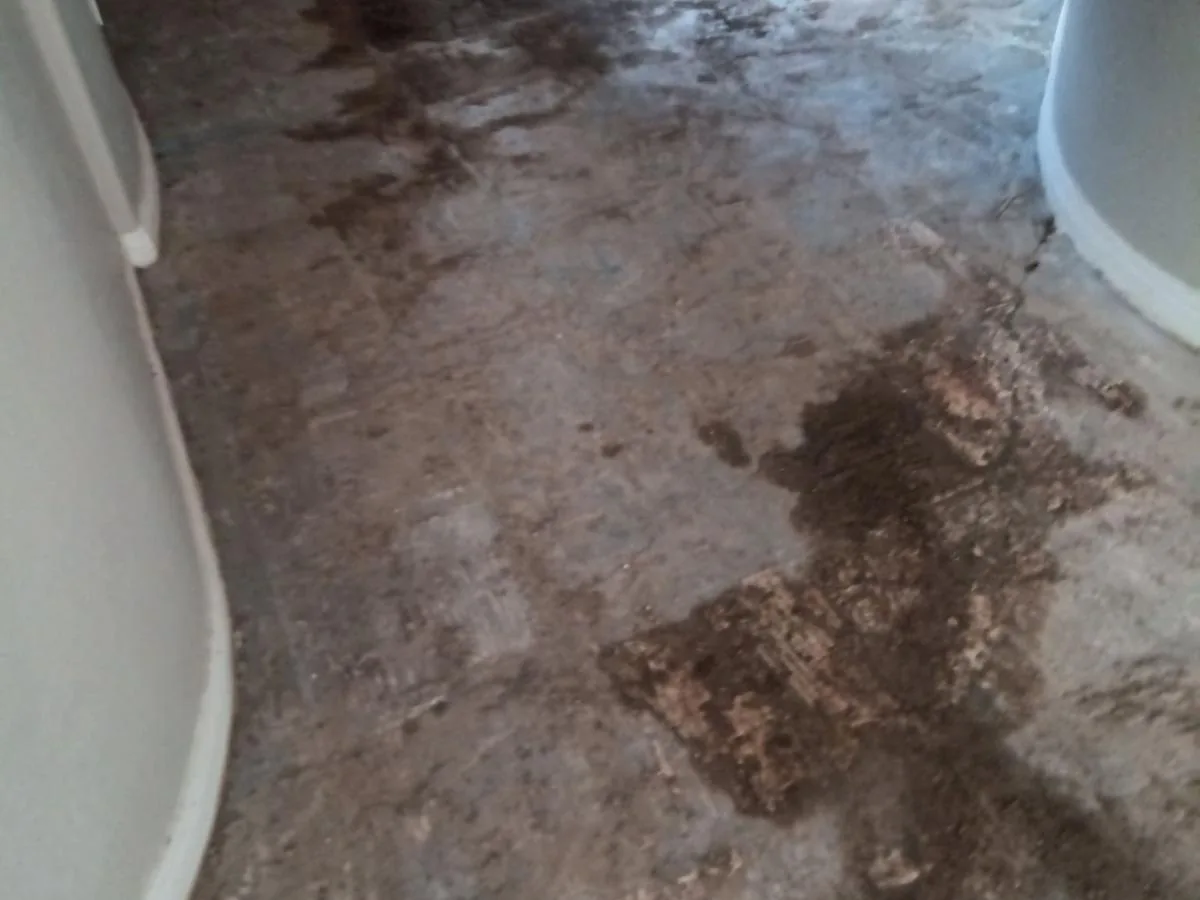
The slab of a Mesa home after RDC removed the old tile, before the new plank went down.
New Slab, Same Moisture Test
A brand-new slab is not automatically ready for a new floor. ASTM F710, the standard practice for preparing concrete floors for resilient flooring, says all concrete slabs should be tested for moisture regardless of age. MSI's LVT installation guide says new slabs must cure for at least 60 days.
The exact limits come from the plank you choose. Mohawk's SolidTech guide requires the concrete to read under 90% relative humidity in an ASTM F2170 probe test. It also calls for leveling wherever the unevenness passes 3/16 inch in a 10-foot radius.
RDC checks moisture and flatness before every installation, in a new house or an old one. Any leveling is its own line on the estimate, at $1 to $4 per square foot. The process is on slab moisture testing and floor leveling in Phoenix.
How Many New Homes Arizona Builds
The Phoenix metro had the third-most single-family homes authorized by building permits in the U.S., 30,277 in 2024 and 23,755 in 2025. The source is the U.S. Census Bureau's Building Permits Survey.
Statewide, 14% of homes were built in 2010 or later, and the median Arizona home dates from 1992 (U.S. Census Bureau, ACS 2020-2024). For the buyer of a new home, the flooring decision comes before closing, at the selection stage. RDC can measure and quote the floors before you buy or while the house is being built.
Builder Flooring Upgrade or After Closing in Phoenix?
In Phoenix, take the builder's flooring upgrade if the floor must be done at move-in. Replace the base floor after closing for a wider choice. At RDC, LVP runs $4 to $9 per square foot installed, plus $3 to $5 for removing a builder floor. Only 12% of Phoenix homes were built in 2010 or later.
The median Phoenix home dates from 1985 (ACS 2020-2024). RDC's 1-year workmanship warranty covers every install and passes to a later owner of the home.
Those figures come from Census tables B25034 and B25035 (ACS 2020-2024). In Phoenix, RDC has installed white-oak-look LVP in a guest bedroom and wood-look LVP treads on a staircase.
If the builder carpeted the stairs in a two-story home, they belong in the same decision. At RDC, each LVP stair costs $100 to $185, a price that covers pulling the old carpet, the installation and the stair nose. A straight run of 13 to 14 steps comes to $1,300 to $2,590.
For the full service, see RDC's Phoenix flooring installation, or call or text (602) 788-1446.
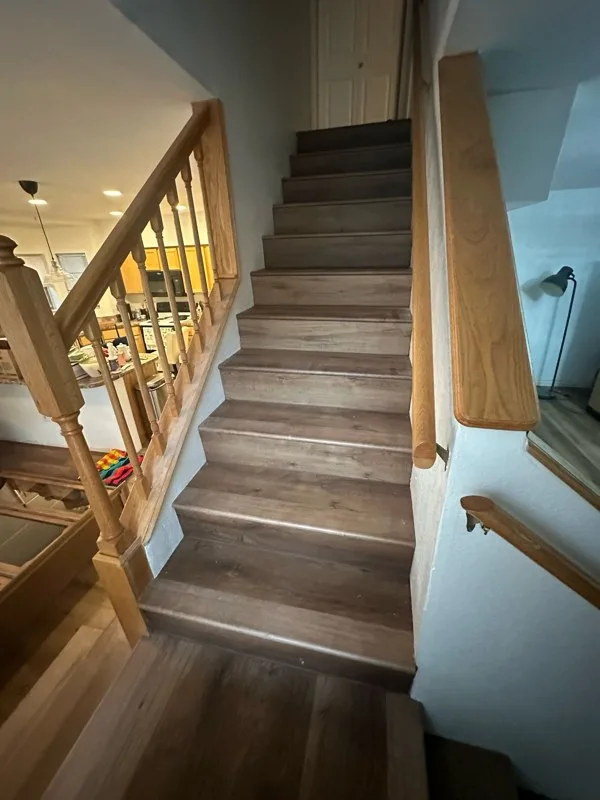
Wood-look LVP treads up a staircase in a Phoenix home, installed by RDC.
Comparing Your Builder Picks at the North Phoenix Showroom
The roughly 1,200 sq ft Bell Rd showroom (1610 E Bell Rd, Suite 101, North Phoenix) has full-size plank and tile on display. Seeing a full-size plank makes it easier to judge a color first picked from a builder's option list. You can take samples home free, from more than 25 brands of flooring, tile and countertops.
RDC works with all the major brands, and if you want one it does not stock, it opens an account and orders it. No appointment is needed Sunday through Friday, 10 AM to 5 PM; on Saturday the showroom is closed. A same-day estimate is possible at the showroom, and the final written quote comes after RDC measures the rooms. Details: the flooring showroom and store in Phoenix.
New-Build Flooring in Scottsdale, Paradise Valley, Mesa and Peoria
RDC's prices are the same in these four cities as in Phoenix. What differs is how new the houses are, per U.S. Census Bureau estimates (ACS 2020-2024).
- Scottsdale. Median home built in 1991, with 12% built in 2010 or later. RDC installed white-oak-look LVP through a two-story Scottsdale living room. See Scottsdale flooring installation.
- Paradise Valley. Median home built in 1985, with 14% built in 2010 or later. On a new-construction custom home in Paradise Valley, RDC supplied and installed all of the flooring. See flooring for a new custom home.
- Mesa. Median home built in 1989, with 13% built in 2010 or later. In a Mesa home, RDC took out the old tile and installed gray wood-look LVP. See Mesa flooring installation.
- Peoria. Median home built in 1999, with 21% built in 2010 or later. In Peoria, RDC has removed tile and installed LVP. See RDC's Peoria flooring page.
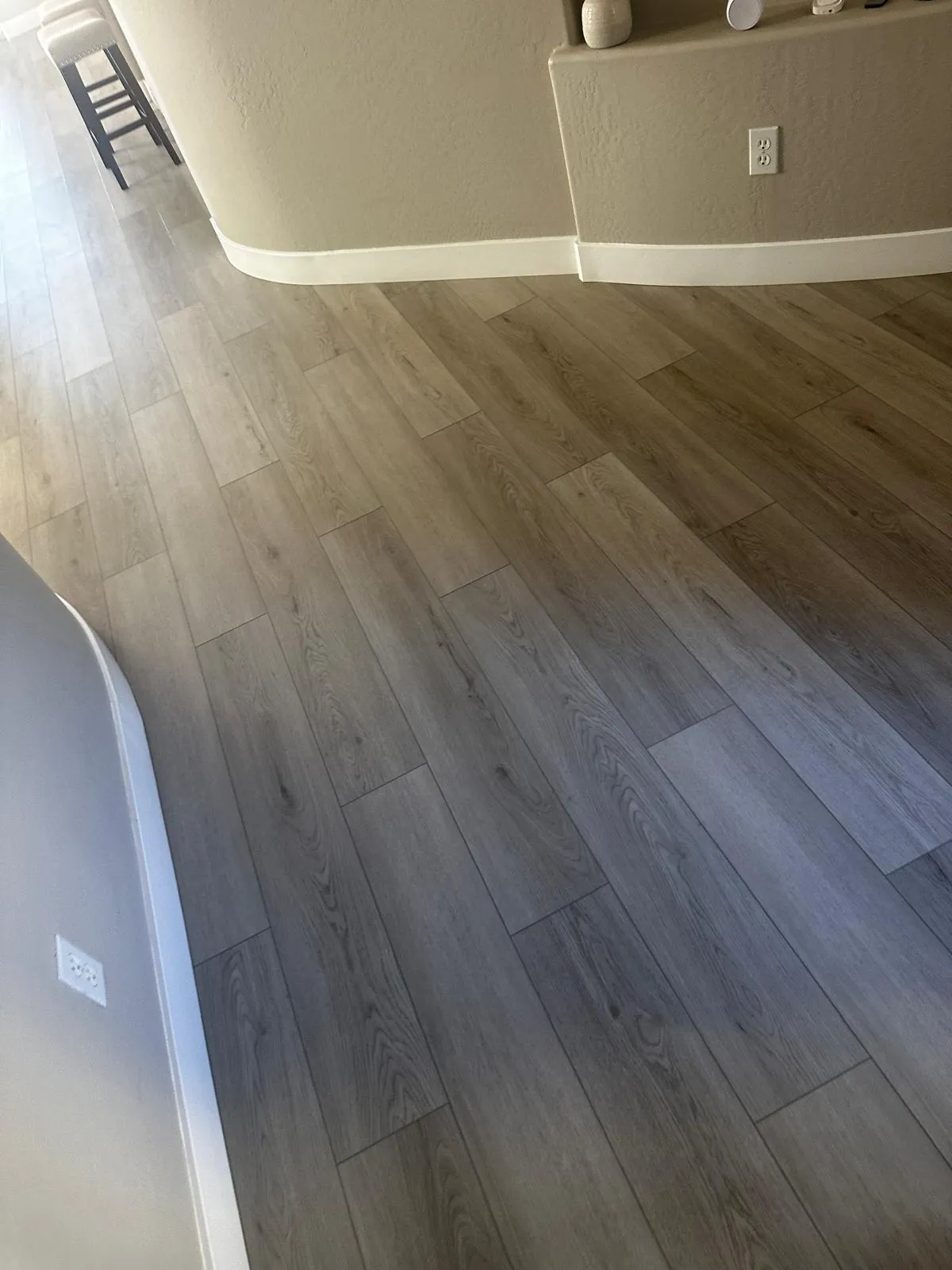
Gray wood-look LVP beside a kitchen counter in a Mesa home, an RDC install.
Buckeye, Surprise and Gilbert: Mostly Homes From 2000 On
In each of these three cities, most homes were built in 2000 or later. Of the cities on this page, Buckeye has the largest share built in 2020 or later. The figures are U.S. Census Bureau estimates (ACS 2020-2024).
- Buckeye. Median home built in 2011. 52% of homes were built in 2010 or later, and 14% in 2020 or later. RDC serves Buckeye from its Bell Rd showroom; see flooring and tile installation in Buckeye.
- Surprise. Median home built in 2005, with 53% built from 2000 to 2009. A home from that median year is now about 21 years old. See tile installation and flooring in Surprise.
- Gilbert. Median home built in 2003, with 60% built in 2000 or later. See flooring and tile installation in Gilbert.
Elsewhere in the Valley: the same prices apply in Chandler, Tempe, Glendale and Anthem.
Sources
- ASTM International, ASTM F710-26, Standard Practice for Preparing Concrete Floors to Receive Resilient Flooring.
- MSI LVT Installation, Warranty and Care guide; Mohawk SolidTech Installation Guidelines.
- U.S. Census Bureau, Building Permits Survey, annual metro files for 2024 and 2025.
- U.S. Census Bureau, American Community Survey 2020-2024 five-year estimates, tables B25034 and B25035.