How Much Does LVP Flooring Cost per Square Foot Installed?
Installed LVP costs $4 to $9 per square foot at RDC in the Phoenix area. That one figure covers the plank and the labor to lay it. Where a floor lands inside the range depends mostly on two choices: the thickness of the wear layer on top and the type of core underneath.
| LVP tier | Installed per sq ft | Where it fits |
|---|---|---|
| Standard LVP, 12 to 20 mil wear layer | $4 – $6 | Bedrooms, guest rooms and most rooms of a home |
| Premium rigid-core (SPC), 20 mil or more | $6 – $9 | Kitchens, hallways, homes with pets, rooms with strong sun |
Please note: ranges, not quotes. RDC sets each price after measuring the home, and the written estimate is the number that counts.
The installation method moves the number too. Click-lock (floating) plank runs about $5 to $9 installed and glue-down about $4 to $8. Glue-down is the firmer, quieter option for large open areas and slabs with minor variation, while click-lock lets a single damaged plank be swapped without touching the rest of the floor. RDC recommends one or the other after seeing the slab, not before.
How Much Does LVP Cost for a 1,000, 1,500 or 2,000 Sq Ft House?
At $4 to $9 per square foot, LVP for 1,000 sq ft of floor costs about $4,000 to $9,000 installed, 1,500 sq ft about $6,000 to $13,500, and 2,000 sq ft about $8,000 to $18,000. Each total is the floor area multiplied by RDC's published rate, before the old floor is removed and before any slab leveling.
| Floor area | Standard ($4–$6) | Premium ($6–$9) | Full range ($4–$9) |
|---|---|---|---|
| 1,000 sq ft | $4,000 – $6,000 | $6,000 – $9,000 | $4,000 – $9,000 |
| 1,500 sq ft | $6,000 – $9,000 | $9,000 – $13,500 | $6,000 – $13,500 |
| 2,000 sq ft | $8,000 – $12,000 | $12,000 – $18,000 | $8,000 – $18,000 |
Use the area that will actually get plank, which is seldom the listed size of the house. If you keep carpet in the bedrooms, a 2,000 sq ft home might need only 1,400 sq ft of LVP: $5,600 to $12,600 at the same rates. RDC builds the estimate from its own room-by-room measurement, so the square footage on the quote is the floor you are buying.
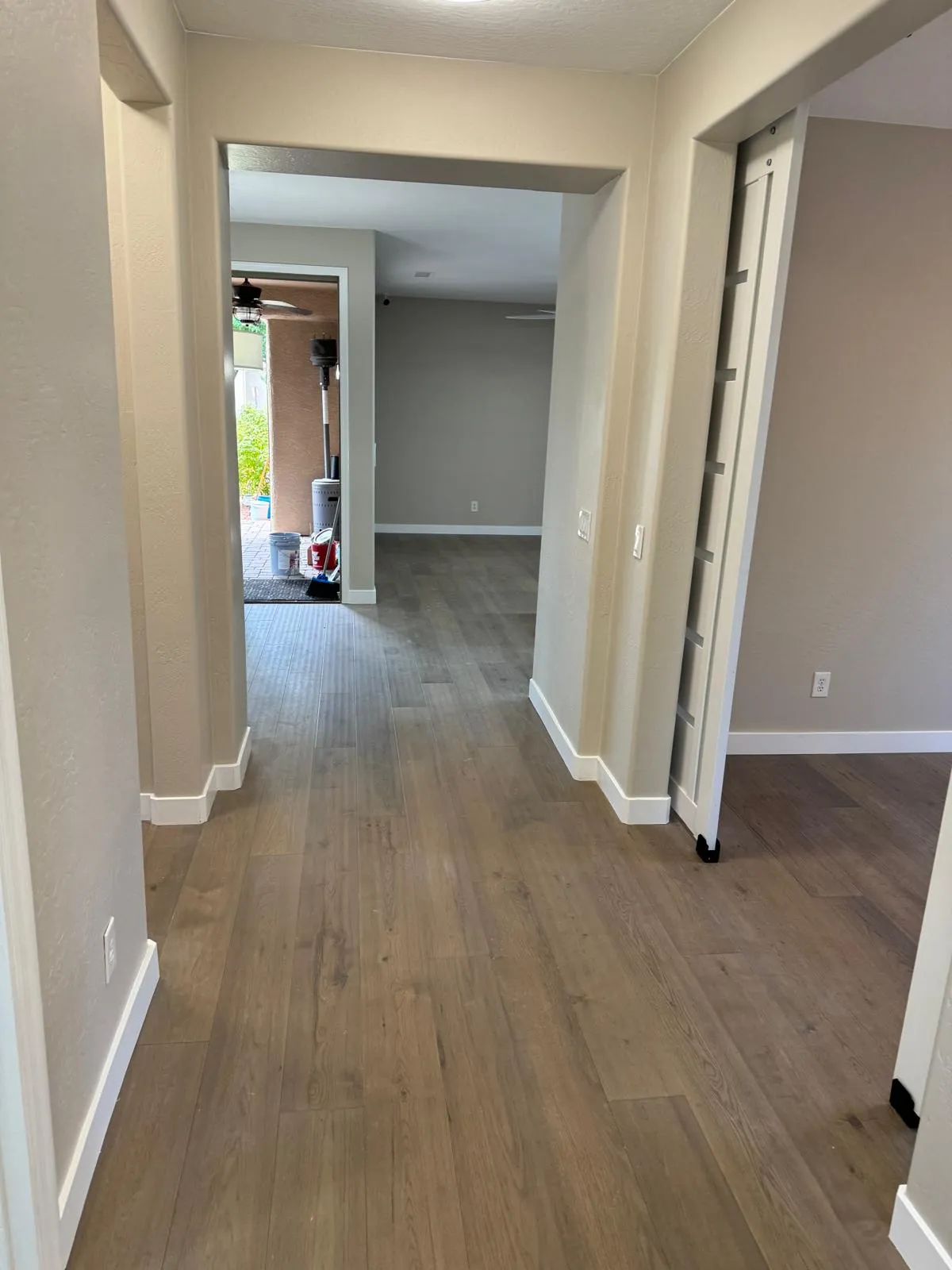
One plank carried through the hallway and archway, so the whole area is priced as a single continuous floor.
What Do Removal and Slab Prep Add to an LVP Floor?
Taking out the old floor adds about $1 to $3 per square foot, and slab leveling adds about $1 to $4 per square foot when the concrete needs it. On 1,500 sq ft that means $1,500 to $4,500 for removal and, where leveling is required, another $1,500 to $6,000. Each appears as its own line on the estimate.
Carpet and pad lift quickly, so removal sits at the low end. Old ceramic set in thick thinset sits at the high end, because the mortar has to be ground off until the slab is flat; a thin plank shows every ridge left behind. RDC removes old tile only when a new floor is going in, as described on the tile removal and replacement page. Before a single plank goes down, the slab is moisture-tested following ASTM guidelines, since Shaw's warranty, for one, excludes damage from subfloor moisture. How the test and the leveling work is on the slab prep and moisture testing guide. Baseboards, transitions and stair nosings are priced per house on separate lines.
What Is the Labor Cost to Install LVP?
RDC does not publish a separate labor-only rate. The $4 to $9 figure is an installed price, plank and labor together, because RDC supplies the LVP and manages the installation under one contract. On the written estimate the plank, the removal, the prep and the installation each have their own line, so the labor on your job is visible.
That split matters when two bids look far apart. A quote that shows a low labor number on its own can leave the material, the moisture test or the leveling for later, and those return as change orders once the old floor is up. When one company supplies and installs, there is also one warranty to call on: RDC's 1-year workmanship warranty sits on top of the manufacturer's material warranty, and the plank is installed to the manufacturer's written specification so the material warranty stays valid. The work is done by the licensed installers RDC works with. The reasons to buy and install through one company are set out on the LVP sales and installation page.
Is $4 to $9 per Square Foot a Fair Price for LVP in Arizona?
Yes. A national cost guide updated in 2026 puts professionally installed LVP at about $5 to $10 per square foot on a typical job, with the labor share alone around $2.50 to $6. RDC's $4 to $9 in Phoenix starts a little below that band and tops out under it, and every line of the written estimate is itemized.
A national average blends very different jobs, so treat it as a sanity check rather than a quote. Two things push a Phoenix floor above it: an old hard floor that has to come out first, and a slab that needs grinding or leveling. Two things keep it lower: click-lock plank over a slab that is already flat and dry, and a simple layout with few doorways. With any low bid, check what it covers: the removal, the moisture test, the leveling, the trim and the transitions. Ask each bidder to list the plank, the removal, the slab prep and the trim as separate lines so the quotes can be compared side by side.
How Much Does LVP Flooring Cost in Phoenix?
Inside Phoenix the $4 to $9 installed price does not change from one neighborhood to the next. The concrete does. The Phoenix floors RDC installs usually go over a concrete slab, so what sits under the old floor decides how much preparation a new LVP floor needs, and that is where two Phoenix homes of the same size end up with different totals.
According to U.S. Census estimates, the median Phoenix home was built in 1985, and 49% of the city's housing dates from 1970 to 1999. If a house still has its original ceramic, that means removal and thinset grinding before anything else. Newer pours tend to be flatter but can hold construction moisture, which is why the moisture test is never skipped. Once the slab is right, the plank itself suits the climate: the core is waterproof, a matte finish hides the fine dust that settles into desert homes, and the one thing to plan around is strong sun, covered further down this page. For the rest of the Valley, see Scottsdale, Mesa and Peoria flooring, and for the installation itself, LVP flooring installation in Phoenix.
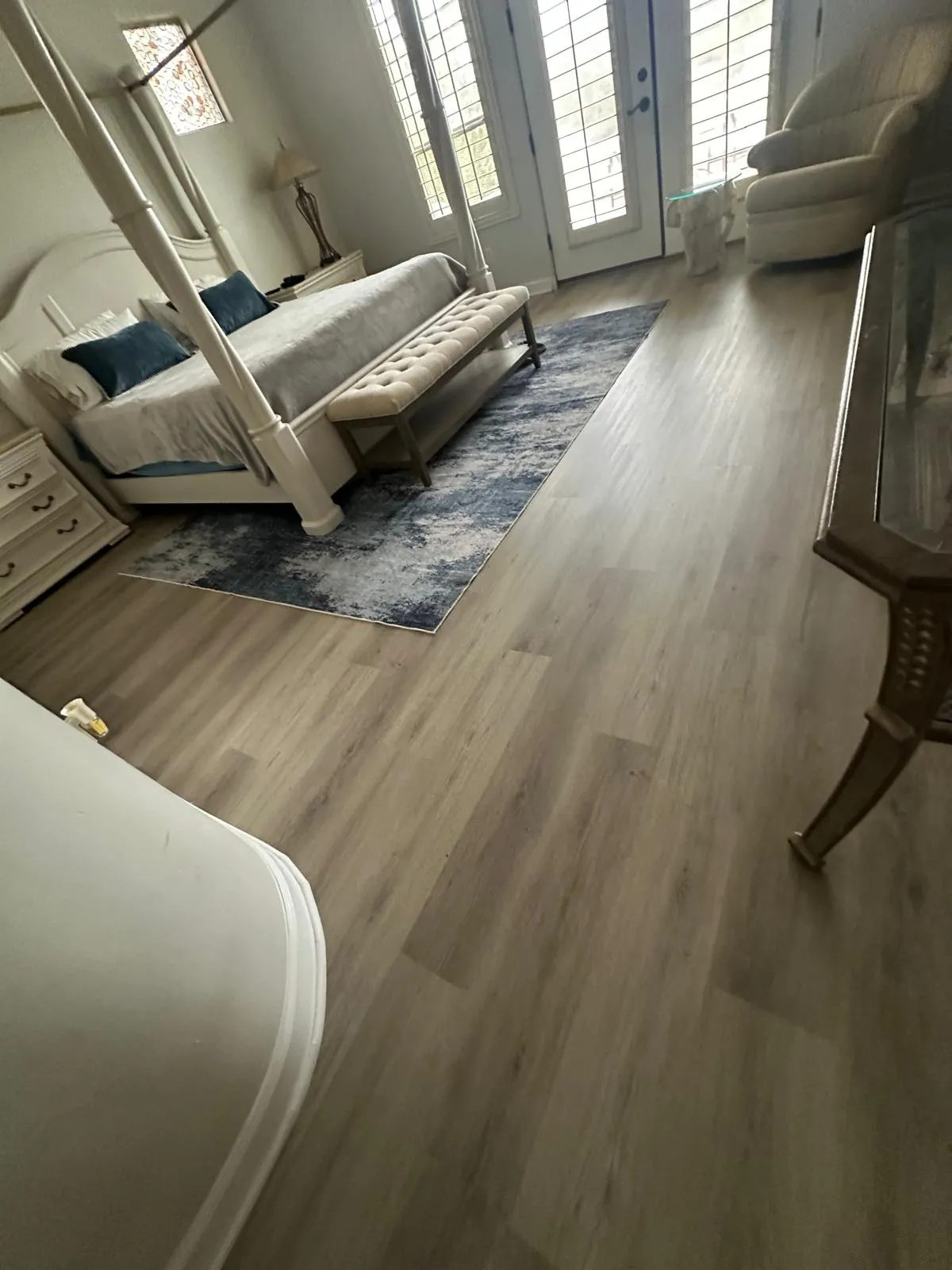
Wide-plank LVP in a primary bedroom, an alternative to keeping carpet in the bedrooms.
Where Can You Compare LVP Prices in North Phoenix?
RDC's flooring showroom is at 1610 E Bell Rd, Suite 101, in North Phoenix, with samples from more than 25 brands, including Mohawk, Shaw and COREtec LVP, in full-size planks. Side by side in real light, you can see what separates a $4 floor from a $9 one: wear layer, core, texture and plank length.
From the showroom, RDC books a free in-home visit to measure every room and check the slab for flatness and moisture, then writes the itemized estimate. There is no obligation to go ahead. For a whole-house floor, financing lets the cost be paid over time, and the estimate is itemized the same way either way. Finished floors are in the project gallery.
Does Arizona Heat Change What an LVP Floor Costs?
Not the price per square foot, but it can change which tier is worth buying. LVP makers warn that long direct sun can fade a plank and make it expand, and one brand asks for a wider gap at the walls wherever the floor sits above 85°F. In a sunny Phoenix room, that means premium rigid-core plank and window coverings.
The installation sheets are specific. Mohawk's SolidTech instructions call for a 1/4 inch expansion space around the room, widened to 5/8 inch where temperatures exceed 85°F. Shaw's Floorte guidelines say heat from direct sunlight can cause thermal expansion and UV fading, and recommend drapes or blinds during peak hours. Neither rule adds a line to the estimate by itself; both shape the plan, from the plank chosen for the brightest rooms to the gap left at the walls and hidden under baseboard or quarter round. Shaw also calls its plank waterproof while excluding damage from moisture rising through the subfloor, which is why the slab moisture test comes before any plank is ordered.
How Much Does LVP Flooring Cost in Scottsdale, Paradise Valley, Mesa and Peoria?
LVP costs the same $4 to $9 per square foot installed in Scottsdale, Paradise Valley, Mesa and Peoria, because RDC uses one price list across the Valley. What moves the total between cities is the house itself: its age, the floor coming out, and how much work the slab needs before the new plank goes down.
- Scottsdale. The median Scottsdale home was built in 1991, and well over half of the city's housing dates from 1970 to 1999. When an older hard floor comes out first, removal adds $1 to $3 per square foot. See flooring installation in Scottsdale.
- Paradise Valley. Floors being replaced here are often travertine or saltillo from the 1980s and 1990s, or marble on a thick mortar bed. Handmade saltillo rarely meets LVP flatness rules as it sits, so removal and leveling ($1 to $4 per square foot) belong in the budget. See Paradise Valley flooring.
- Mesa. Mesa's median home dates from 1989, with 61% built between 1970 and 1999. An older central Mesa slab can need more leveling than a newer East Mesa pour. See flooring in Mesa.
- Peoria. The youngest housing of the four, with a median year of 1999. Newer pours are flatter but can hold construction moisture, so the moisture test still comes first. See flooring in Peoria.
Home ages: U.S. Census Bureau, American Community Survey 2020-2024 five-year estimates (median year structure built).
Is LVP Worth the Cost Compared With Tile or Hardwood?
LVP is the lowest-cost hard floor RDC installs after laminate. Porcelain tile runs $9 to $18 per square foot installed and engineered hardwood $8 to $16, so on 1,500 sq ft porcelain comes to $13,500 to $27,000 against $6,000 to $13,500 for LVP.
The price is not the only difference. Tile stays cooler underfoot in summer and lasts for decades, which is why it can make sense to keep it at the entry and in the laundry room. Engineered hardwood is real wood, but it needs steady indoor humidity. LVP is waterproof, softer and quieter to stand on, and quicker to install. The trade-offs are compared in LVP vs tile for Arizona homes and the best flooring for Arizona heat, and every material is priced on the flooring installation cost guide.