
RDC Renovation & Design Concepts is a flooring contractor in Phoenix, Arizona, that sells and installs flooring, tile and countertops from its Bell Rd showroom. A whole-house plank job runs through its luxury vinyl plank installation in Phoenix. The plank, the removal, the slab prep and the installation sit on one contract.
Key takeaways
- One plank can run through a whole Arizona house, but each plank maker sets its own rules for doorways, long runs and the wall gap.
- Mohawk's SolidTech guide needs no extra expansion space between rooms, while MSI's rigid-core guide requires a transition at doorways and past 40 feet.
- The bathrooms are the rooms to check first, because some plank warranties exclude wet areas.
- At RDC, 1,600 sq ft of LVP costs $6,400 to $14,400 installed, plus $3 to $5 per sq ft to take out the old floor.
What "whole-house LVP" means: one luxury vinyl plank (LVP) floor carried through the living areas, halls, bedrooms and the kitchen. Some plans also take it into the bathrooms and the laundry room. LVP itself is a vinyl plank with a printed wood look under a clear wear layer, made in click-lock and glue-down versions.
Should You Put LVP in Your Whole House?
LVP in your whole house makes sense when you want one continuous floor and the concrete slab under it is dry and flat. It is the wrong plan for rooms the plank maker excludes, such as a sunroom without permanent air conditioning. At RDC you choose the plank first, then confirm which rooms it can cover.
The real answer is room by room. Living rooms, dining areas, halls and bedrooms are the easy part. The kitchen, the bathrooms, an enclosed patio room and the stairs each carry a rule worth checking before one plank goes everywhere.
One plank means one decision for the whole house, so it pays to see it in several rooms first. Take samples home from the showroom and look at them in your own light, morning and afternoon.
Can You Run LVP Through Every Room Without Transition Strips?
Running LVP through every room without transition strips depends on the plank, because each maker writes its own rule. Mohawk's SolidTech guide says "there is no need for additional expansion space within or between rooms." MSI's guide requires a transition molding at doorways and in any rigid-core span over 40 feet.
Shaw's Floorte guidelines list no maximum run length at all. They ask for a 1/4 inch gap at the walls under 2,500 sq ft and a 1/2 inch gap above that. Two planks that look alike in a showroom can need different trim in the same hallway.
A strip still goes where the plank meets a different floor, such as bathroom tile you keep. RDC installs to the chosen maker's guide, so any molding that guide requires appears on the estimate as its own line.
Mohawk also recommends taking off the old base trim and fitting new moldings after the plank is down. At RDC, new baseboards run $4 to $6 per linear foot installed, a separate line on the estimate.
Whole-House Plank Rules From Three Install Guides
The table compares what three published install guides say about the questions a whole-house plan raises. Read the guide for the exact plank you choose, since rules differ by product line.
| Install guide | Doorways and long runs | Gap at the walls | Heat and sun | Bathrooms |
|---|---|---|---|---|
| Mohawk SolidTech | No extra expansion space needed within or between rooms | 1/4 in.; 5/8 in. where it gets above 85°F | 48 hours in the room at 55 to 85°F before installing | Not addressed in this guide |
| MSI rigid core | Transition at doorways and in any span over 40 ft (hybrid rigid core: over 50 ft) | 1/4 in. (hybrid: 3/8 in.) | 65 to 85°F for the life of the floor; blinds in direct sun | Warranty excludes wet areas and standing water |
| Shaw Floorte | No maximum run length listed | 1/4 in. under 2,500 sq ft; 1/2 in. above | Direct sun can cause thermal expansion and UV fading | Silicone caulk around the bathroom floor's perimeter |
Sources: Mohawk SolidTech Installation Guidelines (Rev. October 2018); MSI LVT Installation, Warranty and Care guide; Shaw Floorte and Floorte Plus WPC Installation Guidelines (03/18/2021).
Should LVP Go in the Bathrooms Too?
LVP can go in the bathrooms too, but only after you read what the plank's warranty says about wet areas. MSI's warranty does not apply to wet areas or to areas subject to standing water. Shaw's Floorte guide allows bathrooms and asks for silicone caulk around the floor's perimeter.
A whole-house plan can also stop the plank at the bathroom door and keep tile inside. The two floors then meet at one strip per doorway, and the rest of the house still reads as one floor.
Where tile stays, Phoenix water matters for the grout. The City of Phoenix 2025 Water Quality Report lists hardness of 10 to 17.6 grains per gallon. RDC chooses the grout for each area, cement-based, sealed or epoxy, with the hard water in mind.
The full material comparison for wet rooms is on LVP vs. tile for Arizona homes.
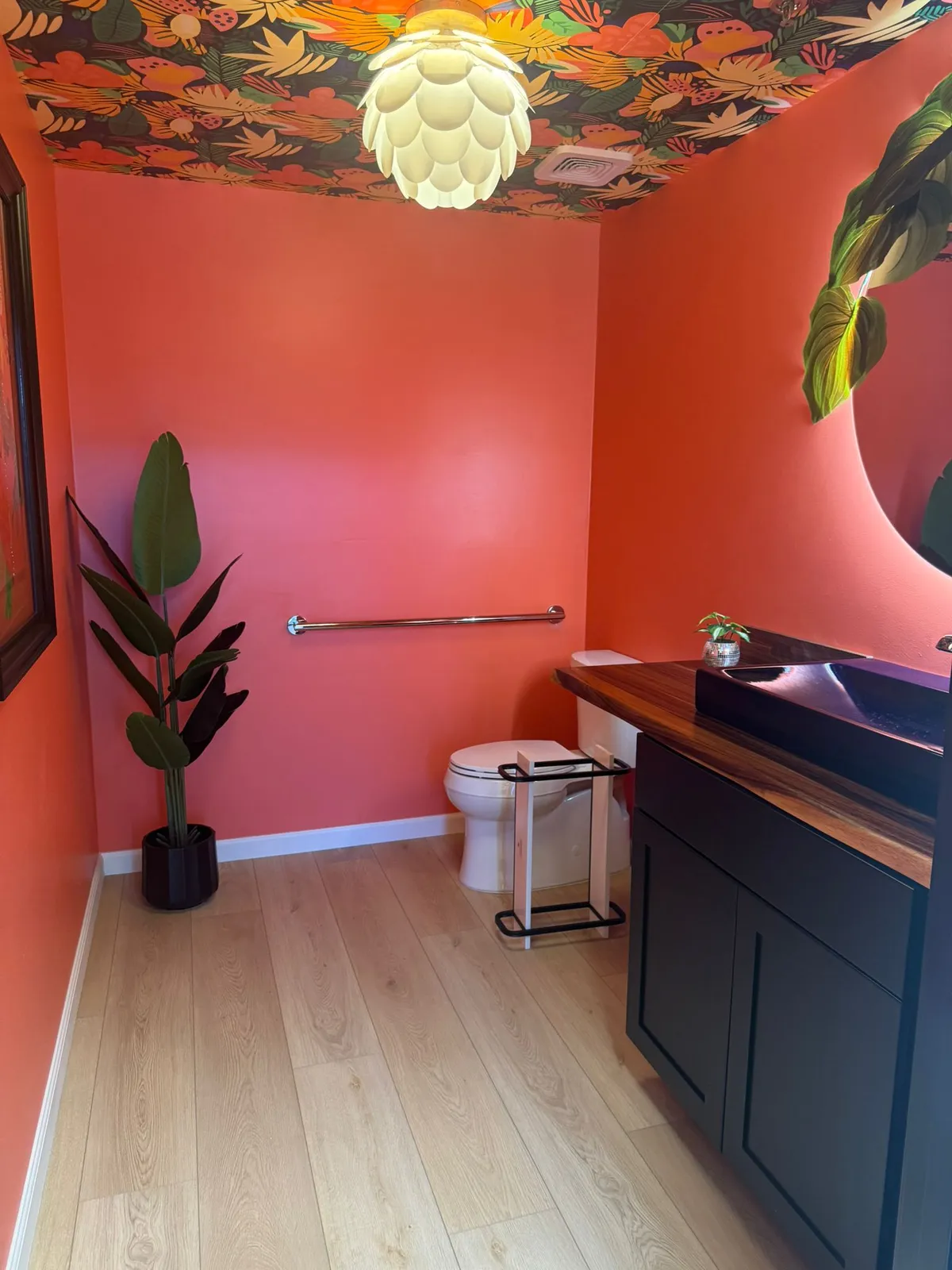
Light plank flooring in a half bath at a Phoenix clinic, an RDC install.
Which Rooms Should Get LVP in a Whole-House Plan?
The rooms that should get LVP in a whole-house plan are the dry, air-conditioned ones: living and dining areas, halls, bedrooms and the kitchen. The bathrooms, an enclosed patio room and the stairs come next, each with its own check. Here is how RDC looks at each one.
- Living, dining and halls. These are the core of the plan. In a long open area, the plank's span rule decides whether a break is needed.
- Kitchen. RDC replaces a kitchen floor without removing the cabinets, so the plank runs up to the cabinet bases. MSI's warranty excludes cabinets or islands set on top of a floating floor.
- Bedrooms. Plank or carpet is a separate choice, covered on carpet installation in Phoenix.
- Bathrooms and laundry. Check the plank's wet-area rules first, as above.
- Enclosed patio room or sunroom. MSI excludes sunrooms and three-season rooms unless expressly allowed. Shaw's floating Floorte allows three-season spaces between 32°F and 100°F.
- Stairs. LVP stairs at RDC run $100 to $185 per step, including removal of the old carpet, installation and the stair nose.
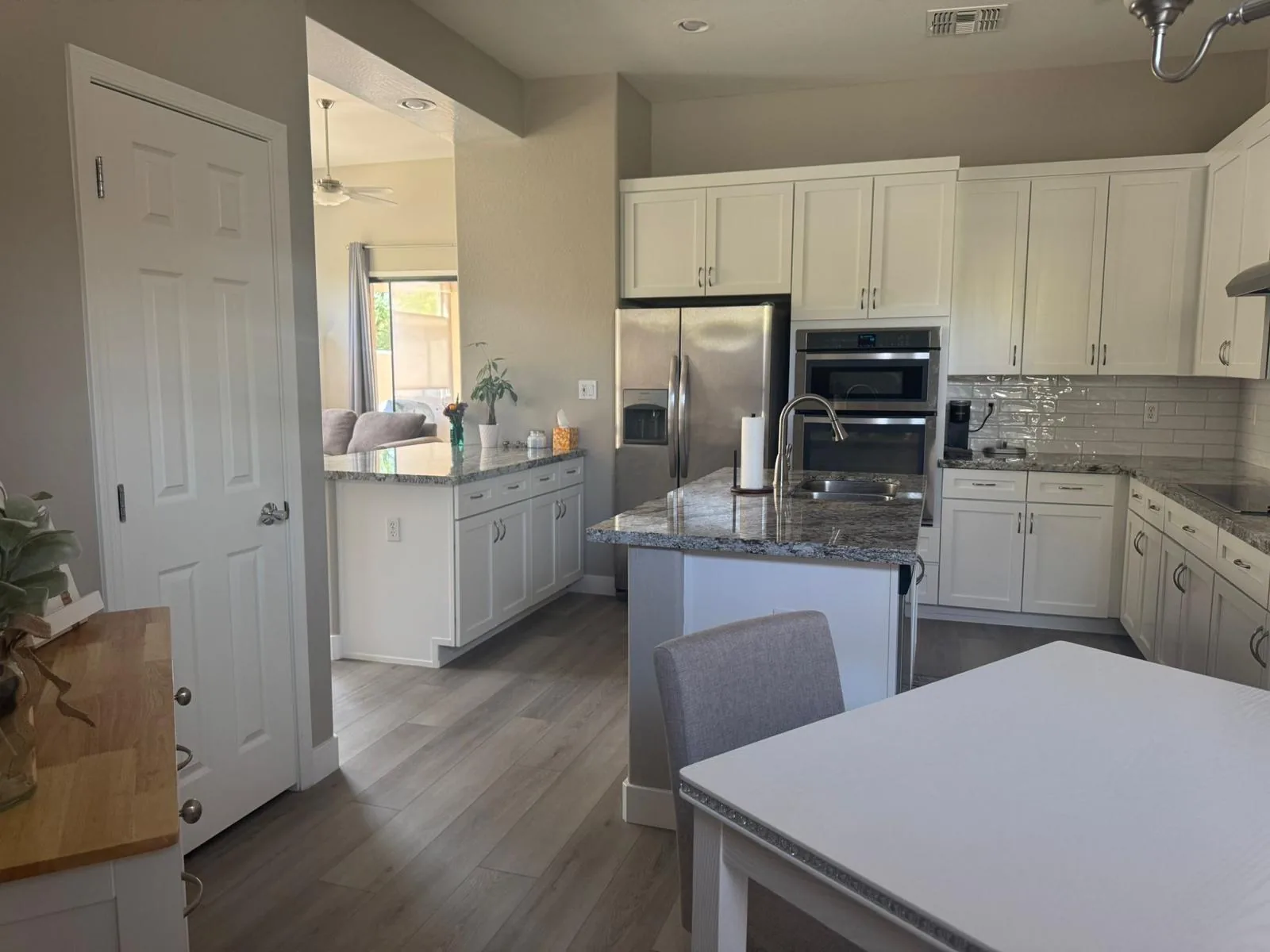
The kitchen of a whole-home tile-to-LVP job in Mesa, with the plank running to the cabinet bases.
What Are the Downsides of Whole-House LVP in Arizona?
The downsides of whole-house LVP in Arizona come from heat, sun and the slab. Mohawk widens the wall gap from 1/4 inch to 5/8 inch where temperatures pass 85°F. Shaw warns that direct sun can cause thermal expansion and UV fading, and MSI recommends blinds or drapes during peak hours.
- Slab flatness. Mohawk's SolidTech guide requires leveling where the slab is uneven by more than 3/16 inch in a 10-foot radius. It warns that subfloor flaws may translate through the planks.
- Slab moisture. Mohawk asks for concrete below 90% relative humidity, tested to ASTM F2170. RDC checks the slab before the plank goes down; see slab moisture testing and floor leveling in Phoenix.
- A house closed for summer. MSI's rigid core must stay between 65°F and 85°F for the life of the floor. Its vacation-home rule allows 40°F to 95°F after installation.
- One choice for every room. A plank picked for the living room also sets the look of the bedrooms and halls.
Does LVP devalue a home? Nothing in the published resale data says so, as the guide on whether new flooring increases home value in Arizona explains. Is LVP used in high-end homes? That depends on the tier, and RDC's premium rigid-core plank runs $6 to $9 per square foot installed.
How Much Does Whole-House LVP Cost at RDC?
Whole-house LVP at RDC costs $4 to $9 per square foot installed, so 1,600 sq ft of plank runs $6,400 to $14,400. Removing the old carpet or tile is another $3 to $5 per square foot. Where the slab is uneven, leveling runs $1 to $4 per square foot.
Worked example, a 1,600 sq ft one-level house with the old floor removed (RDC published prices):
- LVP: 1,600 × $4 = $6,400 to 1,600 × $9 = $14,400
- Removal of the old floor: 1,600 × $3 = $4,800 to 1,600 × $5 = $8,000
- LVP with removal: $6,400 + $4,800 = $11,200 to $14,400 + $8,000 = $22,400
- If the whole slab needs leveling: 1,600 × $1 = $1,600 to 1,600 × $4 = $6,400, for $12,800 to $28,800 before stairs and baseboards
- If two bathrooms (150 sq ft together) keep their tile, the plank covers 1,450 sq ft: $5,800 to $13,050, or $10,150 to $20,300 with removal
Totals for other home sizes are in the Phoenix flooring installation cost report. The standard and premium tiers are broken down on how much LVP flooring costs in Arizona.
What changes the price of a whole-house plank floor:
- The plank tier. Standard plank runs $4 to $6 and premium rigid-core $6 to $9 per square foot installed.
- The floor coming out. Removal is $3 to $5 per square foot, and taking out old tile adds 1 to 4 days. See tile removal and replacement in Phoenix.
- The slab. Leveling adds $1 to $4 per square foot, only where it is needed.
- Stairs and baseboards. Stairs run $100 to $185 per step, and baseboards run $4 to $6 per linear foot installed.
- Moving and toilets. Moving furniture and pulling and resetting toilets are priced on the estimate, depending on the size of the job.
Please note: these are typical ranges and can vary. Final pricing is set individually for each customer based on their specific project, after a free measure and a written estimate.
Whole-House LVP Across Arizona
Across Arizona, 64% of homes are detached single-family houses, per the U.S. Census Bureau's American Community Survey 2020-2024 (table B25024). In a detached house, the whole-house decision is yours, room by room. What the state adds is heat, and every install guide above names a temperature.
An Arizona house left closed in summer needs one extra check. Read the maker's temperature range before the plank goes in, and keep the air conditioning set inside it.
Should You Put LVP in Your Whole House in Phoenix?
In Phoenix, LVP through the whole house works on a tested, level slab, with the wider wall gap in rooms that pass 85°F. The median Phoenix home was built in 1985, per the American Community Survey 2020-2024. A house that age may still have an older mix of carpet and tile to take out.
In one Phoenix home, RDC replaced both the carpet and the Saltillo tile with LVP. About 60% of Phoenix homes are detached single-family houses, per the same survey, and 37% are attached or in buildings of two or more units.
- West and south glass. Rooms with west and south windows take the afternoon sun. They are where the wider wall gap and window coverings matter most.
- The slab first. A moisture test and leveling where needed come before one plank covers the house.
- Shared floors. In a condo or townhome, check your HOA documents before choosing the plank and underlayment.
Most RDC flooring installations take 1 to 3 days; the size of the house and the material decide where a job lands. RDC is fully insured, and each installation comes with its 1-year workmanship warranty. Call or text (602) 788-1446 to book the free in-home measure.
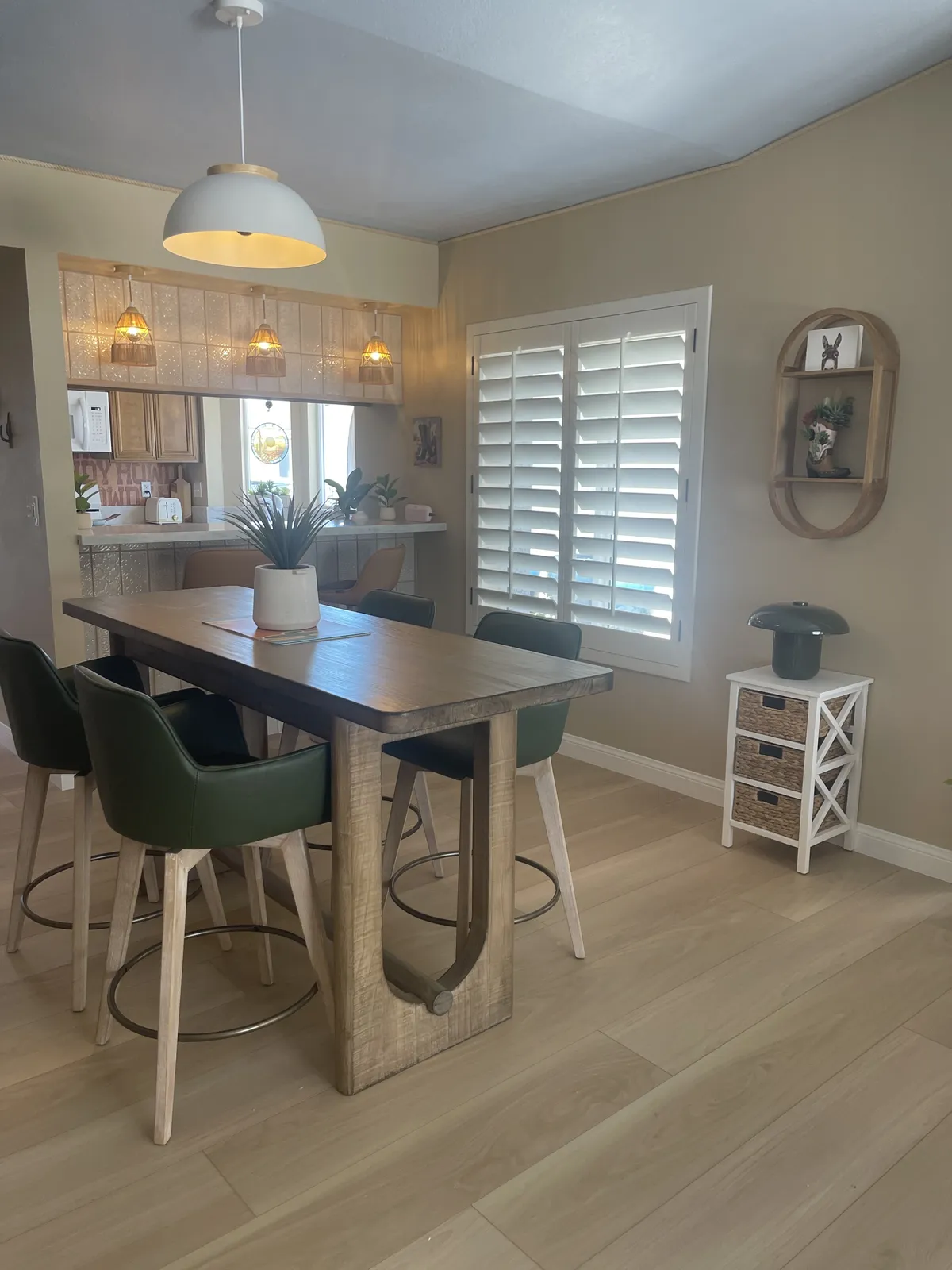
White oak LVP running from the dining area toward the kitchen in a Phoenix home.
Comparing Whole-House Planks at the North Phoenix Showroom
The Bell Rd showroom, Suite 101 in North Phoenix, sets out full-size planks and tiles across roughly 1,200 sq ft. For a whole-house choice that matters, because standard and premium plank lie next to each other under one light. Free samples go home with you.
No appointment is needed Sunday through Friday, 10 AM to 5 PM; on Saturday the showroom is closed. You can get a same-day estimate there, then the exact written quote once RDC measures your home. Or text room photos to (602) 788-1446 for a preliminary number, answered within 2 hours during business hours. See the flooring showroom and store in Phoenix.
Whole-House LVP in Scottsdale, Paradise Valley, Mesa and Peoria
Whole-house LVP is priced from one Valley-wide list, so these four cities pay what Phoenix pays. What differs is the housing: how old it is and how much of it shares walls. Figures below are from the U.S. Census Bureau, ACS 2020-2024.
- Scottsdale. 12% of homes are attached single-family and 35% are in buildings of two or more units. In attached homes, RDC recommends acoustic underlayment even where the HOA does not require it. RDC's Scottsdale work includes a white-oak-look LVP living room. See flooring contractor in Scottsdale.
- Paradise Valley. 96% of homes are detached single-family, with a median year built of 1985. In an open room longer than 40 feet, an MSI rigid-core plank would need a break, while a plank without a span limit would not. See Paradise Valley flooring, tile and stone.
- Mesa. Median home built 1989. In one Mesa home, RDC took out the tile and ran gray LVP through the kitchen, the hallway, a bedroom and the living room. See flooring contractor in Mesa.
- Peoria. Median home built 1999, and 74% of homes are detached. In Peoria, RDC has taken out old tile and installed LVP. See flooring contractor in Peoria.
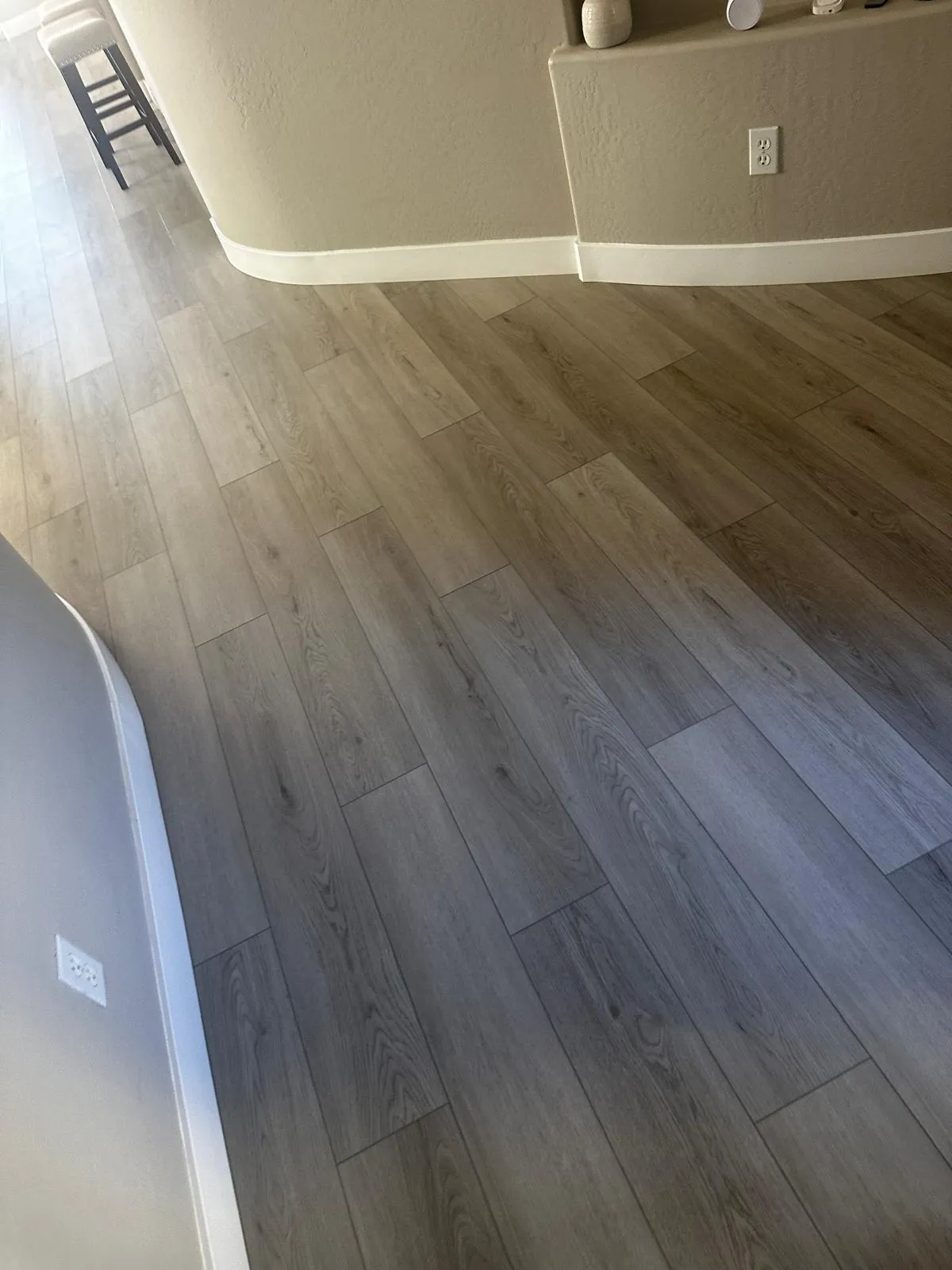
The same Mesa home: the plank runs on past the kitchen counter.
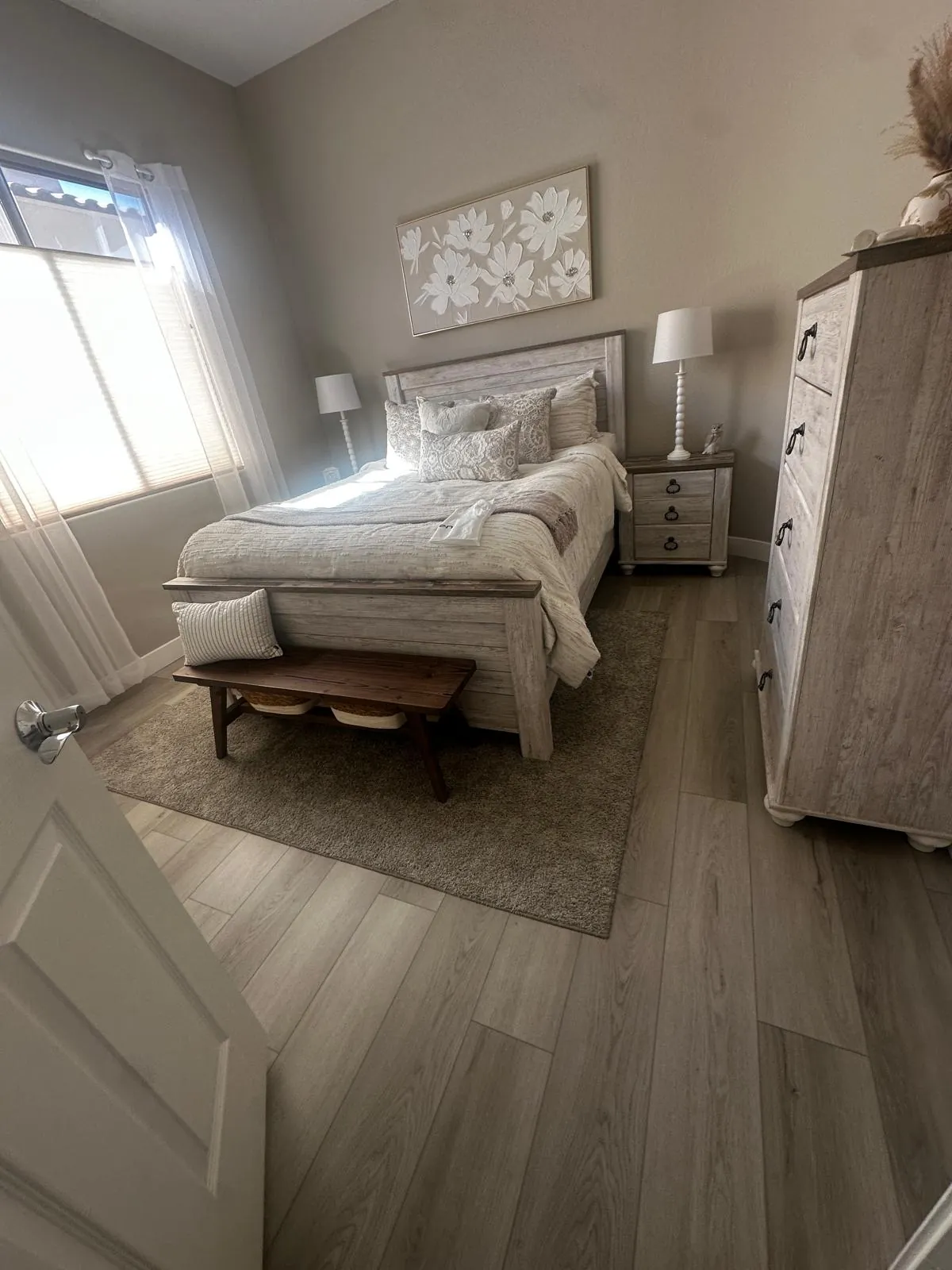
The same plank carried on into a bedroom.
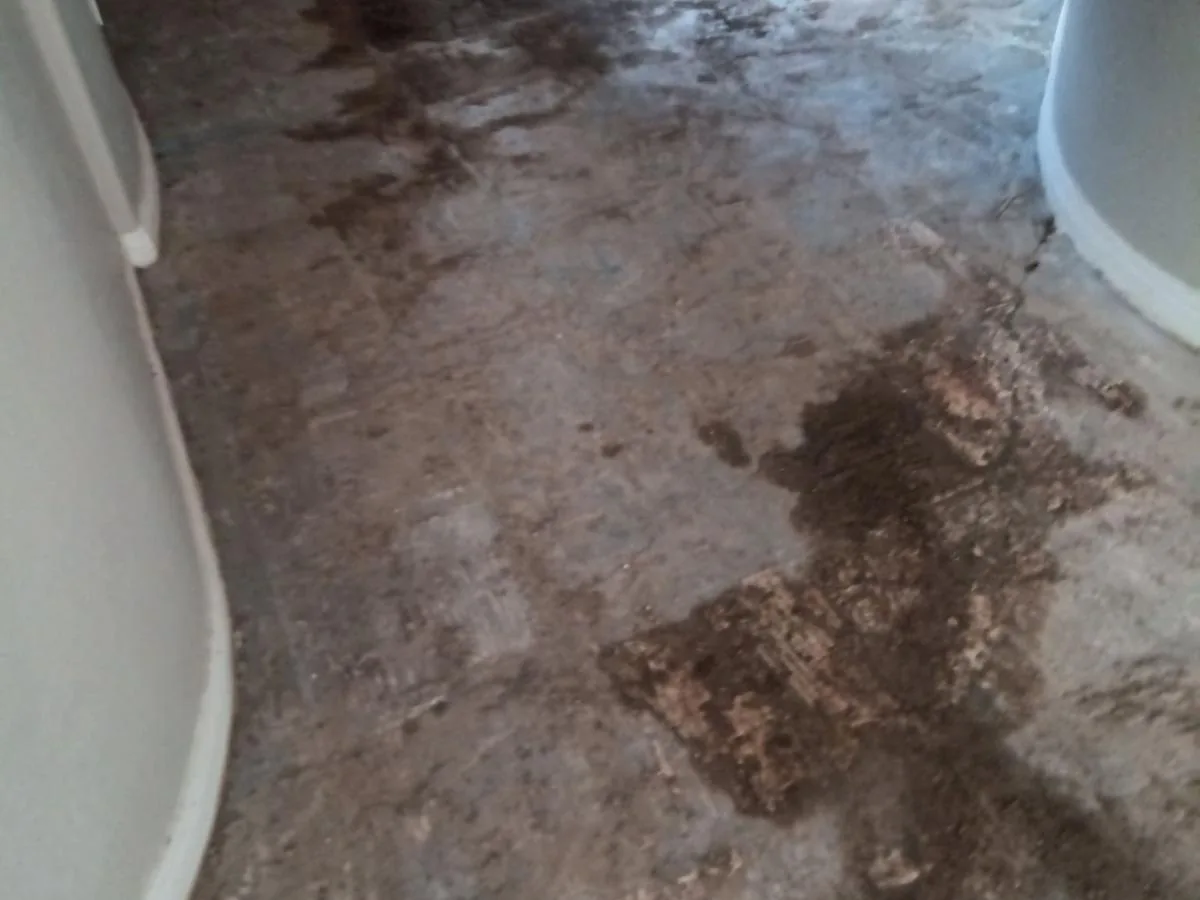
During the Mesa job: the old tile removed down to the slab, before the plank.
Across the rest of the Valley: the same prices and install rules apply. The Gilbert flooring page sizes a 2,000 sq ft ground floor, and the median Gilbert home dates from 2003. RDC also serves Glendale, Chandler, Arcadia, Cave Creek and Carefree, Fountain Hills and Anthem from the Bell Rd showroom.
Sources
- Mohawk SolidTech Installation Guidelines (Rev. October 2018).
- MSI LVT Installation, Warranty and Care guide.
- Shaw Floorte and Floorte Plus WPC Installation Guidelines (03/18/2021).
- U.S. Census Bureau, American Community Survey 2020-2024 five-year estimates, tables B25024 and B25035.
- City of Phoenix 2025 Water Quality Report.