
Please note: this is general information, not legal advice. Read your association's declaration and rules, and ask the board before you buy flooring.
RDC Renovation & Design Concepts is a flooring contractor in Phoenix, Arizona, that sells and installs flooring, tile and countertops from its Bell Rd showroom. In a condo, one contract covers the plank or tile, the underlayment under it and the installation. Plank options and installation are on the luxury vinyl plank installation in Phoenix page.
Key takeaways
- A 2024 change to A.R.S. 33-1221 limits a condo association's power to prohibit interior changes that may disturb neighbors.
- The owner's side of that rule is paying for reasonably necessary materials that eliminate or minimize the disturbance.
- The statute does not mention flooring by name, so ask the board how it applies before you order.
- The International Building Code sets IIC 50 and STC 50 for floor-ceiling assemblies between dwelling units.
What Does Arizona Law Say About Changing Condo Floors?
The Arizona statute closest to changing condo floors is A.R.S. 33-1221, part of the Condominium Act. Subsection A lets an owner improve the unit, subject to the declaration, if the work does not impair the structure or mechanical systems. Subsection B, added in 2024, limits what an association can prohibit inside a unit.
Subsection B reads, in full (A.R.S. 33-1221):
"In addition to allowed modifications as prescribed by subsection A of this section and notwithstanding the condominium documents, the association shall not prohibit a unit owner from improving or altering the interior of the unit in a manner that may disturb adjacent unit occupants if the unit owner purchases and installs at the unit owner's own expense any reasonably necessary improved materials, accessories or other adjustments that eliminate or minimize the potential disturbance. The association shall not prohibit a unit owner from using any manner of decoration on the interior of the unit."
That text came from HB 2141, which became Laws 2024, Chapter 27. The Governor approved it on March 29, 2024, and the general effective date of the 2024 session was September 14, 2024. The Condominium Act applies to every condominium in Arizona, whatever year it was created (A.R.S. 33-1201).
What the section leaves out matters too. It never names flooring, and it does not define "reasonably necessary." It also does not say who decides which materials are enough, so ask your board how it applies the section to a floor change.
The association keeps real powers. Under A.R.S. 33-1242, it may adopt and amend rules. After notice and a chance to be heard, it may also impose reasonable fines on an owner for breaking the declaration, bylaws or rules. Arizona defines "condominium documents" as the declaration, bylaws, articles of incorporation and rules (A.R.S. 33-1202).
Do You Need HOA Approval to Change Floors in a Condo?
You should get your association's approval in writing before you change floors in a condo. Your declaration and rules may require it, and the board can tell you how it applies them. A written approval also records the underlayment and the sound standard the board accepted.
Ask the board, or the management company, for these four answers in writing:
- The process. Whether a hard floor needs an application or an architectural review, and how long a decision takes.
- The sound standard. The IIC or STC number the rules set, and whether it is a lab rating or a field test.
- The underlayment. Whether the rules name a product, a thickness or a type for under LVP, tile or wood.
- The building rules. Elevator reservations, parking for the installers, allowed work hours and where debris goes.
Have the approval letter in hand before any material is ordered. RDC asks for the association's standard before it quotes, so the estimate lists the underlayment and its rating apart from the plank price. Call or text (602) 788-1446 if you want the estimate ready for your application.
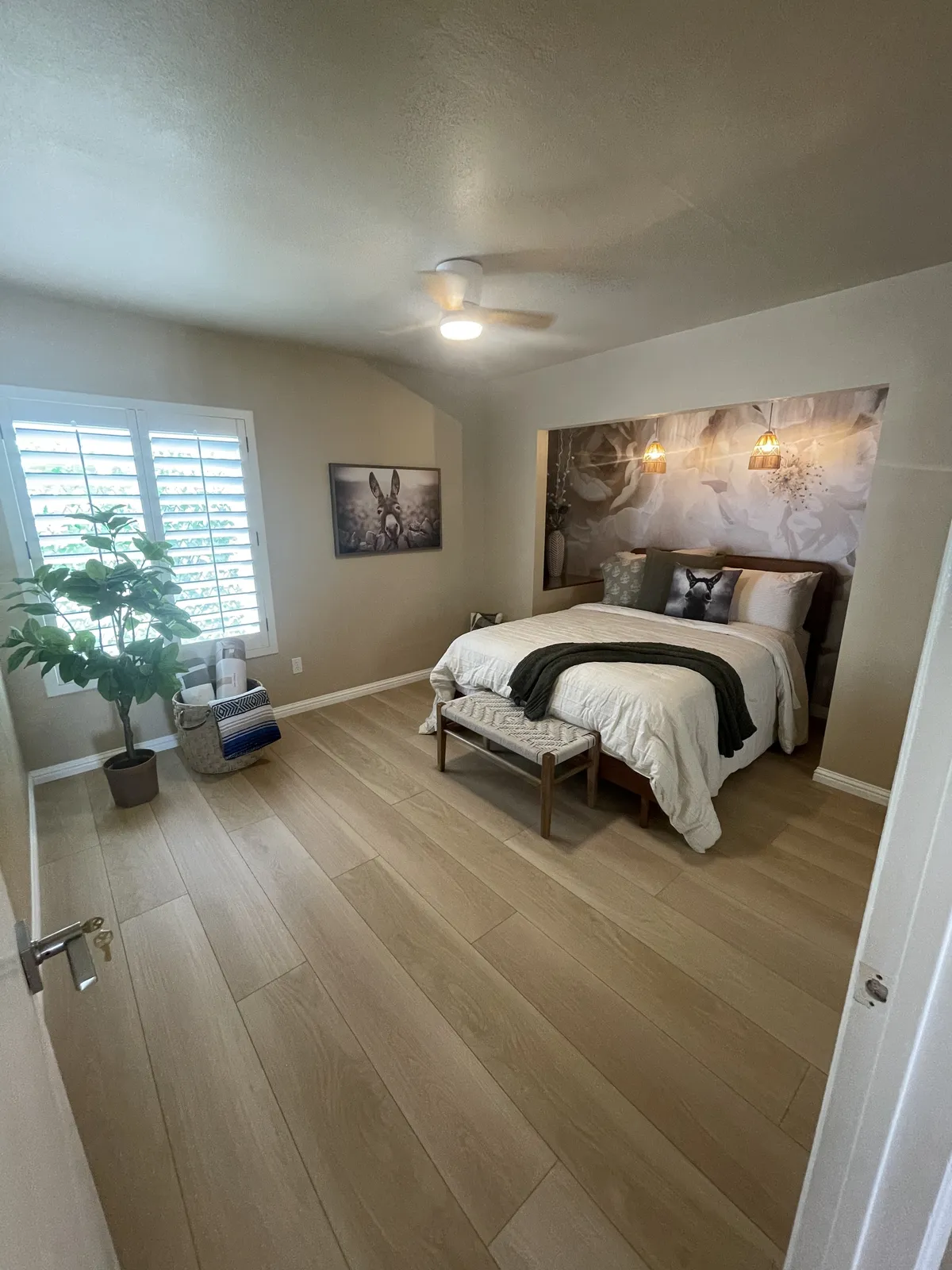
White-oak-look LVP in a Phoenix guest bedroom, installed by RDC.
What IIC and STC Ratings Do Condo Floors Need?
Condo floors are judged by two sound ratings. IIC, the Impact Insulation Class, rates impact sound such as footsteps heard below. STC, the Sound Transmission Class, rates airborne sound such as voices. The International Building Code sets at least 50 for each between dwelling units.
Those code numbers apply to the whole floor-ceiling assembly between units: the slab or framing, the ceiling below and the floor on top. They do not rate a plank or a pad on its own. If your association's rules set a number, ask the board to confirm it in writing; that is the number RDC quotes to.
Product ratings depend on the test setup. Ask for the test report of the exact product, then compare its assembly with your building.
RDC lists the underlayment and its published rating on the written estimate, so the board reviews the same product you buy. Click-lock and glue-down plank are compared on the LVP installation page.
What Type of Flooring Is Best for Condos?
The best flooring for a condo is the one your association approves at the sound standard it sets. LVP, porcelain tile, engineered hardwood and carpet all go into condos. The difference is how each is installed and what goes under it.
Installed prices from RDC Renovation & Design Concepts, Phoenix, AZ (2026). Prices are per square foot, before removal of the old floor, any leveling and any sound underlayment the board requires.
| Floor | Installed at RDC | How it goes down | Ask the board |
|---|---|---|---|
| Standard LVP | $4 to $6 / sq ft | Click-lock over an underlayment, or glue-down | Is an attached pad enough, or is a separate sound underlayment required? |
| Premium rigid-core LVP | $6 to $9 / sq ft | Click-lock, floating over an underlayment | Which IIC and STC numbers does the rule set? |
| Porcelain tile | $9 to $18 / sq ft | Set in thinset on the subfloor | Is a sound layer required under tile, and which one? |
| Large-format porcelain (24x48 in. and up) | $12 to $22 / sq ft | Thinset over a very flat subfloor | The same sound question, plus any limit on leveling work |
| Engineered hardwood | $8 to $16 / sq ft | Floated or glued | Does the rule treat wood like other hard floors? |
| Carpet (with pad) | $3 to $7 / sq ft | Stretched over a pad | Does the rule list carpet as the baseline? |
Please note: these ranges are typical, not a quote. Each customer's final price is set for the specific condo and scope, once RDC has measured and written the estimate.
For tile formats and prices, see tile installation in Phoenix. Plank tiers and totals are on how much LVP flooring costs in Arizona. Still choosing a plank type? See LVP vs. laminate vs. LVT in Phoenix.
Is a Ground-Floor Condo Different From an Upper-Floor Unit?
A ground-floor condo on a concrete slab has no unit below it, so there is no ceiling under it to protect from footsteps. An upper-floor unit sits over a neighbor's ceiling. Ask whether your association's rule treats the two floors differently before you choose a material.
On a ground-floor slab, the slab itself is the risk to the new floor. RDC tests the slab for moisture to ASTM F2170 before any vinyl goes down, then levels the low spots. Most LVP makers want the subfloor within 3/16 inch of flat over 10 feet. The steps are in slab moisture testing and floor leveling in Phoenix.
On an upper floor, the subfloor can be concrete or wood framing, depending on how the building was built. The underlayment and any leveling have to fit the assembly the board's sound rule assumes.
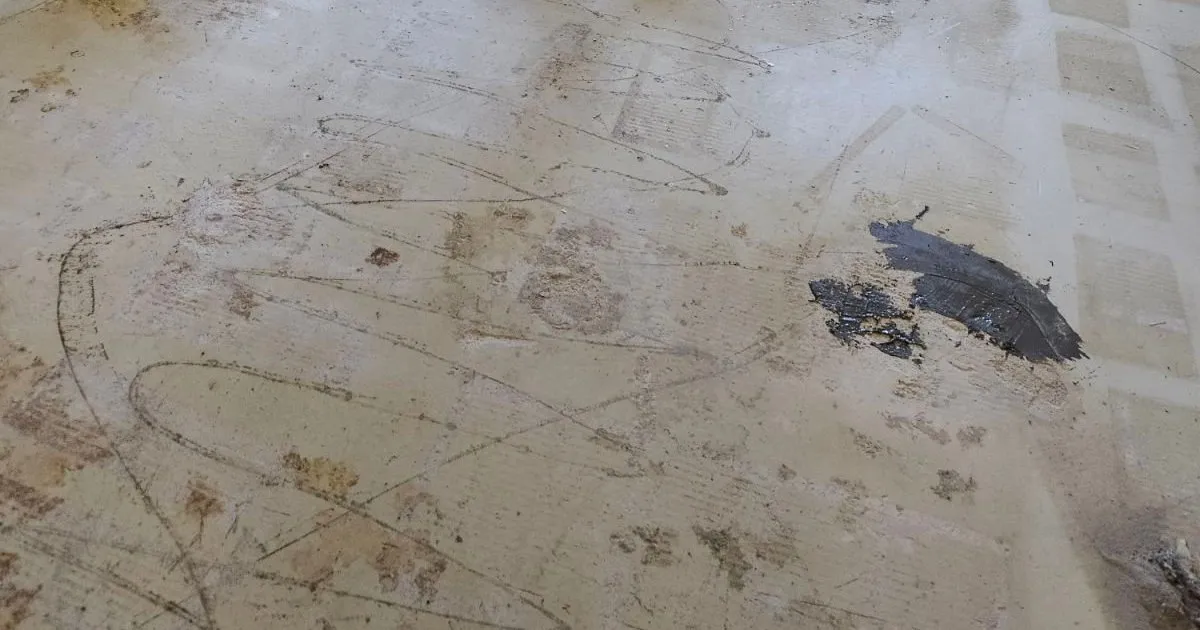
Low spots in a slab patched after RDC took up the old tile, before the new floor.
How Does RDC Install LVP or Tile in a Condo?
RDC installs LVP or tile in a condo in the same order every time: approval and measurements first, material second, installation last. LVP usually takes RDC 1 to 3 days, and about 1,200 sq ft of tile takes one to two weeks. If old tile has to come up first, add 1 to 4 days.
- Read your documents. Find the flooring and alteration sections in your declaration and rules.
- Free in-home measure. RDC measures every room at your condo and checks the subfloor.
- Written, itemized estimate. It names the plank or tile, the underlayment and its rating.
- Board approval. The approval letter comes back before any material is ordered.
- Building logistics. Confirm the elevator booking, parking and work hours with the manager before the start date.
- Installation. The old floor comes out, the subfloor is prepared, and the new floor goes in.
- Records. Progress photos document the job, and the 1-year workmanship warranty covers the installation.
Old tile in the unit? RDC takes tile out only when it is installing the new floor; the process is on tile removal and replacement in Phoenix.
What Changes the Price of a Condo Floor?
A condo floor's price depends on the material, the floor coming out, the subfloor and the sound layer the board requires. At RDC the removal, the slab prep and the installation each get their own estimate line. You see the full price before work starts.
- Removal of the old floor: $3 to $5 per square foot, only together with a new installation.
- Leveling: $1 to $4 per square foot, only where the subfloor needs it.
- The required underlayment: the product the board accepts is named on the written estimate as its own line.
- Pattern: herringbone or diagonal tile adds 10% to 20% to labor.
- Baseboards: $4 to $6 per linear foot installed, a separate line on the estimate.
- Furniture: moving furniture is priced on the estimate, depending on the size of the job.
What a 900 Sq Ft Condo Floor Costs at RDC
At RDC, new LVP across 900 sq ft of condo floor costs $3,600 to $8,100 installed. Taking out the old floor adds $2,700 to $4,500, for $6,300 to $12,600 in total. Porcelain tile over the same area costs $8,100 to $16,200 before removal.
Worked example, 900 sq ft, old floor removed (RDC published prices):
- LVP: 900 × $4 = $3,600 to 900 × $9 = $8,100
- Removal of the old floor: 900 × $3 = $2,700 to 900 × $5 = $4,500
- LVP with removal: $3,600 + $2,700 = $6,300 to $8,100 + $4,500 = $12,600
- Porcelain with removal: 900 × $9 = $8,100 to 900 × $18 = $16,200, plus removal, for $10,800 to $20,700
- If the whole subfloor needs leveling: 900 × $1 = $900 to 900 × $4 = $3,600 more
These totals use RDC's published installed ranges. If the board requires a specific sound underlayment, the written estimate shows what it adds. Totals for larger homes are in the Phoenix flooring installation cost report.
Please note: the example is arithmetic on published ranges. Your price is set for your own condo after a free in-home measure.
Condo Flooring Rules Across Arizona
The state limit in A.R.S. 33-1221 is the same across Arizona, while each association's declaration and rules still differ. Another difference is how many homes sit in shared buildings. Statewide, 21.0% of housing units are in buildings with two or more units, per the U.S. Census Bureau's American Community Survey 2020-2024.
That count, from table B25024, covers condos and apartments together, so it is a measure of shared buildings, not of ownership. Each building's declaration and rules still decide the details.
Can You Put LVP or Tile in a Phoenix Condo?
Yes, a Phoenix condo can take LVP or tile once the association approves the floor and its underlayment. About one Phoenix home in three is in a shared building. Of the city's housing units, 32.5% are in buildings with two or more units, and 26.4% in buildings with five or more (ACS 2020-2024).
The building code side is local too. On June 18, 2025, the Phoenix City Council adopted the 2024 Phoenix Building Construction Code. It took effect August 1, 2025, and is built on the 2024 International Building Code. The city's IBC amendments change nothing in its sound-transmission section.
In Phoenix, RDC has installed white-oak-look LVP in a guest bedroom and replaced carpet and Saltillo with LVP in another home. The same written estimate and 1-year workmanship warranty apply in a condo. Start with flooring installation in Phoenix, or call or text (602) 788-1446 to book the measure.
Choosing a Condo Floor at the North Phoenix Showroom
With the board's sound number in hand, compare floors at RDC's North Phoenix showroom, 1610 E Bell Rd, Suite 101. The roughly 1,200 sq ft room shows planks and tiles at full size. Take samples home free to see them in your unit's light. Hours are Sunday to Friday, 10 AM to 5 PM, closed Saturday, and no appointment is needed.
You can leave the showroom with a same-day estimate; the final written quote comes after RDC measures your condo. Prefer to start by phone? Text room photos to (602) 788-1446 for a preliminary number, and expect a reply within 2 hours during business hours. More on the space: the flooring showroom and store in Phoenix.
Condo Floors in Scottsdale, Paradise Valley, Mesa and Peoria
RDC uses the same prices across the Valley, and the same state law applies in every city. What changes is how many homes share walls and floors. The shares below are housing units in buildings with two or more units (ACS 2020-2024, table B25024).
- Scottsdale. 34.9% of housing units are in buildings with two or more units, more than in Phoenix. The Scottsdale hub answers the city version of this question: hard flooring in a Scottsdale condo or townhome.
- Paradise Valley. 96.0% of homes are detached single-family houses. Only 1.7% are in buildings with two or more units, so few homes there share a floor with a neighbor. See Paradise Valley flooring, tile and stone.
- Mesa. 25.7% of housing units are in buildings with two or more units. RDC has replaced tile with gray wood-look LVP in a Mesa home. See flooring contractor in Mesa.
- Peoria. 15.4% of housing units are in buildings with two or more units, fewer than in Phoenix, Scottsdale or Mesa. There, RDC has replaced old tile with LVP. See flooring contractor in Peoria.
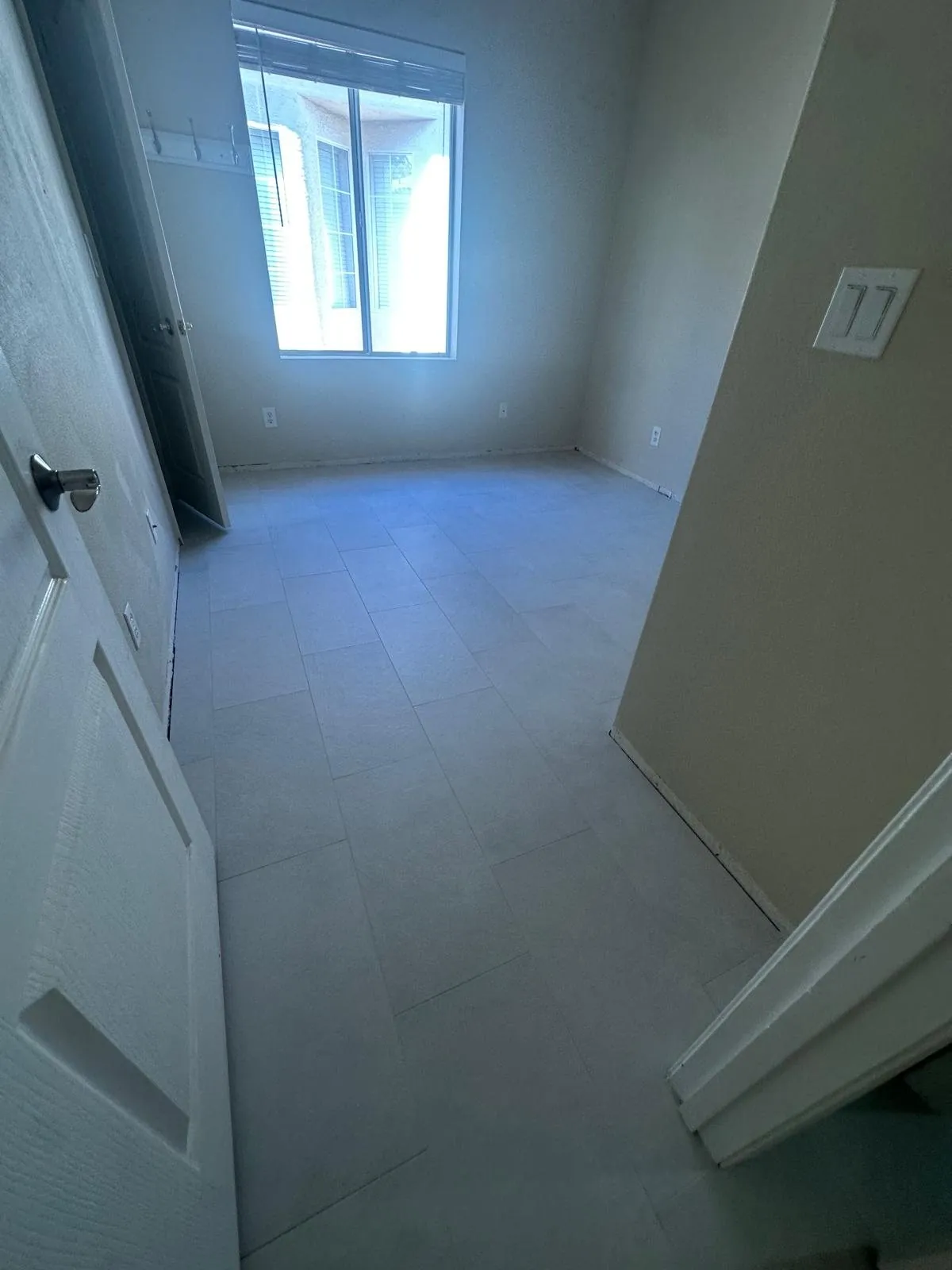
Light gray tile through a Scottsdale bedroom, an RDC install.
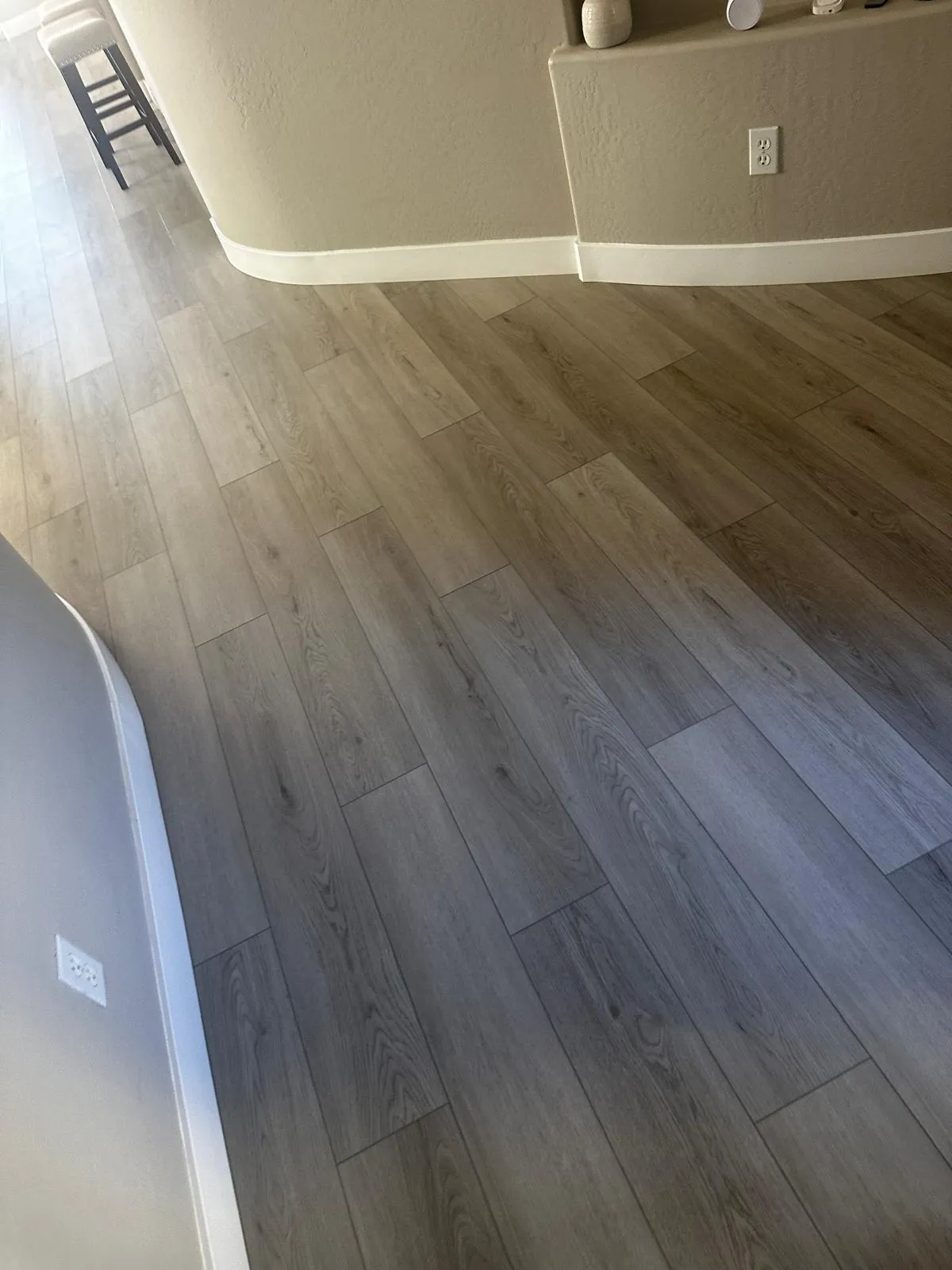
Gray wood-look LVP in a Mesa home, installed by RDC.
Across the rest of the Valley: in Tempe, 49.5% of housing units are in buildings with two or more units. That is the highest share of the cities on this page. The same steps apply in Glendale, Chandler, Gilbert and Fountain Hills.
Sources (general information, not legal advice):
- Arizona Revised Statutes 33-1221, 33-1242, 33-1202 and 33-1201; Laws 2024, Chapter 27 (HB 2141); Arizona Legislature, general effective dates.
- City of Phoenix, Building Construction Code and 2024 IBC amendments.
- U.S. Census Bureau, American Community Survey 2020-2024 five-year estimates, table B25024, Units in Structure.
- International Building Code, sound transmission requirements between dwelling units (STC and IIC 50).