
RDC Renovation & Design Concepts is a flooring contractor in Phoenix, Arizona, that sells and installs flooring, tile and countertops from its Bell Rd showroom. RDC publishes its installed prices, so the cost side of the resale math is a known number.
Key takeaways
- In NAR's 2022 Remodeling Impact Report, new wood flooring had a national cost-recovery estimate above 100%.
- NAR's 2025 edition gives new wood flooring a Joy Score of 9.1 out of 10 but publishes no flooring cost-recovery figure.
- Appraisers rate floors by condition and quality grade, not by material name.
- A worn floor is what appraisal guidance marks down, so the floor being replaced matters more than the new material.
What "cost recovery" means: cost recovery is what NAR calls the Recovered Project Cost. It is the dollar value Realtors estimate a project adds at resale, divided by the cost remodelers estimate for it. A figure above 100% means Realtors expect the sale price to rise by more than the job costs. It is a survey of professional opinion, not an appraisal or a measured sale price.
Does New Flooring Increase Home Value?
New flooring increases home value most clearly when it replaces a worn or dated floor. In NAR's 2022 Remodeling Impact Report, Realtors put the value new wood flooring adds at $6,500. Remodelers estimated the job at $5,500, so an estimated 118% of the cost comes back.
Those are national medians for a hypothetical 2,495 sq ft house, built after 1981 with no hidden problems. The report says recovery depends on design, materials, location, and the age and condition of the home.
NAR's newest edition, the 2025 Remodeling Impact Report, did not repeat a flooring cost-recovery figure. Its top 12 projects run from a new steel front door at 100% to a bathroom renovation at 50%, with no floor among them. It did score how owners felt afterwards. New wood flooring earned a Joy Score of 9.1, against a typical 8.2 across projects.
So the data supports a careful yes, but no study promises a fixed return, and RDC does not either. What RDC can give you is the exact price of the new floor, the other half of the math. Start with flooring installation in Phoenix.
What Flooring Adds the Most Value to a Home?
Wood flooring adds the most value to a home on the published data. It is the only floor type with a national resale figure, the NAR estimate above. In NAHB's 2024 survey of more than 3,000 home buyers, 81% rated hardwood on the main level essential or desirable.
Zillow adds a listing-language signal. It analyzed more than 2 million homes listed in 2024 (March 2025 release). Listings that mentioned white oak floors sold 3.2% above Zillow's pre-listing estimate, and herringbone floors 2.6%. Zillow says the analysis did not examine the return on installing a feature for resale, so read it as a taste signal.
In an Arizona house the wood question has a climate answer. The NWFA installation guidelines ask for indoor conditions of 60 to 80°F and 30 to 50% relative humidity, year-round. On slab homes RDC recommends engineered hardwood, with its cross-layered core, over solid wood. More on both: hardwood floor installers in Phoenix.
The floor that adds the most value to your house is the one that suits its price point and how it is lived in. A home with big dogs and a pool may be better served by porcelain or rigid-core plank that still looks new at the showing. The best flooring for Arizona heat guide compares how each one holds up.
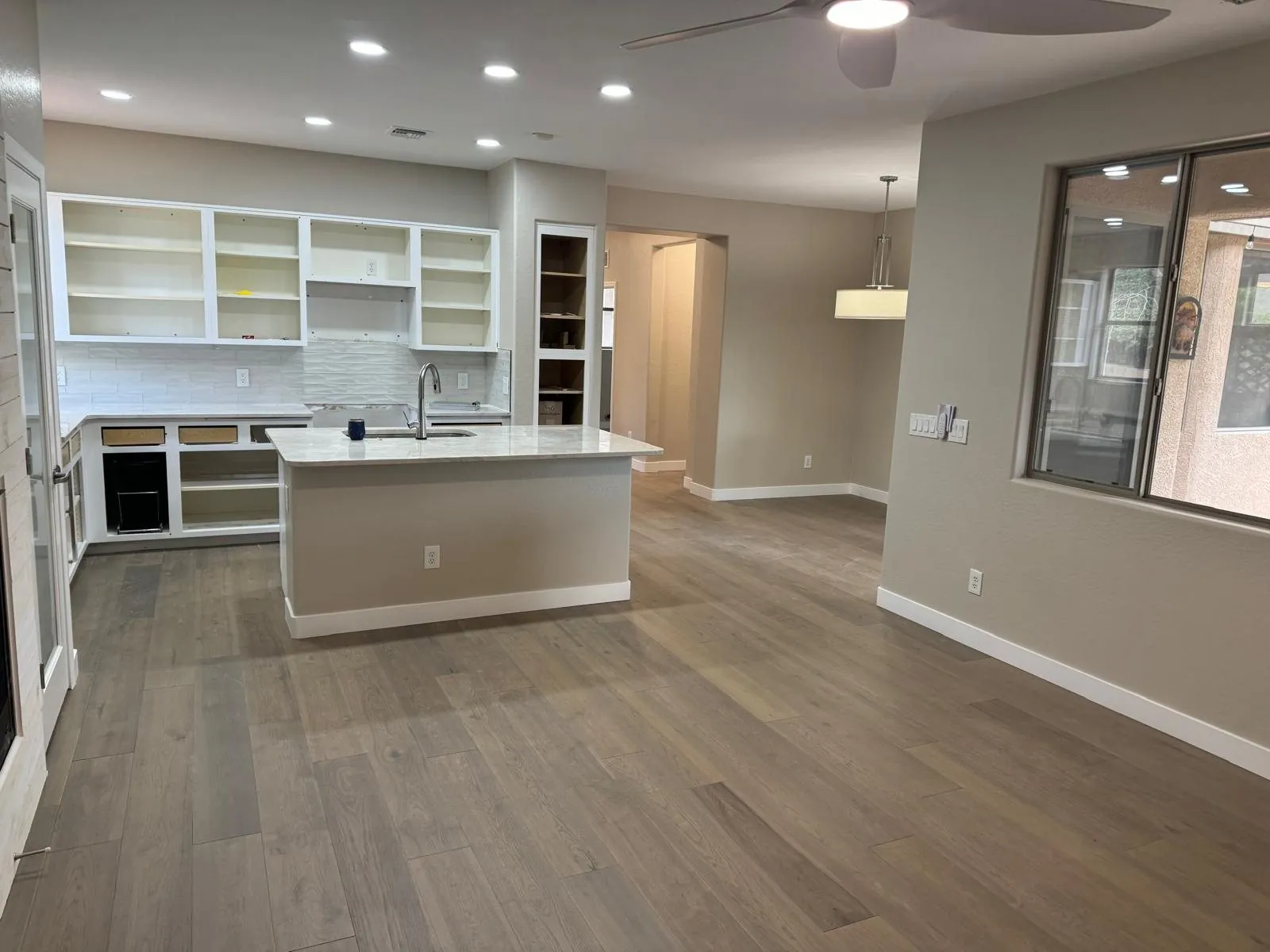
Engineered hardwood through an open kitchen and living area, an RDC job in Glendale.
Does LVP Flooring Increase Home Value?
LVP flooring increases home value through condition, not through a published percentage. What a new plank changes is how the house rates on condition. At RDC in Phoenix, standard plank runs $4 to $6 and premium rigid-core $6 to $9 per square foot installed.
The condition ratings that Fannie Mae and Freddie Mac publish for appraisers (UAD definitions, April 2025) are specific. They name "new / newer floor coverings" among the updates of a C3 home. They name "worn floor finishes or carpet that shows age" among the signs of a C4 home.
That also answers whether replacing carpet with vinyl plank increases home value. What changes is that worn carpet, the item an appraiser and a buyer would mark down, is gone.
In Arizona the installation decides how long the plank keeps looking new. Mohawk's SolidTech instructions widen the wall gap from 1/4 inch to 5/8 inch where temperatures pass 85°F. More on the product and the process: luxury vinyl plank installation in Phoenix. Tier totals are on how much LVP flooring costs in Arizona, and the head-to-head is LVP vs. tile for Phoenix homes.
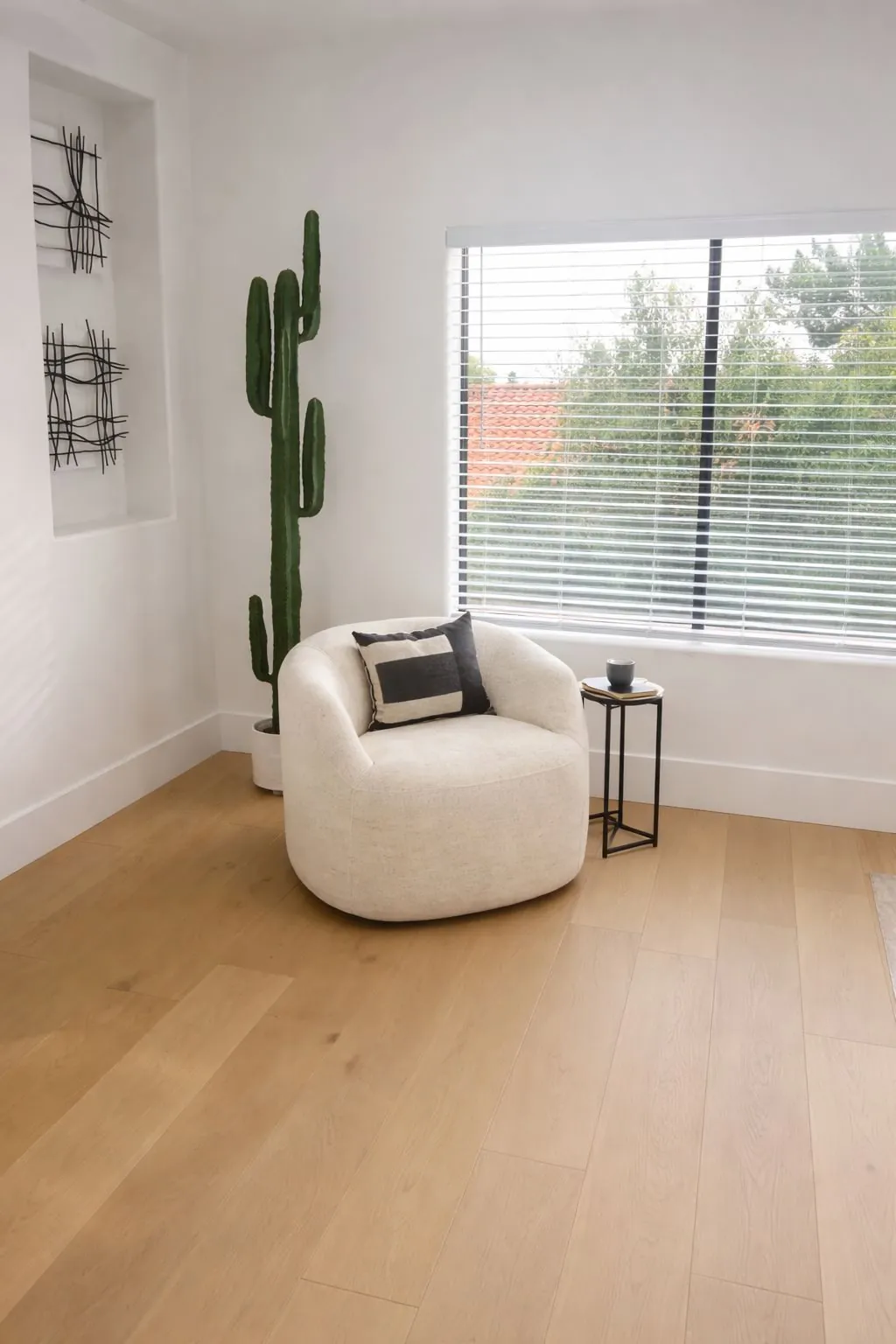
White-oak-look LVP through a Scottsdale living room, installed by RDC.
Does Tile Flooring Increase Home Value?
Tile flooring's value comes from condition and durability, the same way LVP's does. The Tile Council of North America defines porcelain as impervious, with water absorption of 0.5% or less. At RDC in Phoenix, porcelain tile runs $9 to $18 per square foot installed, and large-format tile $12 to $22.
A tile floor can date a house through a small format, a color from another decade, or grout lines stained gray. Phoenix water is hard: 10 to 17.6 grains per gallon in the City of Phoenix 2025 Water Quality Report. RDC chooses the grout for each area, cement-based, sealed or epoxy, with the hard water in mind.
Large-format porcelain (24x48 inches and up) gives fewer grout lines, but large tiles need a very flat slab. Leveling is then more likely to appear on the estimate. In Phoenix, RDC has taken out an old tile floor and replaced it with new porcelain. Formats and prices are on tile installation in Phoenix.
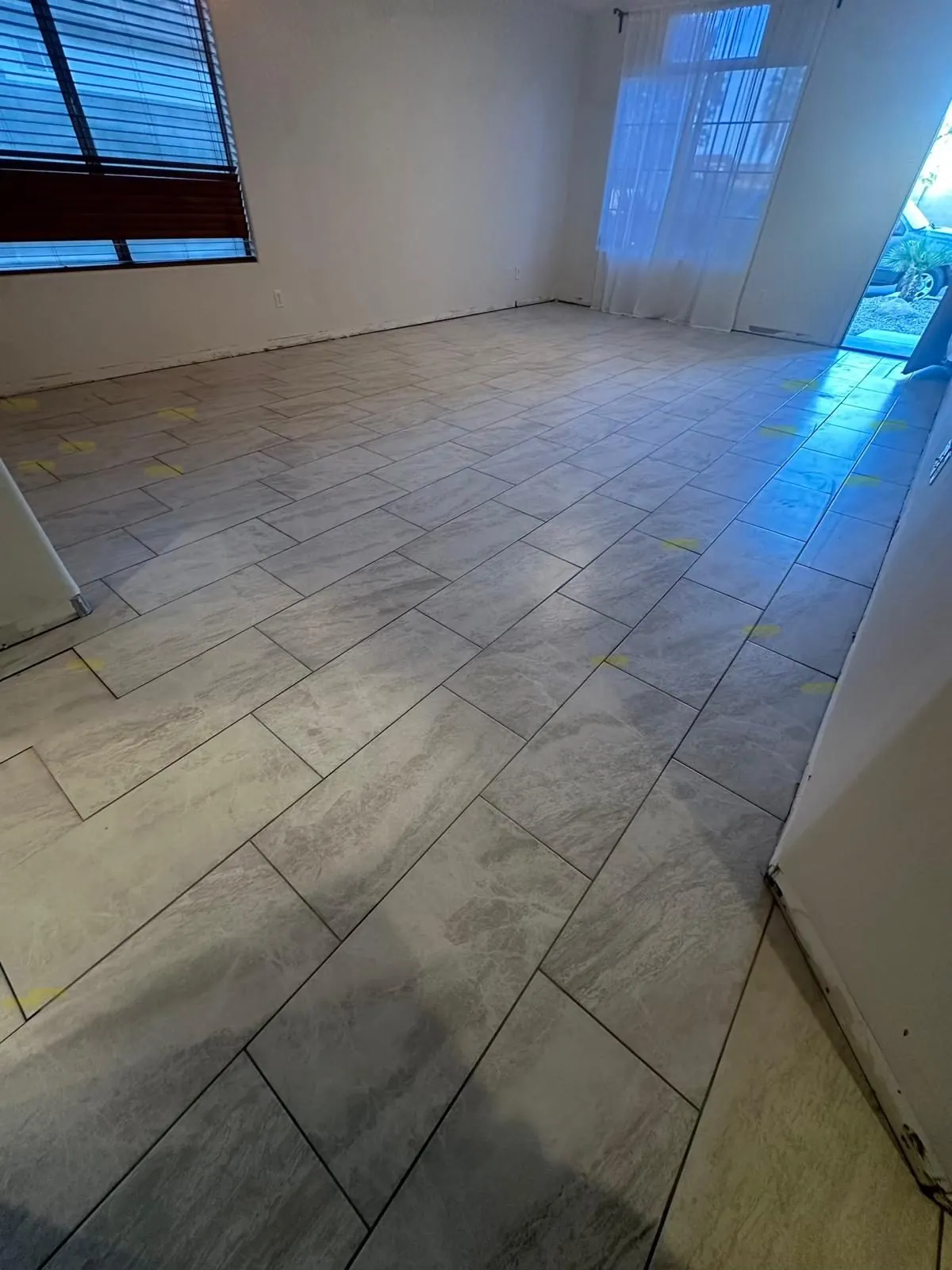
12x24 porcelain tile in a Phoenix living room, set by RDC.
Should You Replace Flooring Before Selling a House?
You should replace flooring before selling a house when the current floor is worn, damaged or mismatched from room to room. Buyers and appraisers both notice condition. In NAR's 2025 report, Realtors said 46% of buyers are less willing to compromise on a home's condition. RDC's free in-home estimate gives you the exact cost before you decide.
Realtors do not put floors at the top of their pre-sale advice. In NAR's 2022 report, 13% recommended new wood flooring before selling, and 22% recommended refinishing an existing wood floor. In the 2025 edition, painting led: the whole home (50%) and one room (41%). New roofing (37%), a kitchen upgrade (30%) and a bathroom renovation (24%) followed.
Zillow's February 2025 analysis found that remodeled homes sold for 3.7% more than expected. Neither that figure nor NAR's 46% isolates flooring, so treat both as context. The practical point is visibility: the floor runs through nearly every listing photo and every room of a showing.
Signs it is likely worth doing:
- Carpet in the main living areas that is stained, matted or clearly old.
- Tile that is cracked, hollow-sounding, or a small dated format with stained grout.
- Three or four different floors meeting at odd transitions across one open area.
- Floor damage a home inspector would write up.
Signs it is likely not:
- The floor is sound and only needs cleaning.
- The rest of the house would look dated next to a brand-new floor, and nothing else is being updated.
- A premium material chosen mainly to impress, on a street where buyers will not pay for it.
Is new flooring a good investment if you are staying? Owners in NAR's surveys think so: new wood flooring scored a Joy Score of 10 in 2022. In that survey, 77% of owners reported more enjoyment at home after the project. See what RDC flooring installation covers, or call or text (602) 788-1446.
What Changes the Value Impact of a New Floor?
The value impact of a new floor depends less on the material than on five things. The first is the floor it replaces, and the second is one floor through the main rooms. The others are the installation, the trim at doorways and the grade buyers expect on the street.
- The floor it replaces. Swapping worn carpet or cracked tile changes how a house rates. Swapping a sound floor for a slightly nicer one changes much less.
- One floor, not five. A continuous floor through the living, dining and kitchen areas reads as one updated space. A patchwork of materials and transition strips reads as piecemeal work.
- The installation. Mohawk warns that unevenness in the subfloor "may translate through the planks." RDC tests the slab first and levels it where it needs it. The steps are in slab moisture testing and floor leveling in Phoenix.
- The trim at doorways. Clean thresholds and finished baseboards are what the eye checks at each doorway.
- The grade of the street. Appraisal guidance grades floor coverings from economy to standard to upgraded. Match the grade buyers expect nearby rather than buying the most expensive plank.
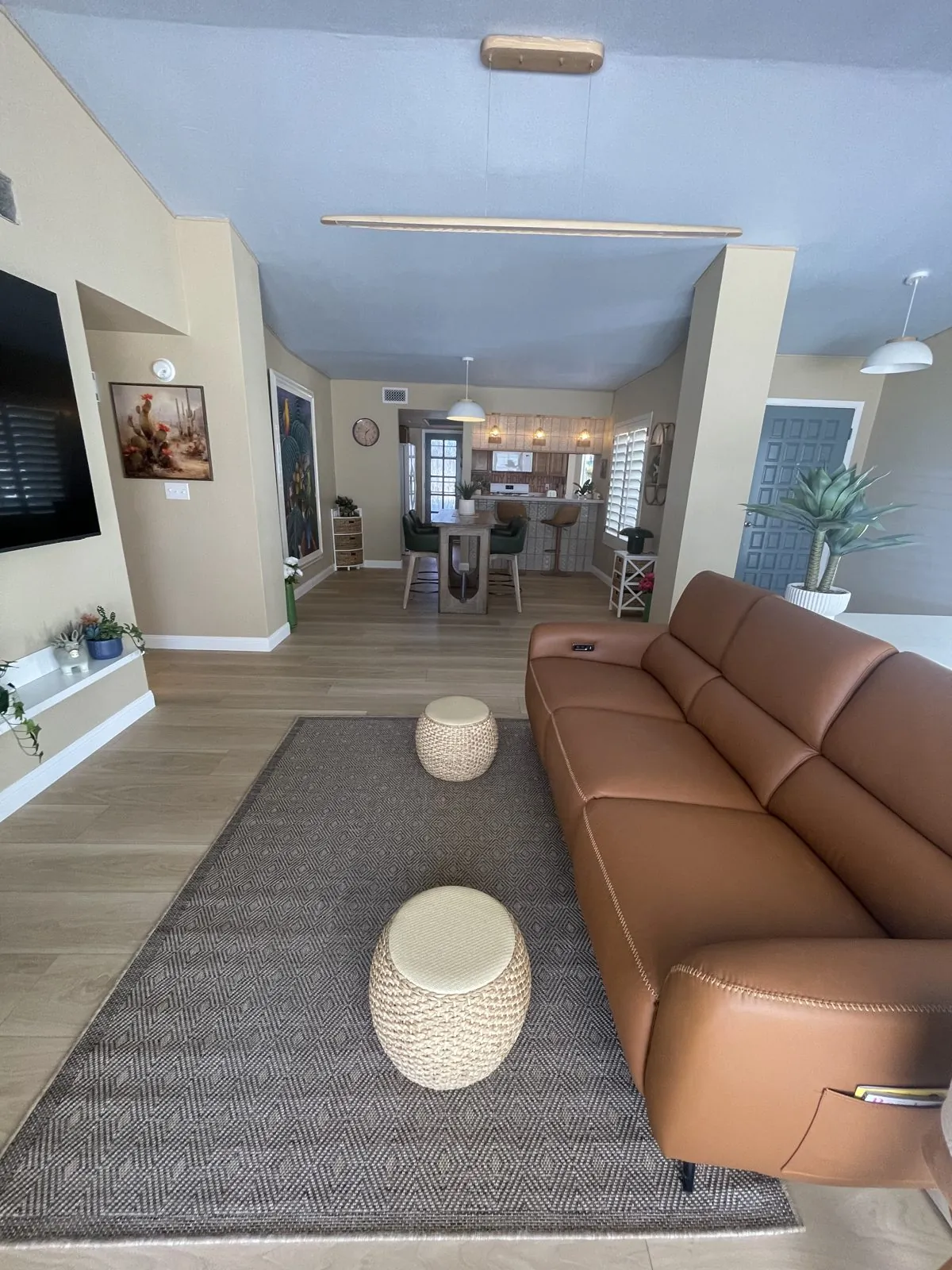
One floor through living, dining and kitchen in a Phoenix home, an RDC install.
New Floors Compared: Price, Arizona Fit and Resale Data
Prices are installed, per square foot, before removal of the old floor and any leveling.
Installed prices from RDC Renovation & Design Concepts, Phoenix, AZ (2026).
| Floor | Installed at RDC | Fit for an Arizona home (sourced) | Published resale data |
|---|---|---|---|
| Luxury vinyl plank (LVP) | $4 to $9 / sq ft | Mohawk SolidTech: 5/8 in. wall gap where it gets above 85°F | No national figure |
| Porcelain tile | $9 to $18 / sq ft | Impervious, 0.5% or less water absorption (TCNA) | No national figure |
| Large-format porcelain (24x48 in. and up) | $12 to $22 / sq ft | Fewer grout lines; needs a very flat slab | No national figure |
| Engineered hardwood | $8 to $16 / sq ft | Real wood; NWFA range 60 to 80°F, 30 to 50% humidity | NAR 2022 "new wood flooring" estimate; NAHB 2024 buyer preference |
| Solid hardwood | $10 to $20 / sq ft | Same NWFA range; RDC recommends engineered on slab homes | Same NAR and NAHB wood data |
| Carpet (with pad) | $3 to $7 / sq ft | Softest underfoot | No national figure |
Please note: these are typical ranges and can vary. Final pricing is set individually for each customer based on their specific project, after a free measure and a written estimate.
What a New Main-Floor Install Costs at RDC
At RDC, new LVP through 1,000 sq ft of main living area costs $4,000 to $9,000 installed. Taking out the old floor adds $3,000 to $5,000, at $3 to $5 per square foot. Leveling, only where the slab needs it, adds $1 to $4 per square foot.
Worked example, 1,000 sq ft of LVP, old floor removed (RDC published prices):
- LVP: 1,000 × $4 = $4,000 to 1,000 × $9 = $9,000
- Removal of the old floor: 1,000 × $3 = $3,000 to 1,000 × $5 = $5,000
- LVP with removal: $4,000 + $3,000 = $7,000 to $9,000 + $5,000 = $14,000
- If the whole slab needs leveling: 1,000 × $1 = $1,000 to 1,000 × $4 = $4,000, for $8,000 to $18,000 all in
Hold those totals next to NAR's figures for context only. The report's $5,500 and $6,500 describe a typical project in a hypothetical house, so they cannot be scaled to square feet. Totals for 1,200 to 2,500 sq ft homes are in the Phoenix flooring installation cost report.
- Pattern: herringbone or diagonal layouts add 10% to 20% to labor.
- Stairs: LVP on stairs runs $100 to $185 per step, including removal of the old carpet, installation and the stair nose.
- Baseboards: quoted as their own line. Moving furniture and appliances is part of the job.
- Old tile: RDC removes it only as part of a new installation; see tile removal and replacement in Phoenix.
Please note: final pricing is set individually for each customer based on their specific project. RDC measures every room before writing the estimate.
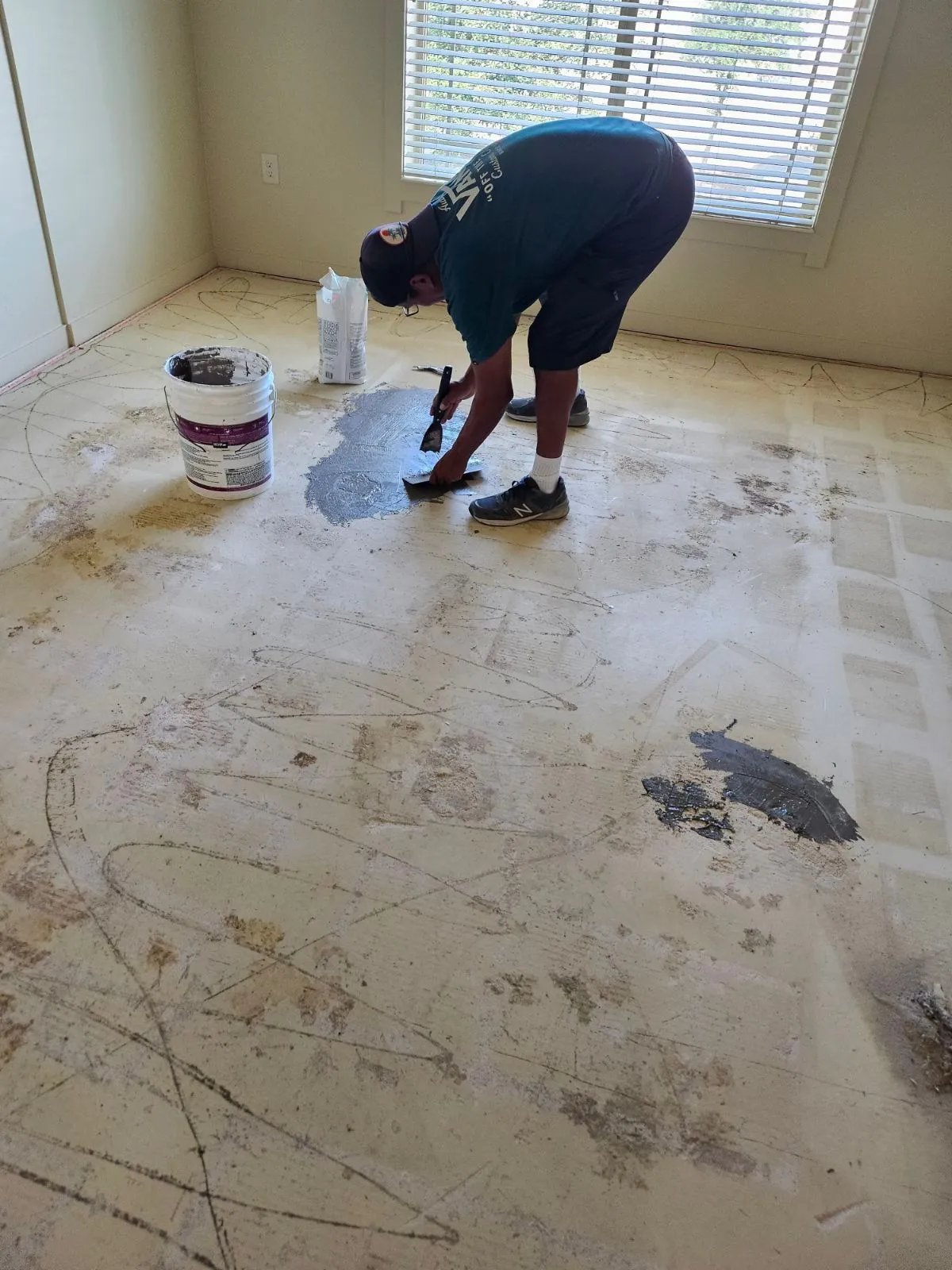
Slab patched and leveled after the old tile came out, before the new floor went down.
New Flooring and Home Value Across Arizona
Across Arizona, the median home was built in 1992, and 63% of homes date from before 2000 (U.S. Census Bureau, ACS 2020-2024). A home that age may still carry an original or second-generation floor. That is the floor appraisal guidance marks down as wear, so removing it is part of the decision.
Does New Flooring Increase Home Value in Phoenix?
In Phoenix, new flooring adds value the same way it does nationally, by replacing a floor that shows its age. Phoenix housing is older than the state's as a whole. The median Phoenix home was built in 1985, and 49% of homes date from 1970 to 1999, per U.S. Census Bureau estimates.
By decade, 19% of Phoenix homes date from the 1970s, 17% from the 1980s and 13% from the 1990s. The source is the American Community Survey 2020-2024, tables B25034 and B25035. In Phoenix, RDC has replaced carpet and Saltillo with LVP in one home and old tile with new porcelain in another.
Three local conditions shape what a new floor needs to keep looking new for the next owner:
- Heat and sun. Rooms with west and south glass get hot. LVP goes in with the wider wall gap its maker sets for heat, and porcelain has no vinyl wear layer.
- Hard water. With the hardness the city reports, the grout chosen for a tile floor decides how clean the lines look in five years.
- A vacant house in summer. If you have already moved out, the air conditioning has to run. Mohawk's SolidTech plank must sit at least 48 hours in the room at 55 to 85°F. The NWFA asks for heating and cooling to run at least 5 days before wood is delivered.
Most RDC flooring installations take 1 to 3 days, depending on the size and the material. Every installation carries RDC's 1-year workmanship warranty, which transfers to a later owner of the home. That is worth a line in the listing. See what RDC's Phoenix flooring installation includes, or call or text (602) 788-1446 to book the measure.
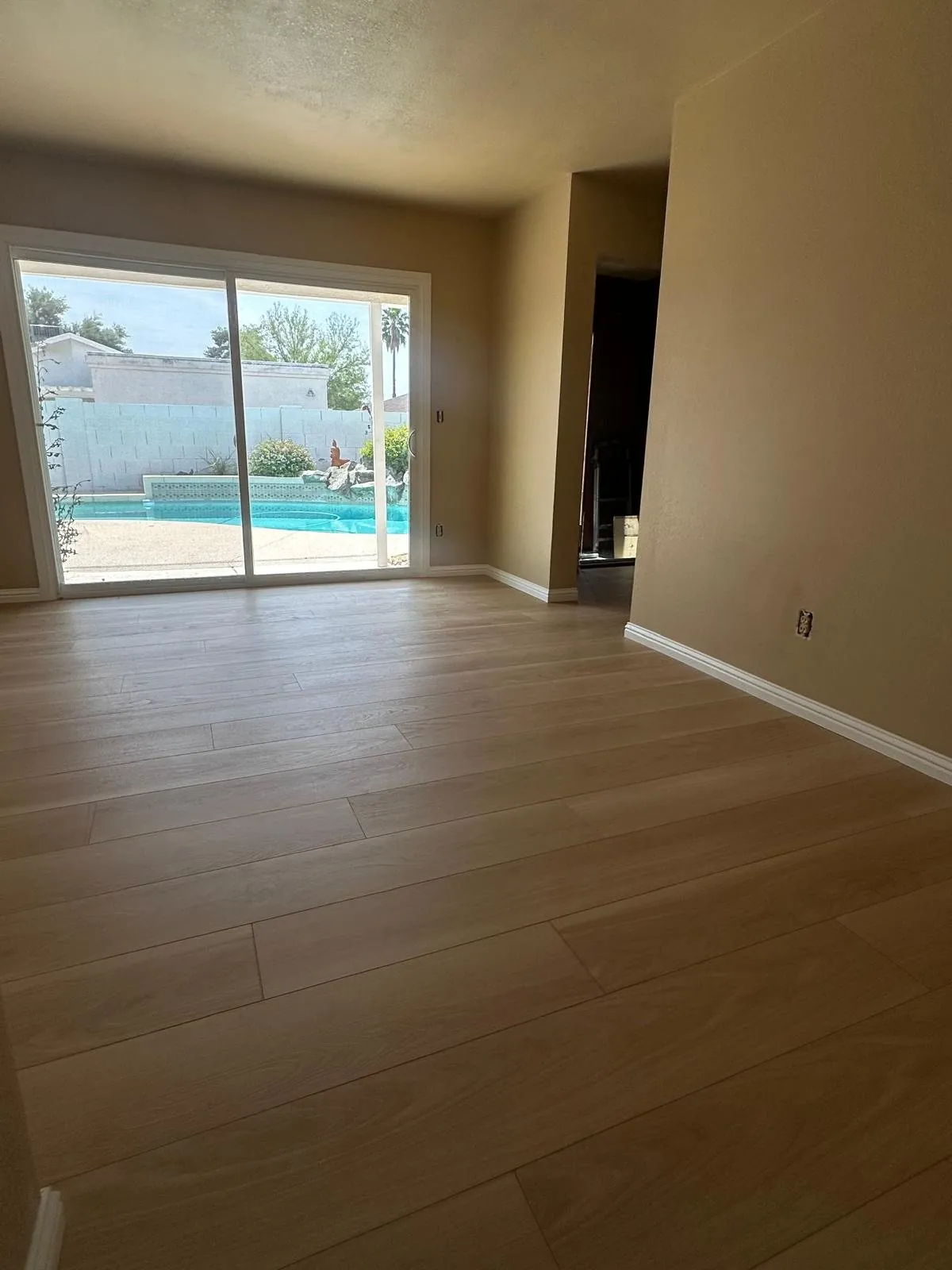
Light wood-look LVP beside a pool-facing slider in a Phoenix home.
Comparing Floors at the North Phoenix Showroom
RDC's showroom at 1610 E Bell Rd, Suite 101, in North Phoenix has about 1,200 sq ft of full-size planks and tiles. Samples from 25+ flooring, tile and countertop brands can go home with you free. Walk-ins are welcome Sunday to Friday, 10 AM to 5 PM, without an appointment, and the showroom is closed Saturday.
A same-day estimate in the showroom is possible, and the exact written quote follows a measure at your home. Short on time before a listing? Text photos of the rooms to (602) 788-1446 for a preliminary estimate; RDC answers within 2 hours during business hours. More on the space: the flooring showroom and store in Phoenix.
New Flooring and Home Value in Scottsdale, Paradise Valley, Mesa and Peoria
RDC uses the same price list across the Valley, so floors cost the same in Scottsdale, Paradise Valley, Mesa and Peoria as in Phoenix. The national value data applies everywhere. What changes between these cities is the age of the houses, which is the main local difference.
Home ages below: U.S. Census Bureau, American Community Survey 2020-2024 five-year estimates.
- Scottsdale. Median home built 1991, with 57% built from 1970 to 1999. RDC's Scottsdale work includes a white-oak-look LVP living room and a carpet replacement. See flooring contractor in Scottsdale.
- Paradise Valley. Median home built 1985, with 49% from 1970 to 1999. Appraisal guidance grades floor coverings up to "high-grade." Where nearby homes carry upgraded or high-grade floors, the grade of the new floor is part of the value picture. See Paradise Valley flooring, tile and stone.
- Mesa. Median home built 1989, with 61% from 1970 to 1999, the highest share of these four cities. RDC has installed gray LVP through a Mesa home and commercial LVP at a Trust Auto dealership in Mesa. See flooring contractor in Mesa.
- Peoria. The newest of the four: median home built 1999, with 27% from the 2000s. Even so, a home from the median year is now 27 years old. In Peoria, RDC has taken out old tile and installed LVP. See flooring contractor in Peoria.
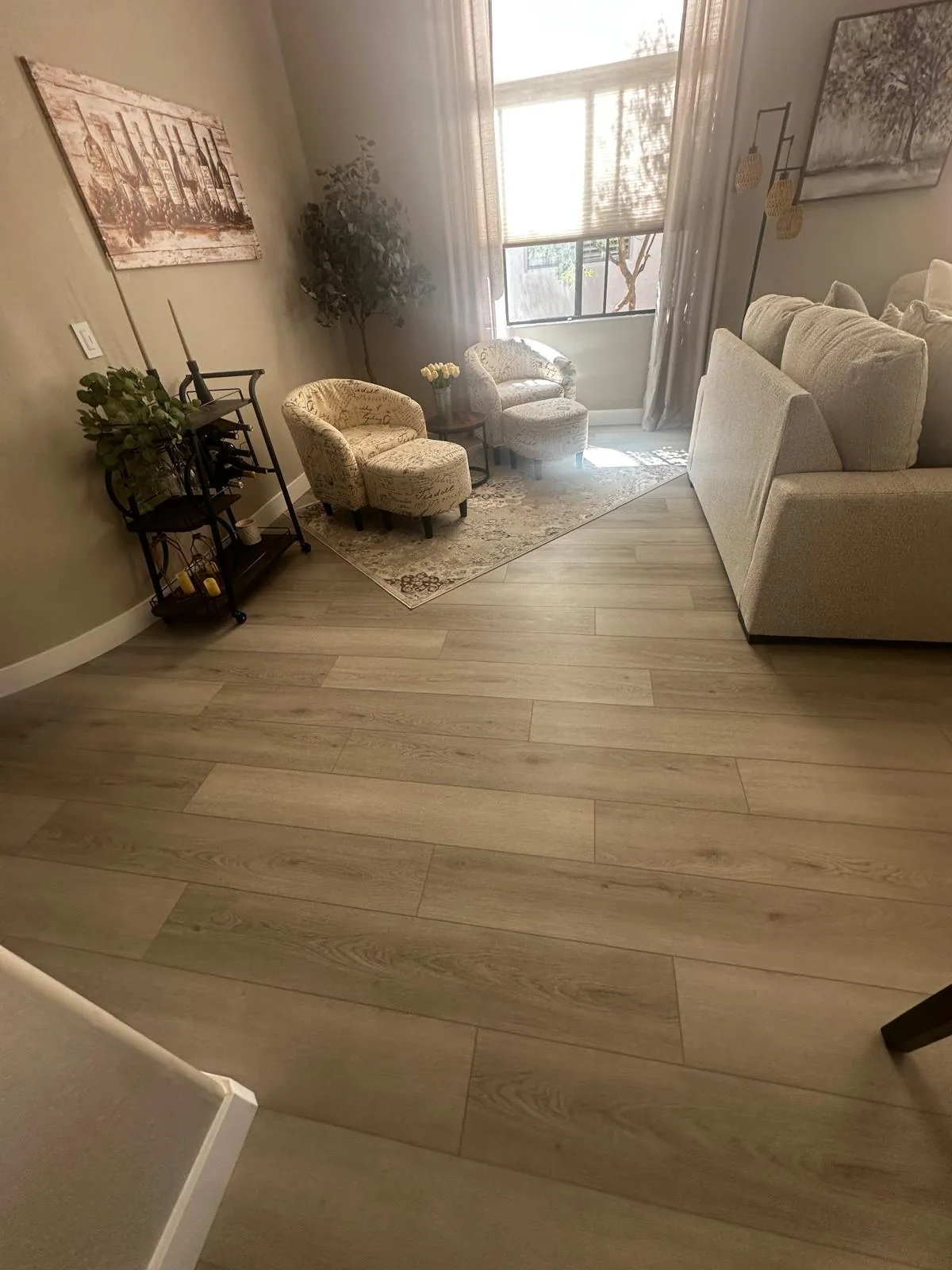
Gray wood-look LVP through a Mesa family room, an RDC install.
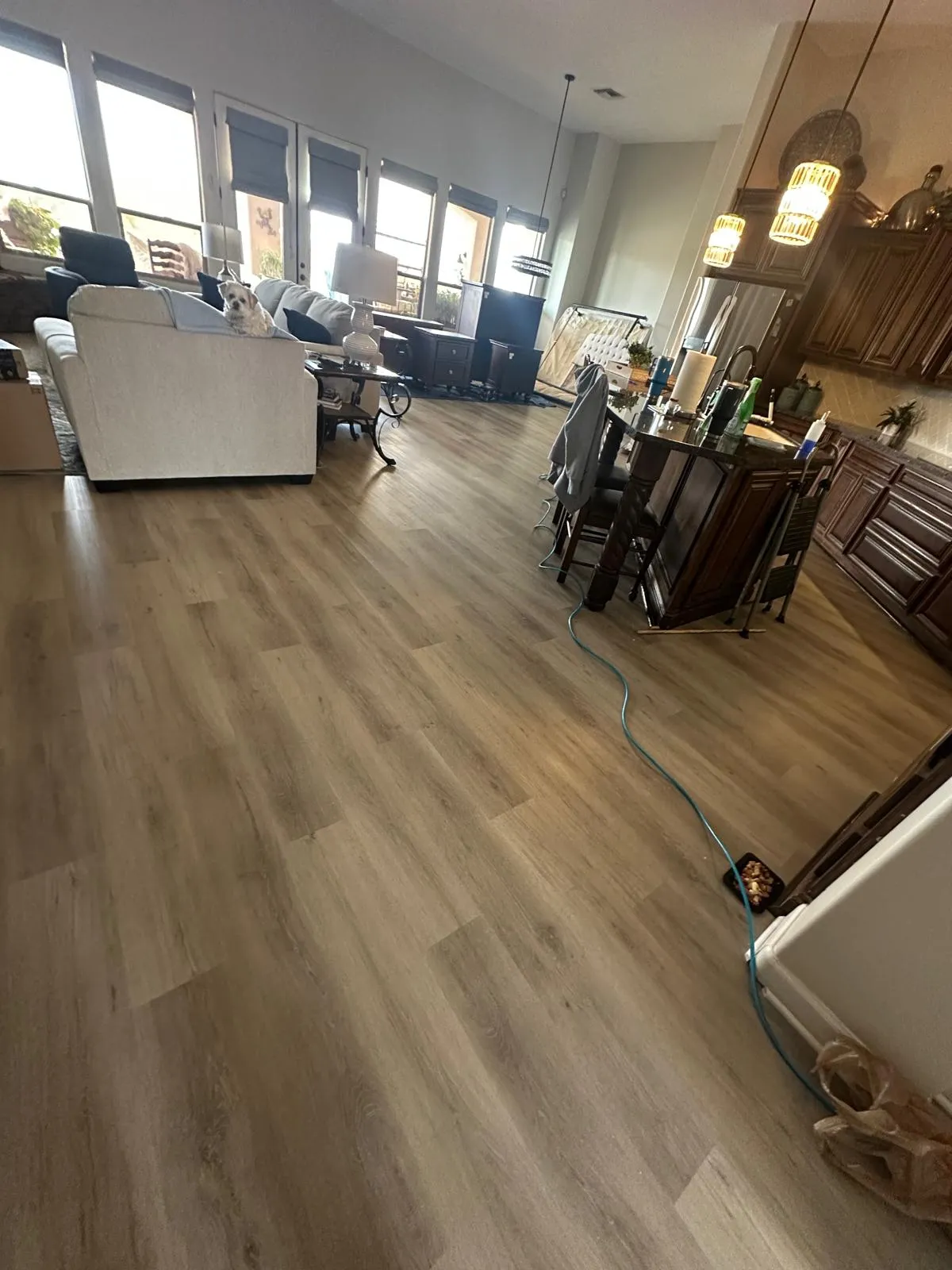
Wood-look LVP across an open living and dining area in Peoria.
Across the rest of the Valley: the same prices and data apply in Arcadia, Cave Creek and Carefree, Fountain Hills and Anthem. In Anthem, RDC replaced old carpet with tile in one home. In Glendale the median home dates from 1986, with 68% built from 1970 to 1999. The median is 1997 in Chandler and 2003 in Gilbert.
Sources (national figures are estimates, not a promise of resale value):
- National Association of Realtors, 2022 Remodeling Impact Report (April 2022) and 2025 Remodeling Impact Report (April 2025).
- NAHB Eye on Housing, What Home Buyers Really Want, 2024 Edition.
- Zillow releases of March 25, 2025 and February 19, 2025.
- Fannie Mae and Freddie Mac, UAD Condition and Quality Rating Definitions (2025).
- City of Phoenix 2025 Water Quality Report; U.S. Census Bureau, ACS 2020-2024, tables B25034 and B25035.
- Mohawk SolidTech Installation Guidelines; NWFA Installation Guidelines; TCNA porcelain definition.